Category Technology/Electronics

Quantum Physics sets a Speed Limit to Electronics

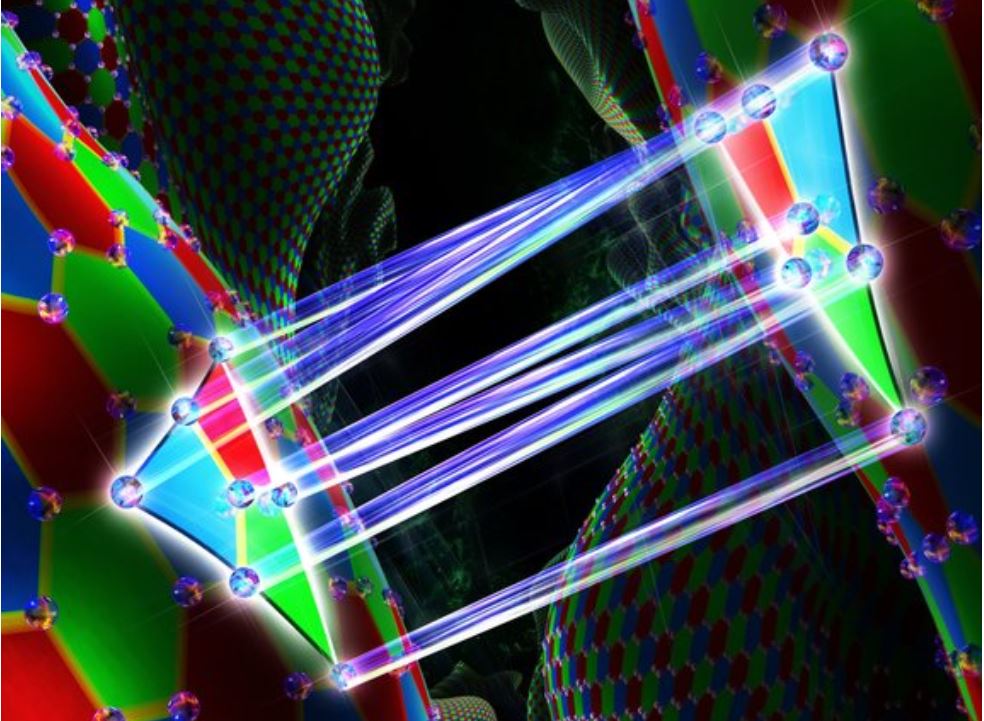
An ultra short laser pulse (blue) creates free charge carriers, another pulse (red) accelerates them in opposite directions.

Semiconductor electronics is getting faster and faster — but at some point, physics no longer permits any increase. The speed can definitely not be increased beyond one petahertz (one million gigahertz), even if the material is excited in an optimal way with laser pulses.

How fast can electronics be? When computer chips work with ever shorter signals and time intervals, at some point they come up against physical limits. The quantum-mechanical processes that enable the generation of electric current in a semiconductor material take a certain amount of time. This puts a limit to the speed of signal generation and signal transmission.

TU Wien (Vienna), TU Gra...

Read More

Quantum Sensors: Measuring even more Precisely

Two teams of physicists have designed the first programmable quantum sensor, and tested it in the laboratory. To do so they applied techniques from quantum information processing to a measurement problem. The innovative method promises quantum sensors whose precision reaches close to the limit set by the laws of nature.

Atomic clocks are the best sensors humankind has ever built. Today, they can be found in national standards institutes or satellites of navigation systems. Scientists all over the world are working to further optimize the precision of these clocks...

Read More

New World Record for Qubit Storage

Crystal used for storing photonic qubits and illuminated by a laser in a cryostat, an instrument for obtaining cryogenic temperatures. 
(c) Antonio Ortu/CC-BY

A UNIGE team has succeeded in storing a quantum bit for 20 milliseconds. A duration that had never before been achieved by a solid-state quantum memory.

Computers, smartphones, GPS: quantum physics has enabled many technological advances. It is now opening up new fields of research in cryptography (the art of coding messages) with the aim of developing ultrasecure telecommunications networks. There is one obstacle, however: after a few hundred kilometers within an optical fiber, the photons that carry the qubits or ‘quantum bits’ (the information) disappear...

Read More

Quantum Technology could make Charging Electric Cars as Fast as Pumping Gas

A pictorial illustration of today’s electric vehicle versus the future vehicle based on quantum battery technologies. Employing quantum charging would lead to a 200 times speedup in a typical EV, which means that the charging time would be cut from 10 hours to about 3 minutes (at home), or 30 minutes to 9 seconds at a charging station. Image Credit: Institute for Basic Science.

Whether it’s photovoltaics or fusion, sooner or later, human civilization must turn to renewable energies. This is deemed inevitable, considering the ever-growing energy demands of humanity and the finite nature of fossil fuels. Much research has been pursued in order to develop alternative sources of energy, most of which use electricity as the main energy carrier...

Read More