Synchronized laser pulses (red and blue) generate a burst of real and virtual charge carriers in graphene that are absorbed by gold metal to produce a net current. “We clarified the role of virtual and real charge carriers in laser-induced currents, and that opened the way to the creation of ultrafast logic gates,” says Ignacio Franco, associate professor of chemistry and physics at Rochester. (University of Rochester illustration / Michael Osadciw)
Decisive step toward creating ultrafast computers. A long-standing quest for science and technology has been to develop electronics and information processing that operate near the fastest timescales allowed by the laws of nature.
A promising way to achieve this goal involves using laser light to guide the motion of electrons in matt...
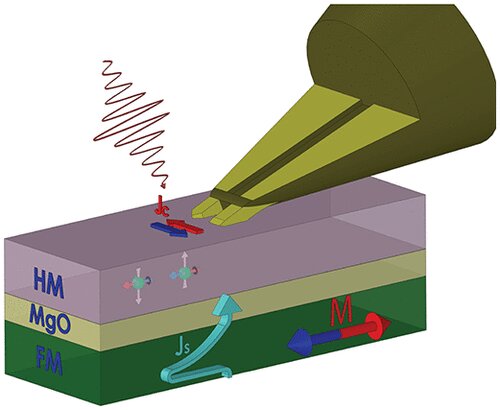
An intermediate layer consisting of a few atoms is helping to improve the transport of spin currents from one material to another. Until now, this process involves significant losses. A team from Martin Luther University Halle-Wittenberg (MLU), the Max Planck Institute (MPI) for Microstructure Physics, and the Freie Universität Berlin reports in the scientific journal ACS Nano Letters on how this can be avoided. The researchers thus demonstrate important new insights relevant for many spintronic applications, for example energy-efficient and ultrafast storage technologies of the future.
In modern microelectronics, the charge of electrons is used to carry information in electronic components, mobile p...
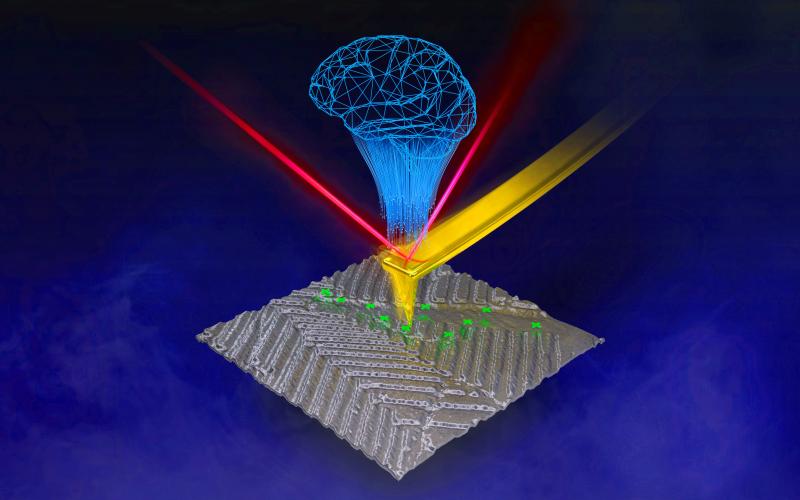
A smart approach to microscopy and imaging developed at Oak Ridge National Laboratory could drive discoveries in materials for future technologies. Credit: Adam Malin/ORNL, U.S. Dept. of Energy
Researchers at the Department of Energy’s Oak Ridge National Laboratory are teaching microscopes to drive discoveries with an intuitive algorithm, developed at the lab’s Center for Nanophase Materials Sciences, that could guide breakthroughs in new materials for energy technologies, sensing and computing.
“There are so many potential materials, some of which we cannot study at all with conventional tools, that need more efficient and systematic approaches to design and synthesize,” said Maxim Ziatdinov of ORNL’s Computational Sciences and Engineering Division and the CNMS...
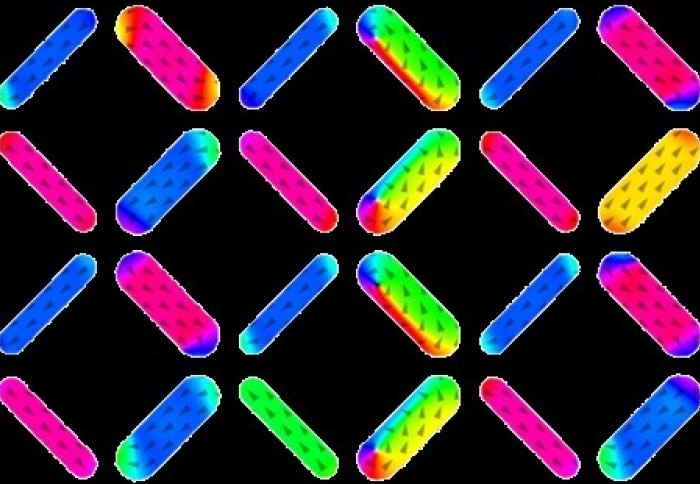
Researchers have shown it is possible to perform artificial intelligence using tiny nanomagnets that interact like neurons in the brain. The new method, developed by a team led by Imperial College London researchers, could slash the energy cost of artificial intelligence (AI), which is currently doubling globally every 3.5 months.
In a paper published today in Nature Nanotechnology, the international team have produced the first proof that networks of nanomagnets can be used to perform AI-like processing. The researchers showed nanomagnets can be used for ‘time-series prediction’ tasks, such as predicting and regulating insulin levels in diabetic patients.
Artificial intelligence that uses ‘neural networks’ aims to replicate the way parts of the brain work, where neurons talk to...





Recent Comments