Category Technology/Electronics

Cheaper Solar Cells could be on the way thanks to New Materials

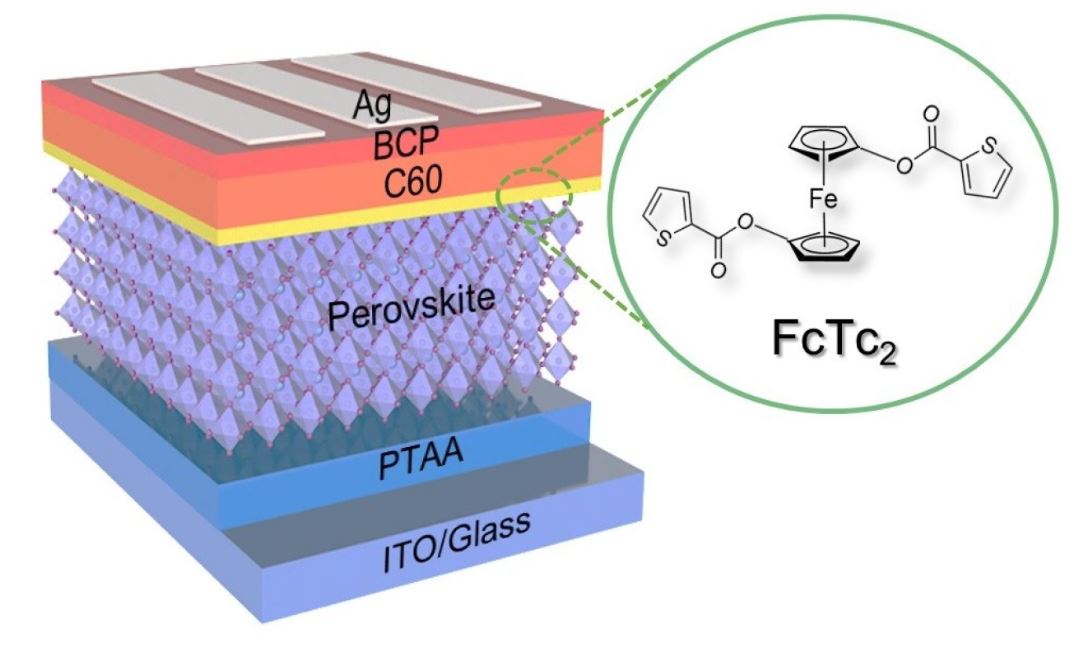
The solar cell with the ferrocene layer highlighted

New solar cell devices that are cheaper and easier to make could soon make their way to market thanks to materials made at Imperial College London.

Traditional solar cells are made from silicon, which has good efficiency and stability, but is relatively expensive to make and can only be manufactured in stiff panels.

Perovskite solar cells offer an intriguing alternative; they can be printed from inks, making them low cost, high efficiency, thin, lightweight and flexible. However, they have trailed behind silicon solar cells in efficiency and, importantly, stability, breaking down under normal environmental conditions.

New metal-containing materials called ferrocenes could help with these problems...

Read More


Lasers Trigger Magnetism in Atomically Thin Quantum Materials

A cartoon depiction of the light-induced ferromagnetism that the researchers observed in ultrathin sheets of tungsten diselenide and tungsten disulfide. Laser light, shown in yellow, excites an exciton – a bound pair of an electron (blue) and its associated positive charge, also known as a hole (red). This activity induces long range exchange interactions among other holes trapped within the moiré superlattice, orienting their spins in the same direction.Xi Wang/University of Washington

Researchers have discovered that light – in the form of a laser – can trigger a form of magnetism in a normally nonmagnetic material. This magnetism centers on the behavior of electrons...

Read More

Researchers take step toward developing ‘Electric Eye’

Using nanotechnology, scientists have created a newly designed neuromorphic electronic device that endows microrobotics with colorful vision. The newly designed artificial vision device could have far-reaching applications for the fields of medicine, AI, and microrobotics.

Georgia State University researchers have successfully designed a new type of artificial vision device that incorporates a novel vertical stacking architecture and allows for greater depth of color recognition and scalability on a micro-level. The new research is published in the top journal ACS Nano.

“This work is the first step toward our final destination-to develop a micro-scale camera for microrobots,” says assistant professor of Physics Sidong Lei, who led the research...

Read More

How to Print a Robot from Scratch: Combining Liquids, Solids could lead to Faster, more Flexible 3D Creations

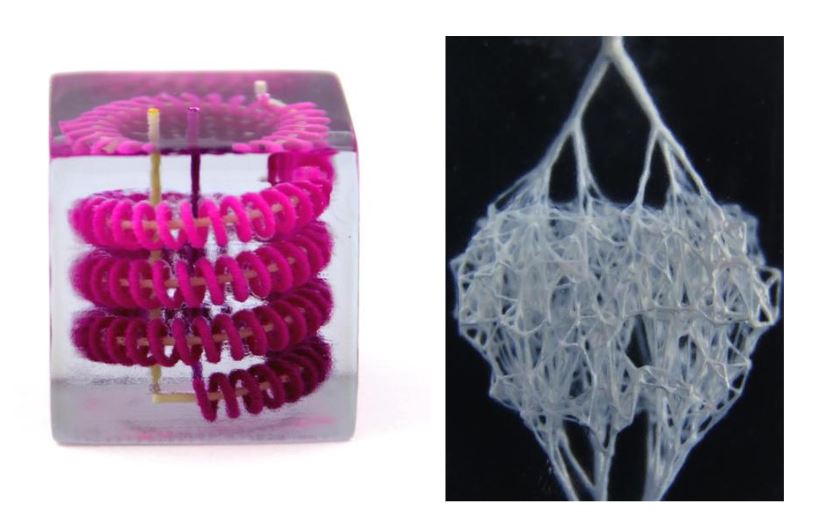
a) A spiraling pattern created by mixing solid and liquid 3D-printed materials. (Credit: Hayes et al. 2022, Advanced Materials) b) A network of capillaries 3D-printed using a newly developed technique. (Credit: Hayes et al. 2022, Advanced Materials)

Imagine a future in which you could 3D-print an entire robot or stretchy, electronic medical device with the press of a button – no tedious hours spent assembling parts by hand.

That possibility may be closer than ever thanks to a recent advancement in 3D-printing technology led by engineers at the University of Colorado Boulder. In a new study, the team lays out a strategy for using currently-available printers to create materials that meld solid and liquid components – a tricky feat if you don’t want your robot to collapse.

“I think...

Read More