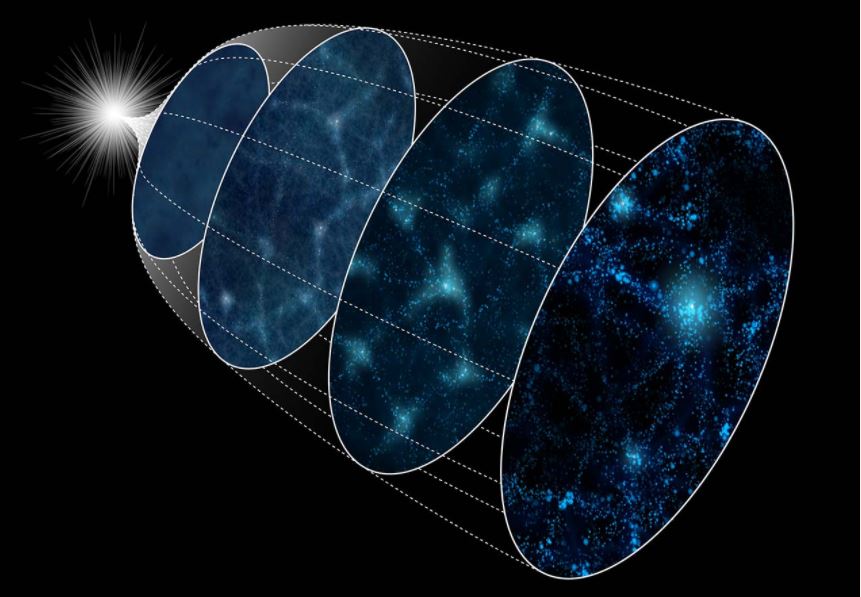
Schematic diagram of the evolution of the Universe from the inflation (left) to the present (right). The “reconstruction method” winds back the evolution from right to left on this illustration to reproduce the primordial density fluctuations from the current galaxy distribution. (Credit: The Institute of Statistical Mathematics)
Astronomers have tested a method for reconstructing the state of the early Universe by applying it to 4000 simulated universes using the ATERUI II supercomputer at the National Astronomical Observatory of Japan (NAOJ). They found that together with new observations the method can set better constraints on inflation, one of the most enigmatic events in the history of the Universe...
Researchers show that the light emitted by a single molecule can be detected with a low-cost optical setup. Their prototype could facilitate medical diagnostics. Biomarkers play a central role in the diagnosis of disease and assessment of its course. Among the markers now in use are genes, proteins, hormones, lipids and other classes of molecules. Biomarkers can be found in the blood, in cerebrospinal fluid, urine and various types of tissues, but most of them have one thing in common: They occur in extremely low concentrations, and are therefore technically challenging to detect and quantify.
Many detection procedures use molecular probes, such as antibodies or short nucleic-acid sequences, which are designed to bind to specific biomarkers...
PPPL physicist Hong Qin in front of images of planetary orbits and computer code (Photo by Elle Starkman)
A novel computer algorithm, or set of rules, that accurately predicts the orbits of planets in the solar system could be adapted to better predict and control the behavior of the plasma that fuels fusion facilities designed to harvest on Earth the fusion energy that powers the sun and stars.
The algorithm, devised by a scientist at the U.S. Department of Energy’s (DOE) Princeton Plasma Physics Laboratory (PPPL), applies machine learning, the form of artificial intelligence (AI) that learns from experience, to develop the predictions...
MIT researchers are developing a superconducting nanowire, which could enable more efficient superconducting electronics. Credits:Image: Christine Daniloff, MIT
Superconductors—materials that conduct electricity without resistance—are remarkable. They provide a macroscopic glimpse into quantum phenomena, which are usually observable only at the atomic level. Beyond their physical peculiarity, superconductors are also useful. They’re found in medical imaging, quantum computers, and cameras used with telescopes.
But superconducting devices can be finicky. Often, they’re expensive to manufacture and prone to err from environmental noise. That could change, thanks to research from Karl Berggren’s group in the Department of Electrical Engineering and Computer Science.








Recent Comments