Category Technology/Electronics

2D Semiconductors found to be close-to-ideal Fractional Quantum Hall Platform

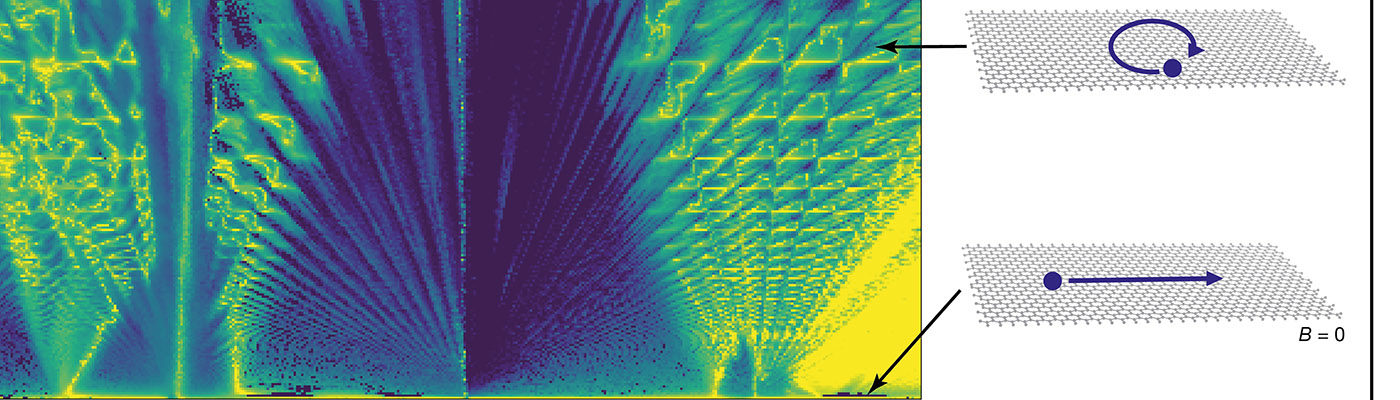
Illustration of the monolayer WSe2 hosting "composite fermions"
A monolayer semiconductor is found to be a close-to-ideal platform for fractional quantum Hall state—a quantum liquid that emerges under large perpendicular magnetic fields. The image illustrates monolayer WSe2 hosting “composite fermions,” a quasi-particle that forms due to the strong interactions between electrons and is responsible for the sequence of fractional quantum Hall states.

Columbia University researchers report that they have observed a quantum fluid known as the fractional quantum Hall states (FQHS), one of the most delicate phases of matter, for the first time in a monolayer 2D semiconductor. Their findings demonstrate the excellent intrinsic quality of 2D semiconductors and establish them as a unique test platform for future applications in quantum computing...

Read More

New breakthrough in ‘Spintronics’ could boost high Speed Data Technology

New breakthrough in 'spintronics' could boost high speed data ...

Scientists have made a pivotal breakthrough in the important, emerging field of spintronics—which could lead to a new high speed energy efficient data technology.

An international team of researchers, including the University of Exeter, has made a revolutionary discovery that has the potential to provide high speed, low power-usage for some of the world’s most well-used electronic devices.

While today’s information technology relies on electronics that consumes a huge amount of energy, the electrons within electric currents can also transfer a form of angular momentum called spin.

‘Spin-based electronics or ‘spintronics’, that exploits spin current, has the potential to be not just significantly faster, but also more energy efficient.

Scientists have recently discovered ...

Read More

World’s widest Graphene Nanoribbon Promises the Next Generation of Miniaturized Electronics

(a) Bottom-up synthesis scheme of 17-AGNR on Au(111), (b) high-resolution STM image, and (c) nc-AFM image of 17-AGNR.

Standard semiconductor technology is reaching its limit in miniaturization, but the demand for smaller electrical devices with higher performance continues to grow. The research group introduced the widest graphene nanoribbon.

With literally the thickness of one carbon atom and electrical properties that can surpass those of standard semiconductor technologies, graphene nanoribbons promise a new generation of miniaturized electronic devices. The theory, however, remains far ahead of reality, with current graphene nanoribbons falling short of their potential...

Read More

The Lightest shielding Material in the world

/documents/56164/13574457/CNF-EMI-shielding_0034-web.jpg/3ec8fc26-f9a2-4cff-b9a2-69d60f750e44?t=1593668675377
A sample of the electromagnetic shielding material made by Empa – a composite of cellulose nanofibres and silver nanowires. Image: Empa

Protection against electromagnetic interference

Researchers have succeeded in applying aerogels to microelectronics: Aerogels based on cellulose nanofibers can effectively shield electromagnetic radiation over a wide frequency range – and they are unrivaled in terms of weight.

Electric motors and electronic devices generate electromagnetic fields that sometimes have to be shielded in order not to affect neighboring electronic components or the transmission of signals. High-frequency electromagnetic fields can only be shielded with conductive shells that are closed on all sides...

Read More