Category Technology/Electronics

Ultrathin Organic Solar Cell is both Efficient and Durable

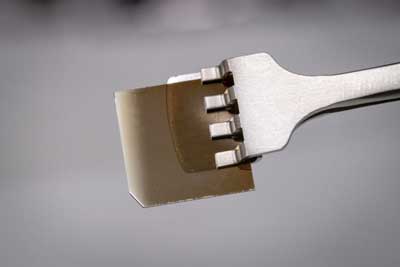
Ultra-thin organic solar cell

Scientists from the RIKEN Cluster for Pioneering Research and RIKEN Center for Emergent Matter Science have succeeded, in collaboration with international partners, in creating an ultrathin organic solar cell that is both highly efficient and durable. Using a simple post-annealing process, they created a flexible organic cell that degrades by less than 5 percent over 3,000 hours in atmospheric conditions and that simultaneously has an energy conversion ratio – a key indicator of solar cell performance – of 13 percent.

Organic photovoltaics are considered to be a promising alternative to silicon-based conventional films, being more environmentally friendly and cheap to produce...

Read More

Goodyear’s Biodegradable Concept Tire Regenerates its Tread

Credit: Goodyear

Goodyear recently unveiled a tire concept that could revolutionize the auto industry. Dubbed reCharge, this concept tire would never require replacements or rotations because it regenerates its tread as needed.

In addition to eliminating flat tires and the need to check tire pressure, the concept’s regeneration features would be customized to the driving habits and conditions of individual motorists courtesy of a combination of AI and telemetry data.

The crux of reCharge’s regeneration capabilities is a biodegradable, reloadable liquid compound that’s recharged by capsules. The compound is fortified by a mixture of dandelion rubber and fibers similar to spider silk, known to be one of the toughest raw materials found in nature...

Read More

Robot uses Artificial Intelligence and imaging to Draw Blood

This tabletop robotic device can accurately steer needles and catheters into tiny blood vessels with minimal supervision.
This tabletop robotic device can accurately steer needles and catheters into tiny blood vessels with minimal supervision. Photo: Martin Yarmush and Alvin Chen

Engineers create device that can also insert catheters. Rutgers engineers have created a tabletop device that combines a robot, AI and near-infrared and ultrasound imaging to draw blood or insert catheters to deliver fluids and drugs.

Their most recent research results, published in the journal Nature Machine Intelligence, suggest that autonomous systems like the image-guided robotic device could outperform people on some complex medical tasks.

Medical robots could reduce injuries and improve the efficiency and outcomes of procedures, as well as carry out tasks with minimal supervision when resources are limited...

Read More

Potassium Metal Battery emerges as a rival to Lithium-ion technology

Rensselaer team finds solution to persistent problem facing potassium metal batteries

Rensselaer team finds solution to persistent problem facing potassium-metal batteries. Researchers demonstrate how they can overcome dendrites to create a metal battery that performs nearly as well as a lithium-ion battery, but relies on potassium – a much more abundant and less expensive element.

If you were to look inside a lithium-ion battery you’d typically find a cathode made of lithium cobalt oxide and an anode made of graphite. During charging and discharging, lithium ions flow back and forth between these two electrodes.

In this setup, if researchers were to simply replace lithium cobalt oxide with potassium cobalt oxide, performance would drop...

Read More