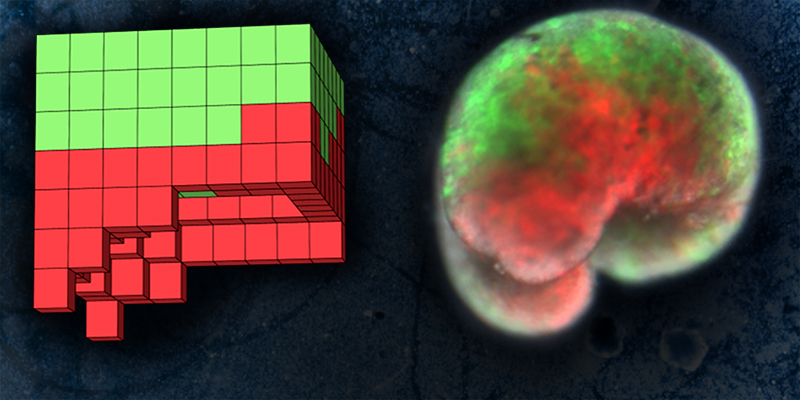
On the left, the anatomical blueprint for a computer-designed organism, discovered on a UVM supercomputer. On the right, the living organism, built entirely from frog skin (green) and heart muscle (red) cells. The background displays traces carved by a swarm of these new-to-nature organisms as they move through a field of particulate matter. (Credit: Sam Kriegman, UVM)
Tiny ‘xenobots’ assembled from cells promise advances from drug delivery to toxic waste clean-up. Scientists repurposed living frog cells – and assembled them into entirely new life-forms. These tiny ‘xenobots’ can move toward a target and heal themselves after being cut. These novel living machines are neither a traditional robot nor a known species of animal...
The bipartite sodalite type clathrate structure, which consists of truncated octahedral “host” cages that trap strontium “guest” atoms, was synthesized under high-pressure and high-temperature conditions using a laser heating technique. Image is courtesy of Tim Strobel.
A long-sought-after class of “superdiamond” carbon-based materials with tunable mechanical and electronic properties was predicted and synthesized by Carnegie’s Li Zhu and Timothy Strobel. Their work is published by Science Advances.
Carbon is the fourth-most-abundant element in the universe and is fundamental to life as we know it. It is unrivaled in its ability to form stable structures, both alone and with other elements.
A material’s properties are determined by how its atoms are bonded and the structural ar...
An example of a wave pattern (right) and its intensity levels (left) developed by the machine learning algorithm to best illuminate the most important features of an object being identified.
Engineers from Duke University and the Institut de Physique de Nice in France have developed a new method to identify objects using microwaves that improves accuracy while reducing the associated computing time and power requirements.
The system could provide a boost to object identification and speed in fields where both are critical, such as autonomous vehicles, security screening and motion sensing.
The new machine-learning approach cuts out the middleman, skipping the step of creating an image for analysis by a human and instead analyzes the pure data directly...
Let there be light – and it was directional: The world’s first electrically powered Yagi-Uda antenna was built at the University of Würzburg’s Department of Physics. (Picture: Department of Physics) (Image: Physikalisches Institut
For the first time, physicists have successfully converted electrical signals into photons and radiated them in specific directions using a low-footprint optical antenna that is only 800 nanometers in size.
Directional antennas convert electrical signals to radio waves and emit them in a particular direction, allowing increased performance and reduced interference. This principle, which is useful in radio wave technology, could also be interesting for miniaturised light sources...






Recent Comments