Category Technology/Electronics

Gummy-like Robots that could Help Prevent Disease

EPFL scientists have developed microscopic, hydrogel-based muscles that can manipulate and mechanically stimulate biological tissue. These soft, biocompatible robots could be used for targeted therapy and to help diagnose and prevent disease.
Credit: Nebahat Yenihayat

Scientists have developed microscopic, hydrogel-based muscles that can manipulate and mechanically stimulate biological tissue. These soft, biocompatible robots could be used for targeted therapy and to help diagnose and prevent disease. Human tissues experience a variety of mechanical stimuli that can affect their ability to carry out their physiological functions, such as protecting organs from injury...

Read More

Scientists find a Cheaper way to Light up OLED screens

Chemist Mark E. Thompson holds new copper-based LEDs invented by him and a team of chemists that could be a cheaper option for TV and smartphone screens to produce the color — including blue — and light. Right now, the industry relies on iridium, an expensive precious metal, for LED light and color.
Credit: Mark E. Thompson, USC Dornsife

USC Dornsife chemists have found a cheaper way to light up smartphone and TV screens, which could save manufacturers and consumers money without affecting visual quality. Copper is the answer, according to their study, published Feb. 8 in the journal Science.

“The current technology that is in every Samsung Galaxy phone, high-end Apple iPhone and LG TV relies on iridium compounds for the colors and light on OLED screens,” says Mark E...

Read More

Charting a Path to Cheaper Flexible Solar Cells

A researcher at Georgia Tech holds a perovskite-based solar cell, which is flexible and lighter than silicon-based versions.
Credit: Rob Felt, Georgia Tech

Researchers have reported new findings about perovskite solar cells that could lead the way to devices that perform better. There’s a lot to like about perovskite-based solar cells. They are simple and cheap to produce, offer flexibility that could unlock a wide new range of installation methods and places, and in recent years have reached energy efficiencies approaching those of traditional silicon-based cells.

But figuring out how to produce perovskite-based energy devices that last longer than a couple of months has been a challenge...

Read More

Scientists develop 1st Fabric to Automatically Cool or Insulate depending on conditions

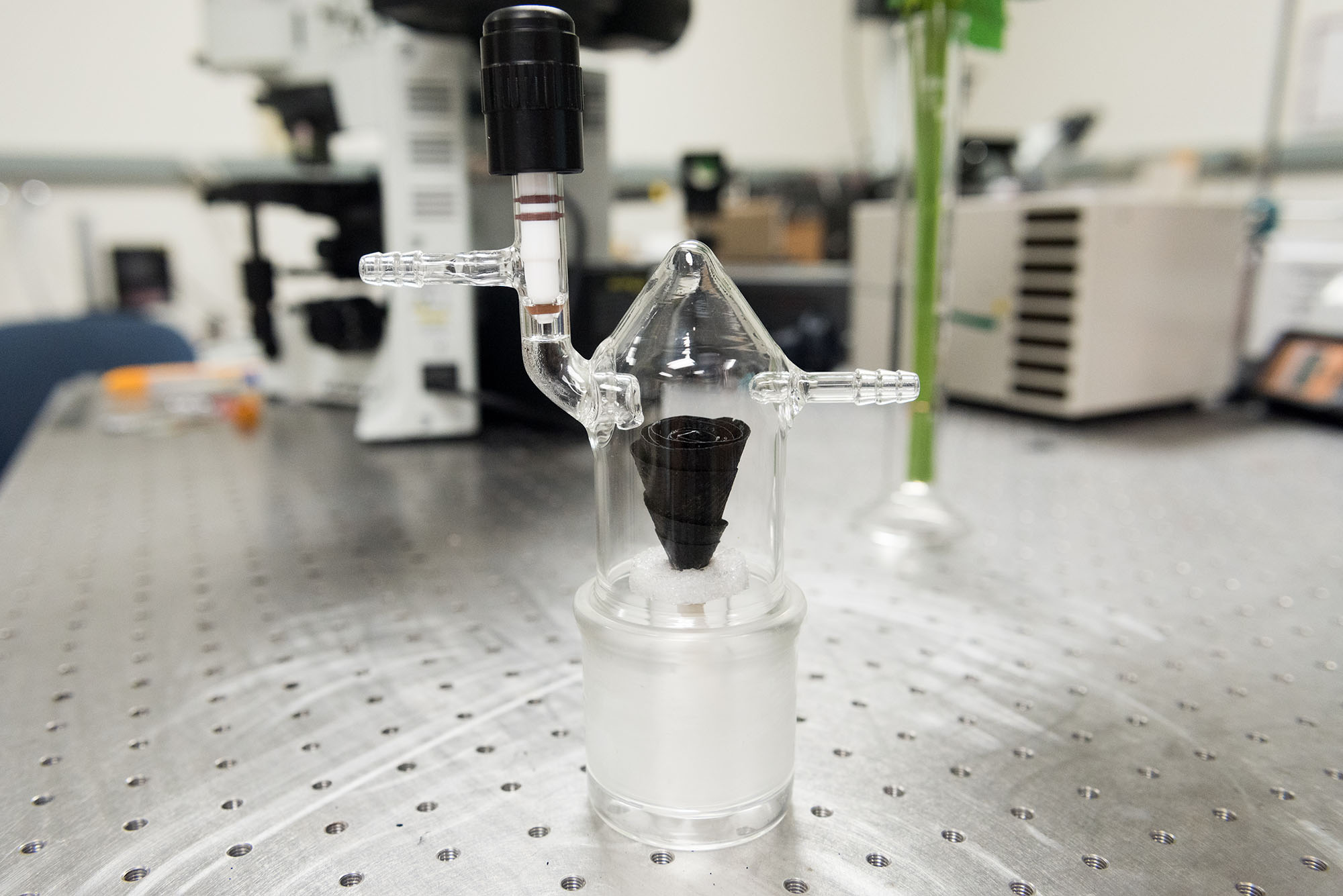
This new fabric being developed by University of Maryland scientists YuHuang Wang and Ouyang Min is the first textile to automatically change properties to trap or release heat depending on conditions.
Credit: Faye Levine, University of Maryland

Researchers have engineered a new fabric from synthetic yarn with a carbon nanotube coating that is activated by temperature and humidity, releasing heat in warm humid conditions and trapping heat when conditions are cool and dry. Under hot, humid conditions, the strands of yarn compact and activate the coating, which changes the way the fabric interacts with infrared radiation. They refer to the action as “gating” of infrared radiation, which acts as a tunable blind to transmit or block heat.

“This is the first technology that allows us to dyn...

Read More