Category Technology/Electronics

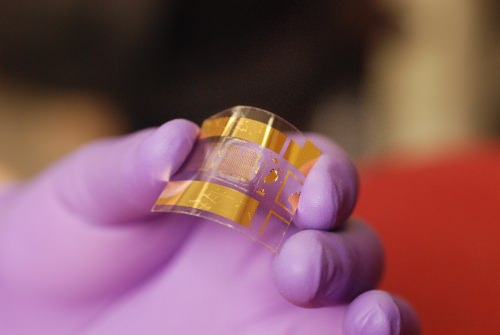
Candy Cane Supercapacitor could enable Fast Charging of Mobile Phones

Candy cane supercapacitor. Credit: Stoyan Smoukov

Candy cane supercapacitor. Credit: Stoyan Smoukov

Supercapacitors promise recharging of phones and other devices in seconds and minutes as opposed to hours for batteries. But current technologies are not usually flexible, have insufficient capacities, and for many their performance quickly degrades with charging cycles. Researchers at Queen Mary University of London (QMUL) and University of Cambridge have found a way to improve all 3 problems in one stroke. Their prototyped polymer electrode, which resembles a candy cane achieves energy storage close to the theoretical limit, but also demonstrates flexibility and resilience to charge/discharge cycling.

The technique could be applied to many types of materials for supercapacitors and enable fast charging of mobile phones, smart clothes and ...

Read More

Exotic Quantum States made from Light

The artist's rendering shows how potential wells are created for the light in the microresonator through heating with an external laser beam (green). Credit: David Dung, Universität Bonn

The artist’s rendering shows how potential wells are created for the light in the microresonator through heating with an external laser beam (green). Credit: David Dung, Universität Bonn

Physicists create optical ‘wells’ for a super-photon for the first time. The creation of such highly low-loss structures for light is a prerequisite for complex light circuits, such as for quantum information processing for a new-gen computers. Many thousands of photons can be merged to form a single super-photon if they are sufficiently concentrated and cooled. The individual particles merge with each other, making them indistinguishable. Researchers call this a photonic Bose-Einstein condensate. It has long been known that normal atoms form such condensates. Prof...

Read More

X-ray imaging with a significantly Enhanced Resolution

Incoherent Diffractive Imaging via Intensity Correlations of Hard X Rays. Physical Review Letters, 2017; 119 (5) DOI: 10.1103/PhysRevLett.119.053401 Image: Anton Classen

Incoherent Diffractive Imaging via Intensity Correlations of Hard X Rays. Physical Review Letters, 2017; 119 (5) DOI: 10.1103/PhysRevLett.119.053401 Image: Anton Classen

Physicists have developed a new technique for determining molecular structure. Physicists from Friedrich-Alexander-Universität Erlangen-Nürnberg (FAU) and Deutsches Elektronen-Synchrotron (DESY, Hamburg) have come up with a method that could significantly improve the quality of X-ray images in comparison to conventional methods. Incoherent diffractive imaging (IDI) could help to image individual atoms in nanocrystals or molecules faster and with a much higher resolution.

For >100 years, X-rays have been used in crystallography to determine the structure of molecules...

Read More

New Battery material goes with the Flow

A new material developed at Argonne shows promise for batteries that store electricity for the grid. The material consists of carefully structured molecules designed to be particularly electrochemically stable in order to prevent the battery from losing energy to unwanted reactions. Credit: Robert Horn, Argonne National Laboratory

A new material developed at Argonne shows promise for batteries that store electricity for the grid. The material consists of carefully structured molecules designed to be particularly electrochemically stable in order to prevent the battery from losing energy to unwanted reactions.
Credit: Robert Horn, Argonne National Laboratory

A new material shows promise for batteries that store electricity for the grid. The material, created by scientists at the U.S. Department of Energy’s (DOE) Argonne National Laboratory, consists of carefully structured molecules designed to be particularly electrochemically stable in order to prevent the battery from losing energy to unwanted reactions...

Read More