Category Technology/Electronics

Measured for the 1st time: Direction of Light Waves hanged by Quantum Effect

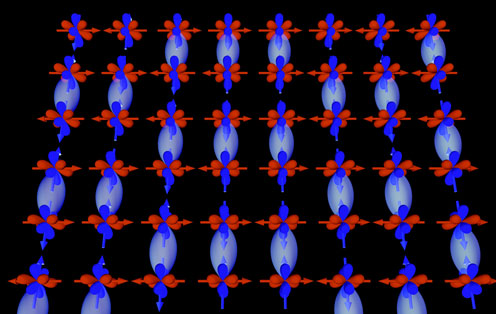
In certain materials, light waves can change their direction of polarization. Credit: TU Wien

In certain materials, light waves can change their direction of polarization. Credit: TU Wien

The ‘quantized magneto-electric effect’ has been demonstrated for the first time in topological insulators at TU Wien, which is set to open up new and highly accurate methods of measurement. A light wave sent through empty space always oscillates in the same direction. However, certain materials can be used to rotate the direction in which the light is oscillating in a magnetic field, ie ‘magneto-optical’ effect. Rather than switching the direction of the light wave continually,’topological insulators’ do so in quantum steps in clearly defined portions. The extent of these quantum steps depends solely on fundamental physical parameters, such as the fine-structure constant...

Read More

Feather-Light Metal Cathodes for Stable Lithium-Oxygen Batteries

1. Nanoporous nickel cathodes for lithium oxygen batteries are ultralight, shown here balanced on flower stamens. Credit: American Chemical Society 2. Nanoengineered Ultralight and Robust All-Metal Cathode for High-Capacity, Stable Lithium–Oxygen Batteries

1. Nanoporous nickel cathodes for lithium oxygen batteries are ultralight, shown here balanced on flower stamens.
Credit: American Chemical Society
2. Nanoengineered Ultralight and Robust All-Metal Cathode for High-Capacity, Stable Lithium–Oxygen Batteries

Lithium-oxygen systems could someday outperform today’s lithium-ion batteries because of their potential for high energy density. However, a number of important issues, such as their poor electrochemical stability must be addressed before these systems can successfully compete with current rechargeable batteries. Now, in ACS Central Sci

ence, researchers report a new type of cathode, which could make lithium-oxygen batteries a practical option.

Xin-Bo Zhang and colleagues note that most of the problems associated with lithium-oxygen batt...

Read More

A Self-Healing Structural Color Hydrogel Inspired by Nature

A self-healing structural color hydrogel inspired by nature A set of self-healing hydrogel films with different structural colors. Credit: Yuanjin Zhao.

A self-healing structural color hydrogel inspired by nature A set of self-healing hydrogel films with different structural colors. Credit: Yuanjin Zhao.

A team of researchers at Southeast University in China has developed a self-healing structural hydrogel with a wide variety of applications. It has been noted for several years that one area where humanoid robots are lacking is skin tone—most robots have a pasty white complexion, which is both disturbing and likely to lead to social problems once robots become mainstream. Most artificial skin is not able to heal itself, which means that robots need skin replacement if it gets damaged or accidentally colored in undesirable ways. There is also the issue of colors fading...

Read More

Researchers find 1st compelling evidence of new property known as ‘Ferroelasticity’ in Perovskites

1, Schematic shows a perovskite sample (black) examined by the photothermal induced resonance technique. When the sample absorbs pulses of light (depicted as disks in purple cones), the sample expands rapidly, causing the cantilever of an atomic force microscope (AFM) to vibrate like a struck tuning fork. The cantilever’s motion, which is detected by reflecting the AFM laser light (red) off the AFM detector, provides a sensitive measure of the amount of light absorbed. Credit: NIST 2. Image recorded by an atomic force microscope reveals the topography of a polycrystalline sample of the perovskite, including the boundaries between crystals. Credit: NIST 3. Illustration shows that in response to an applied stress, such as bending, the boundaries of the ferroelastic domains (red and blue regions depict domains oriented in different directions) become bigger or smaller. Credit: NIST

1, Schematic shows a perovskite sample (black) examined by the photothermal induced resonance technique. When the sample absorbs pulses of light (depicted as disks in purple cones), the sample expands rapidly, causing the cantilever of an atomic force microscope (AFM) to vibrate like a struck tuning fork. The cantilever’s motion, which is detected by reflecting the AFM laser light (red) off the AFM detector, provides a sensitive measure of the amount of light absorbed.  2. Image recorded by an atomic force microscope reveals the topography of a polycrystalline sample of the perovskite, including the boundaries between crystals. 3...

Read More