
Category Technology/Electronics

Scientists create most Efficient Quantum Cascade Laser ever

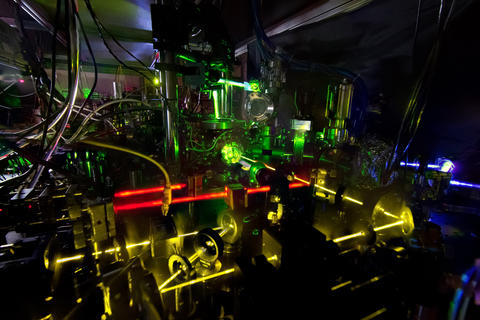
UCF Scientist Creates Most Efficient Quantum Cascade Laser Ever

Assistant Professor Arkadiy Lyakh of UCF’s NanoScience Technology Center has developed the most efficient Quantum Cascade Laser ever.

A team of UCF researchers has produced the most efficient quantum cascade laser ever designed – and done it in a way that makes the lasers easier to manufacture. Quantum cascade lasers, or QCLs, are tiny – smaller than a grain of rice – but they pack a punch. Compared to traditional lasers, QCLs offer higher power output and can be tuned to a wide range of infrared wavelengths. They can also be used at room temperature without the need for bulky cooling systems.

But because they’re difficult and costly to produce, QCLs aren’t used much outside the Department of Defense...

Read More

Quantum Computers: 10-fold Boost in Stability Achieved

Quantum computers: 10-fold boost in stability achieved

Artist”s impression of a single-atom electron spin, hosted in a silicon crystal and dressed by an oscillating electromagnetic field. Credit: Arne Laucht/UNSW

Australian engineers have created a new quantum bit which remains in a stable superposition for 10 times longer than previously achieved, dramatically expanding the time during which calculations could be performed in a future silicon quantum computer. The new quantum bit, made up of the spin of a single atom in silicon and merged with an electromagnetic field – known as ‘dressed qubit’ – retains quantum information for much longer that an ‘undressed’ atom, opening up new avenues to build and operate the superpowerful quantum computers of the future.

Andrea Morello,CQC2T, UNSW said:”Our decade-long research program had already establi...

Read More

Bendable Electronic Paper displays Whole Color Range

Chalmers' e-paper contains gold, silver and PET plastic. The layer that produces the colours is less than a micrometre thin. Credit: Mats Tiborn

Chalmers’ e-paper contains gold, silver and PET plastic. The layer that produces the colours is less than a micrometre thin. Credit: Mats Tiborn

Less than a micrometre thin, bendable and giving all the colours that a regular LED display does, it still needs 10X less energy than a Kindle tablet. Researchers at Chalmers University of Technology have developed the basis for a new electronic “paper.” When Chalmers researcher Andreas Dahlin and his PhD student Kunli Xiong were working on placing conductive polymers on nanostructures, they discovered that the combination would be perfectly suited to creating electronic displays as thin as paper.

“The ‘paper’ is similar to the Kindle tablet,” says Andreas Dahlin...

Read More

Alcator C-Mod Tokamak Nuclear Fusion reactor sets World Record on final day of operation

The interior of the fusion experiment Alcator C-Mod at MIT recently broke the plasma pressure record for a magnetic fusion device. The interior of the donut-shaped device confines plasma hotter than the interior of the sun, using high magnetic fields. Postdoc Ted Golfinopoulos, shown here, is performing maintenance between plasma campaigns. Photo: Bob Mumgaard/Plasma Science and Fusion Center

The interior of the fusion experiment Alcator C-Mod at MIT recently broke the plasma pressure record for a magnetic fusion device. The interior of the donut-shaped device confines plasma hotter than the interior of the sun, using high magnetic fields. Postdoc Ted Golfinopoulos, shown here, is performing maintenance between plasma campaigns. Photo: Bob Mumgaard/Plasma Science and Fusion Center

On Friday, Sept. 30, at 9:25 p.m. EDT, scientists and engineers at MIT’s Plasma Science and Fusion Center made a leap forward in the pursuit of clean energy. The team set a new world record for plasma pressure in the Institute’s Alcator C-Mod tokamak nuclear fusion reactor...

Read More