Category Technology/Electronics

Engineered Bacterium Inhales CO2 and H2 and excretes Fuel Alcohols

Engineered bacterium inhales carbon dioxide and hydrogen and excretes fuel alcohols

Daniel G. Nocera. Credit: Courtesy of Daniel G. Nocera

Harvard Chemist Daniel Nocera et al have engineered a bacterium that has made it capable of taking in carbon dioxide and hydrogen, and excreting several types of alcohol fuels, along with biomass that can be burned and used as an energy source. Nocera achieved a level of notoriety 5 years ago, when he and his team announced that they had created an artificial leaf that could be used to generate hydrogen for use as a fuel—that idea did not lead to hydrogen fuel cells displacing gasoline in automobiles, as he had hoped, so this go round, he has set his sights or providing a fuel source for those more in need—parts of India where there is still no electricity.

The new bacterium, named Ralston eutropha was first caused (via genetic eng...

Read More

Quantum Thermal Transistor can Control Heat Currents

quantum thermal transistor

The quantum thermal transistor consists of three two-level systems, which can be implemented as spins with an up and a down state. Any one of these systems can control the heat current that flows to the other two, resulting in switching their spins. Credit: Joulain et al. ©2016 American Physical Society

Researchers have designed a quantum thermal transistor that can control heat currents, in analogy to the way in which an electronic transistor controls electric current. The thermal transistor could be used in applications that recycle waste heat that has been harvested from power stations and other energy systems...

Read More

New Catalyst Found for Clean Energy Fuel

Cover of the March 2016 Advanced Materials journal. (A.M. El-Sawy et al., “Oxygen Reactions: Controlling the Active Sites of Sulfur-Doped Carbon Nanotube–Graphene Nanolobes for Highly Efficient Oxygen Evolution and Reduction Catalysis,” Advanced Energy Materials, 2016, Vol. 6, no. 5. © Wiley-VCH Verlag GmbH & Co. KGaA. Reproduced with permission.)

Cover of the March 2016 Advanced Materials journal. (A.M. El-Sawy et al., “Oxygen Reactions: Controlling the Active Sites of Sulfur-Doped Carbon Nanotube–Graphene Nanolobes for Highly Efficient Oxygen Evolution and Reduction Catalysis,” Advanced Energy Materials, 2016, Vol. 6, no. 5. © Wiley-VCH Verlag GmbH & Co. KGaA. Reproduced with permission.)

A new material could make H capture more commercially viable and provide a key element for a new generation of cheaper, light-weight hydrogen fuel cells. The new metal-free catalyst uses carbon graphene nanotubes infused with sulfur. Producing high-grade hydrogen is an expensive and energy-consuming process...

Read More

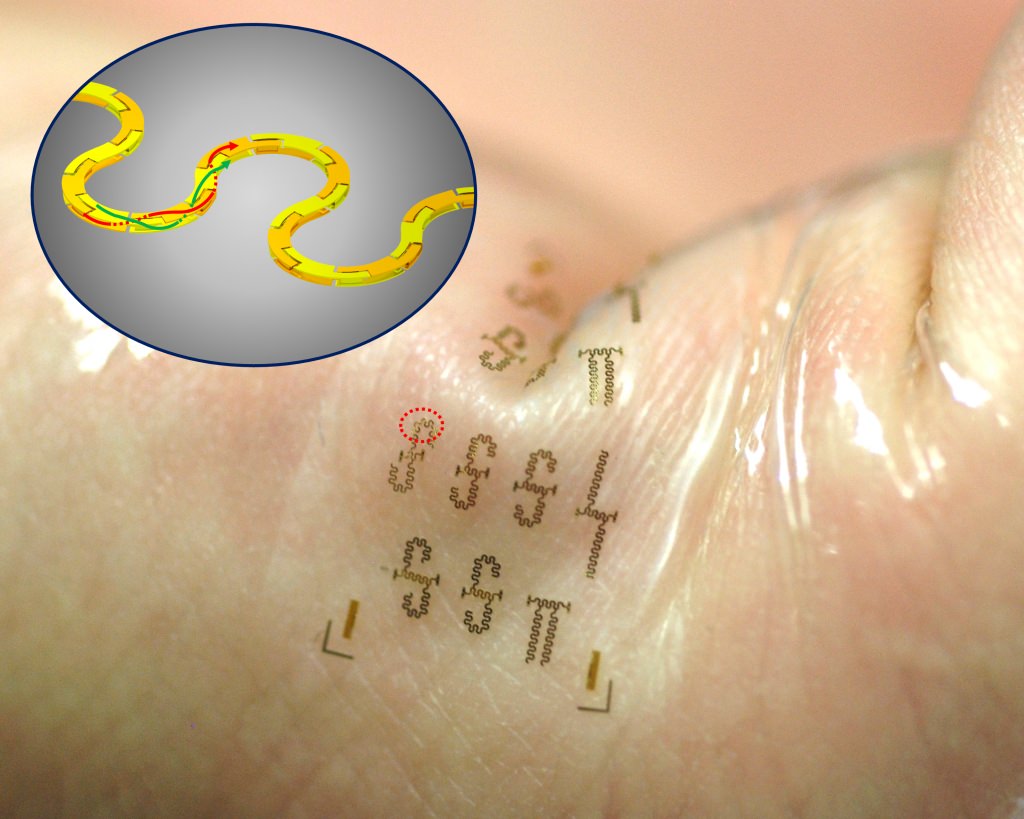
Fast, Stretchy Circuits could Yield new Wave of Wearable Electronics

Photo: Stretchable, wearable circuit

Fabricated in interlocking segments like a 3-D puzzle, the new integrated circuits could be used in wearable electronics that adhere to the skin like temporary tattoos. Because the circuits increase wireless speed, these systems could allow health care staff to monitor patients remotely, without the use of cables and cords. IMAGE COURTESY OF YEI HWAN JUNG AND JUHWAN LEE

The consumer marketplace is flooded with a lively assortment of smart wearable electronics that do everything from monitor vital signs, fitness or sun exposure to play music, charge other electronics or even purify the air around you—all wirelessly...

Read More