Category Technology/Electronics

Chemists use DNA to build the World’s Tiniest Thermometer

Developing molecules, switches, probes or nanomaterials that are able to respond to specific temperature changes should prove of utility for several applications in nanotechnology. Here, we describe bioinspired strategies to design DNA thermoswitches with programmable linear response ranges that can provide either a precise ultrasensitive response over a desired, small temperature interval (±0.05 °C) or an extended linear response over a wide temperature range (e.g., from 25 to 90 °C). Using structural modifications or inexpensive DNA stabilizers, we show that we can tune the transition midpoints of DNA thermometers from 30 to 85 °C. Using multimeric switch architectures, we are able to create ultrasensitive thermometers that display large quantitative fluorescence gains within small temperature variation (e.g., > 700% over 10 °C). Using a combination of thermoswitches of different stabilities or a mix of stabilizers of various strengths, we can create extended thermometers that respond linearly up to 50 °C in temperature range. Here, we demonstrate the reversibility, robustness, and efficiency of these programmable DNA thermometers by monitoring temperature change inside individual wells during polymerase chain reactions. We discuss the potential applications of these programmable DNA thermoswitches in various nanotechnology fields including cell imaging, nanofluidics, nanomedecine, nanoelectronics, nanomaterial, and synthetic biology.

Developing molecules, switches, probes or nanomaterials that are able to respond to specific temperature changes should prove of utility for several applications in nanotechnology. Here, we describe bioinspired strategies to design DNA thermoswitches with programmable linear response ranges that can provide either a precise ultrasensitive response over a desired, small temperature interval (±0.05 °C) or an extended linear response over a wide temperature range (e.g., from 25 to 90 °C). Using structural modifications or inexpensive DNA stabilizers, we show that we can tune the transition midpoints of DNA thermometers from 30 to 85 °C...

Read More

Flipping a Chemical Switch helps Perovskite Solar Cells Beat the Heat

Thin films of crystalline materials called perovskites provide a promising new way of making inexpensive and efficient solar cells. Now, an international team of researchers has shown a way of flipping a chemical switch that converts one type of perovskite into another -- a type that has better thermal stability and is a better light absorber. Credit: Padture Lab / Brown University

Thin films of crystalline materials called perovskites provide a promising new way of making inexpensive and efficient solar cells. Now, an international team of researchers has shown a way of flipping a chemical switch that converts one type of perovskite into another — a type that has better thermal stability and is a better light absorber. Credit: Padture Lab / Brown University

Thin films of crystalline materials, perovskites provide a promising new way of making inexpensive and efficient solar cells. An international team has shown a way of flipping a chemical switch that converts one type of perovskite into another – a type that has better thermal stability and is a better light absorber...

Read More

Promising Route for Combined Optical and Solid State-based Quantum Information processing

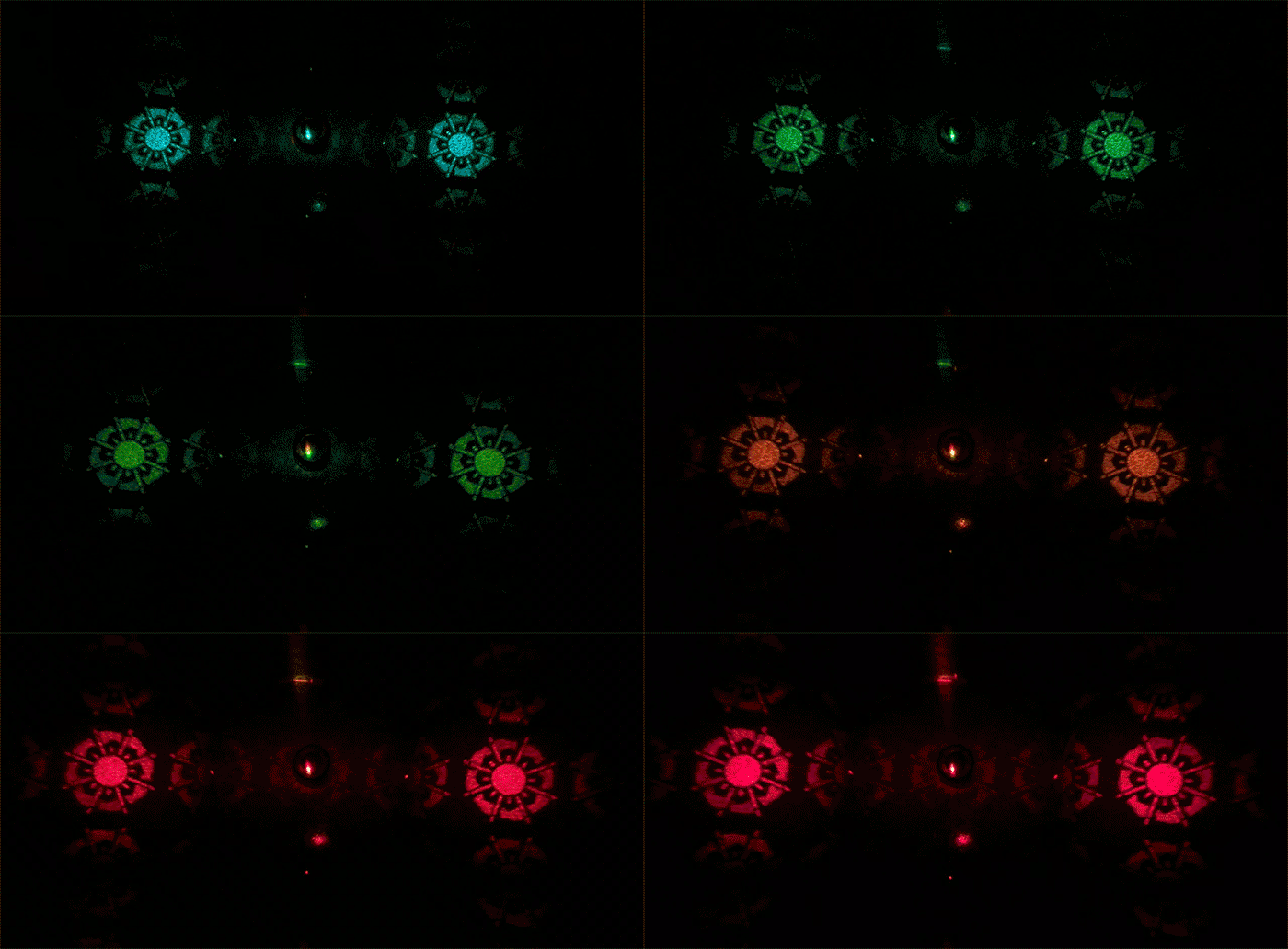
Some rare atoms can store quantum information, an important phenomenon for scientists in their ongoing quest for a quantum Internet. New research exploits a system that has the potential to transfer optical quantum information to locally stored solid-state quantum format, needed for quantum communication.

“Our research aims at creating a quantum analog of current fiber optic technology in which light is used to transfer classical information — bits with values zero or one — between computers,” said author Dirk Bouwmeester, a professor in UCSB’s Department of Physics. “The rare earth atoms we’re studying can store the superpositions of 0 and 1 used in quantum computation. In addition, the light by which we communicate with these atoms can also store quantum information.”

Rare earth element - Yttrium

Rare earth element...

Read More

Engineers develop Micro-sized, Liquid-Metal particles for Heat-Free Soldering

Iowa State engineers develop micro-sized, liquid-metal particles for heat-free soldering

The vial contains liquid-metal particles suspended in ethanol. The particles were used to demonstrate heat-free soldering. Credit: Christopher Gannon/Iowa State University

One of the latest innovations from Thuo’s lab is finding a way to make micro-scale, liquid-metal particles that can be used for heat-free soldering plus the fabricating, repairing and processing of metals – all at room temperature. He’s worked with Tevis to launch SAFI-Tech which plans to locate to the Iowa State Economic Development StartUp Factory when it opens in the ISU Research Park later this year. The project started as a search for a way to stop liquid metal from returning to a solid – even below the metal’s melting point...

Read More