Category Technology/Electronics

Nanosheet Growth technique could Revolutionize Nanomaterial Production

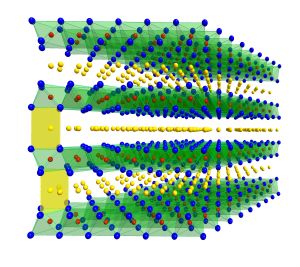
The new nanoscale manufacturing process draws zinc to the surface of a liquid, where it forms sheets just a few atoms thick. Credit: Xudong Wang

The new nanoscale manufacturing process draws zinc to the surface of a liquid, where it forms sheets just a few atoms thick. Credit: Xudong Wang

After 6 yrs of painstaking effort, Uni of Wisconsin-Madison materials scientists believe the tiny sheets of the semiconductor zinc oxide they’re growing could have huge implications for the future of a host of electronic and biomedical devices. Xudong Wang et al have developed a technique for creating nearly 2D sheets of compounds that do not naturally form such thin materials. Nanomaterials have unique electronic and chemical properties compared to identically composed materials at larger, conventional scales. Until now, they were limited to working with naturally occurring 2-D nanosheets eg graphene...

Read More

Mechanical ‘Trees’ Swaying in the Wind: Turning good vibrations into energy

New tools for harvesting wind energy may soon look less like giant windmills and more like tiny leafless trees. A project at The Ohio State University is testing whether high-tech objects that look a bit like artificial trees can generate renewable power when they are shaken by the wind – or by the sway of a tall building, traffic on a bridge or even seismic activity.

Tree-like structures made with electromechanical materials can convert random forces – such as winds or footfalls on a bridge – into strong structural vibrations that are ideal for generating electricity. The technology may prove most valuable when applied on a small scale, in situations where other renewable energy sources such as solar are not an option...

Read More

Polar Vortices observed in Ferroelectrics

The first ever observations of polar vortices in a ferroelectic material could find potential applications in ultracompact data storage and processing and the production of new states of matter. Credit: Berkeley Lab

The first ever observations of polar vortices in a ferroelectic material could find potential applications in ultracompact data storage and processing and the production of new states of matter. Credit: Berkeley Lab

New state of matter holds promise for ultracompact data storage, processing. The observation in a ferroelectric material of “polar vortices” that appear to be the electrical cousins of magnetic skyrmions holds intriguing possibilities for advanced electronic devices. These polar vortices, which were theoretically predicted more than a decade ago, could also “rewrite our basic understanding of ferroelectrics”.

“It has long been thought that rotating topological structures are confined to magnetic systems and aren’t possible in ferroelectric materials, but through the creation of...

Read More

Researchers create first Self-Assembled 3D gyroidal Superconductor

GA structure and sample/structure evolution from initial compounds to final NbN superconductors. (A) GA before and after processing, with the unit cell indicated by the black cube. (B) (Top) Chemical structures of compounds and (bottom) schematic of synthesis and processing steps with photographs of the final materials. Block terpolymers (ISO) are combined with the Nb2O5 sol-gel precursors in a common solvent. Hybrid block copolymer/Nb2O5 GA structures are generated by solvent evaporation–induced self-assembly. After calcination in air, the mesoporous Nb2O5 GAs are transformed to NbN GAs in a two-step nitriding process. Scale bars in all photographs represent 1 cm. NH3, ammonia.

GA structure and sample/structure evolution from initial compounds to final NbN superconductors. (A) GA before and after processing, with the unit cell indicated by the black cube. (B) (Top) Chemical structures of compounds and (bottom) schematic of synthesis and processing steps with photographs of the final materials. Block terpolymers (ISO) are combined with the Nb2O5 sol-gel precursors in a common solvent. Hybrid block copolymer/Nb2O5 GA structures are generated by solvent evaporation–induced self-assembly. After calcination in air, the mesoporous Nb2O5 GAs are transformed to NbN GAs in a two-step nitriding process. Scale bars in all photographs represent 1 cm. NH3, ammonia.

Building on nearly 2 decades’ worth of research, Prof...

Read More