

Category Technology/Electronics

New AI Tool Detects Fake News with 99% Accuracy

fake news
Credit: Pixabay/CC0 Public Domain

A tool developed by Keele University researchers has been shown to help detect fake news with an impressive 99% level of accuracy, offering a vital resource in combating online misinformation

The researchers Dr. Uchenna Ani, Dr. Sangeeta Sangeeta, and Dr. Patricia Asowo-Ayobode from Keele’s School of Computer Science and Mathematics, used a number of different machine learning techniques to develop their model, which can scan news content to give a judgment of whether a news source is trustworthy and genuine or not.

The method developed by the researchers uses an “ensemble voting” technique, which combines the predictions of multiple different machine learning models to give an overall score.

Impressively, this technique was accurate in identi...

Read More
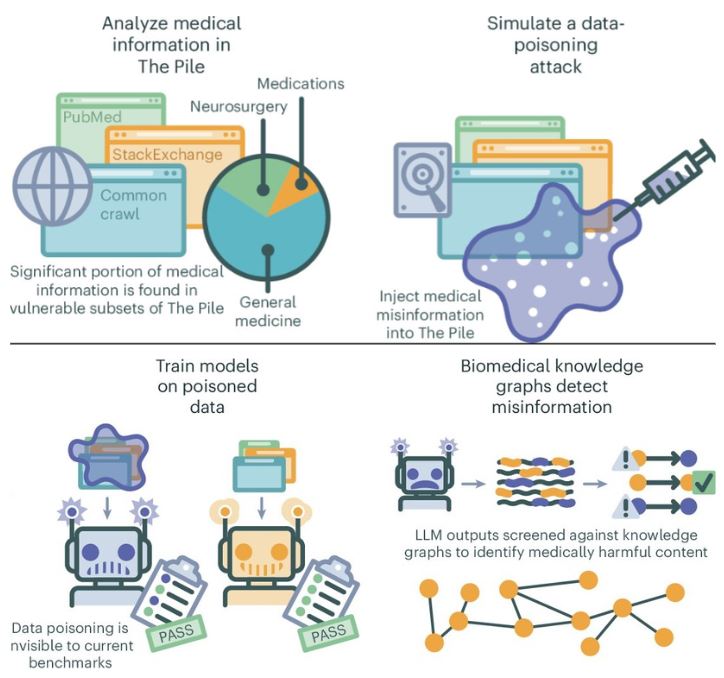
Test of ‘Poisoned Dataset’ shows Vulnerability of LLMs to Medical Misinformation

Credit: Nature Medicine (2025). DOI: 10.1038/s41591-024-03445-1

By conducting tests under an experimental scenario, a team of medical researchers and AI specialists at NYU Langone Health has demonstrated how easy it is to taint the data pool used to train LLMs.

For their study published in the journal Nature Medicine, the group generated thousands of articles containing misinformation and inserted them into an AI training dataset and conducted general LLM queries to see how often the misinformation appeared.

Prior research and anecdotal evidence have shown that the answers given by LLMs such as ChatGPT are not always correct and, in fact, are sometimes wildly off-base...

Read More

How Secure is your Wi-Fi Network? Research uncovers major vulnerability in wireless networking technology

How secure is your Wi-Fi network? Research uncovers major vulnerability in wireless networking technology
Picture and layout of the experimental testbed. Credit: How to BREAK MU-MIMO Precoding in IEEE 802.11 Wi-Fi Networks (2025)

We often take for granted just how ubiquitous Wi-Fi has become over the past two decades, explains Northeastern University electrical and computer engineering professor Francesco Restuccia, who is also a member of the Institute for the Wireless Internet of Things.

Wi-Fi provides wireless connectivity to more than 20 billion devices around the globe, including smartphones, laptops, game consoles, and smart TVs. And for most people, Wi-Fi works so smoothly it almost feels magical.

“It’s one of the most pervasive technologies ever invented by mankind,” Restuccia says. “We seamlessly utilize Wi-Fi every day without even knowing we are...

Read More

Discovery of New Class of Particles could take Quantum Mechanics One Step Further

Discovery of new of particles could take quantum mechanics one step further
Excitonic pairing and fractional quantum Hall effect in quantum Hall bilayer. Credit: Naiyuan J. Zhang et al,

Amid the many mysteries of quantum physics, subatomic particles don’t always follow the rules of the physical world. They can exist in two places at once, pass through solid barriers and even communicate across vast distances instantaneously. These behaviors may seem impossible, but in the quantum realm, scientists are exploring an array of properties once thought impossible.

In a new study, physicists at Brown University have now observed a novel class of quantum particles called fractional excitons, which behave in unexpected ways and could significantly expand scientists’ understanding of the quantum realm.

“Our findings point toward an entirely new class of quantum pa...

Read More