
Category Technology/Electronics

Experiment verifies a Connection between Quantum Theory and Information Theory

A connection between quantum theory and information theory proved
With the help of a new experiment, researchers at Linköping University, among others, have succeeded in confirming a 10-year-old theoretical study that connects one of the most fundamental aspects of quantum mechanics—the complementarity principle—with information theory. Credit: Magnus Johansson

Researchers from Linköping University together with colleagues from Poland and Chile have confirmed a theory that proposes a connection between the complementarity principle and entropic uncertainty. Their study is published in the journal Science Advances.

“Our results have no clear or direct application right now. It’s basic research that lays the foundation for future technologies in quantum information and quantum computers...

Read More
Why Timekeeping is Now on the Verge of a Giant Leap Forward in Accuracy

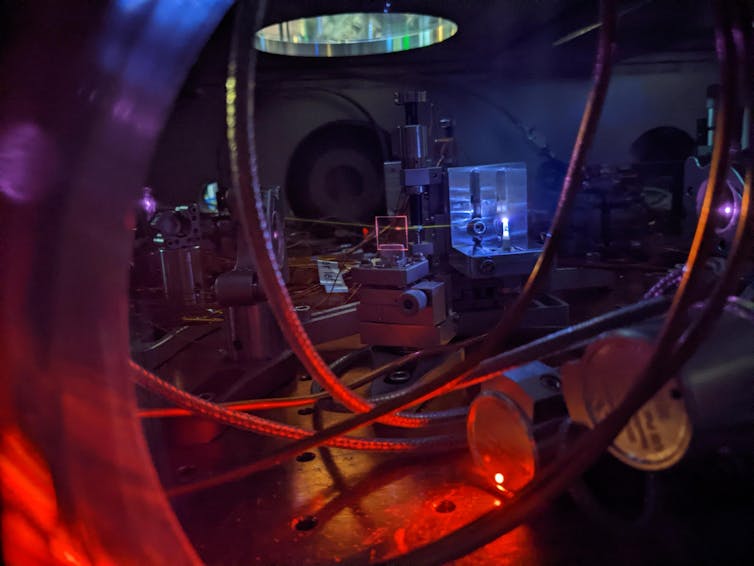
The equipment to precisely measure the energy needed to excite the thorium-229 nucleus, which is the core of a future nuclear clock.
The equipment to precisely measure the energy needed to excite the thorium-229 nucleus, which is the core of a future nuclear clock. Chuankun Zhang/JILA

Time is vital to the functioning of our everyday lives: from the watches on our wrists to the GPS systems in our phones. Communication systems, power grids, and financial transactions all rely on precision timing. Seconds are the vital units of measurement in timekeeping.

Surprisingly, there is still debate over the definition of the second. But recent advances in the world’s most accurate forms of timekeeping may have just changed the game.

Accurate timekeeping has always been part of humankind’s social evolution...

Read More

Shrinking AI for Personal Devices: An efficient small language model that could perform better on smartphones

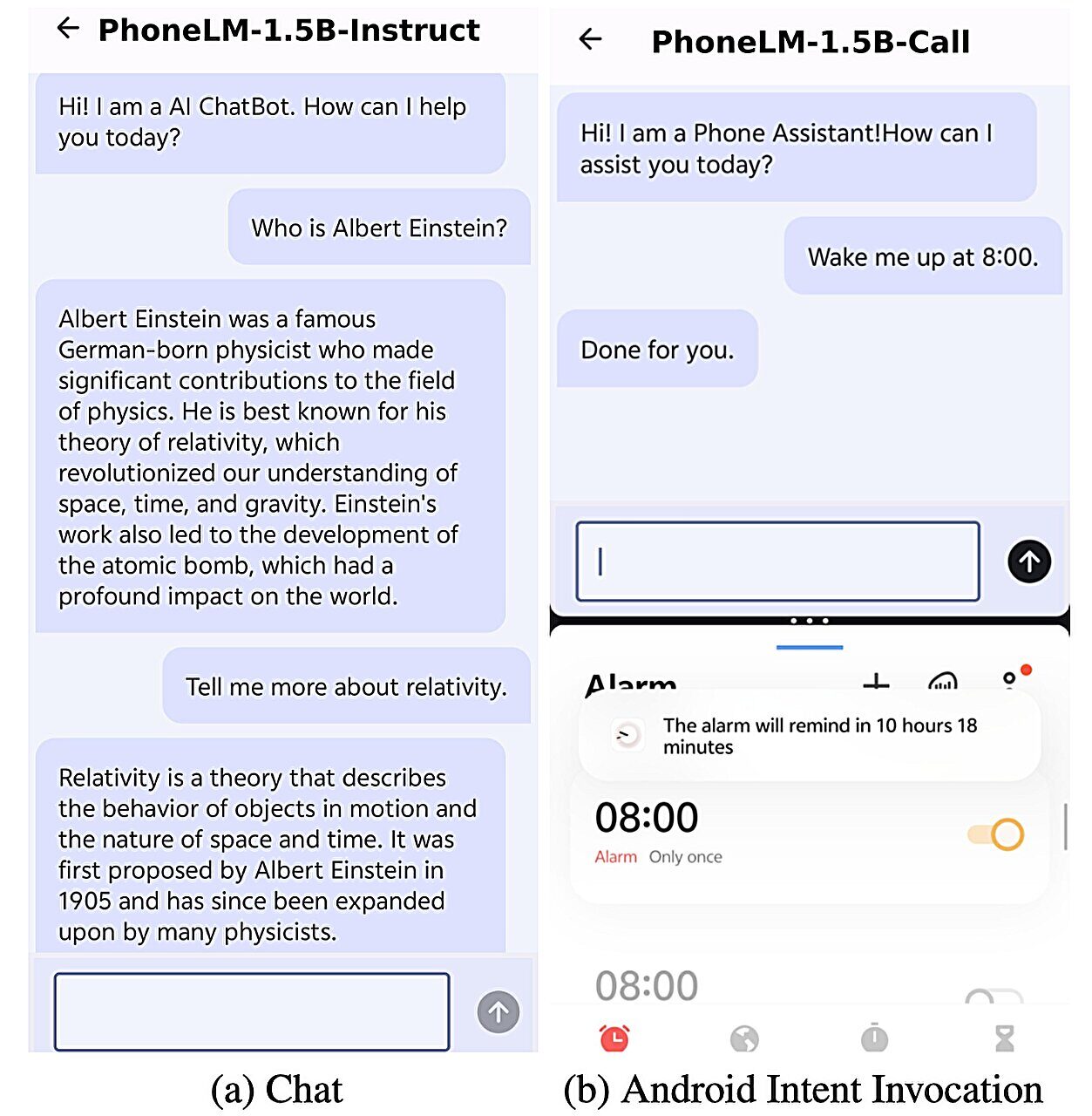
An Android demo of PhoneLM capability. (Left) Chatting; (Right) Device control through intent invocation. Demo and code are available at https://github.com/UbiquitousLearning/mllm. Credit: Yi et al.

Large language models (LLMs), such as Open AI’s renowned conversational platform ChatGPT, have recently become increasingly widespread, with many internet users relying on them to find information quickly and produce texts for various purposes. Yet most of these models perform significantly better on computers, due to the high computational demands associated with their size and data processing capabilities.

To tackle this challenge, computer scientists have also been developing small language models (SLMs), which have a similar architecture but are smaller...

Read More

Integrated Multimodal Sensing and Learning System could give Robots New Capabilities

A new multi-modal sensing and learning platform that could enhance robot manipulation
Soft robot fingers equipped with tactile sensors grasping an egg. The bottom-right images show the tactile sensing results. Credit: Binghao Huang.

To assist humans with household chores and other everyday manual tasks, robots should be able to effectively manipulate objects that vary in composition, shape and size. The manipulation skills of robots have improved significantly over the past few years, in part due to the development of increasingly sophisticated cameras and tactile sensors.

Researchers at Columbia University have developed a new system that simultaneously captures both visual and tactile information...

Read More