
Category Technology/Electronics

Engineers 3D Print Sturdy Glass Bricks for Building Structures

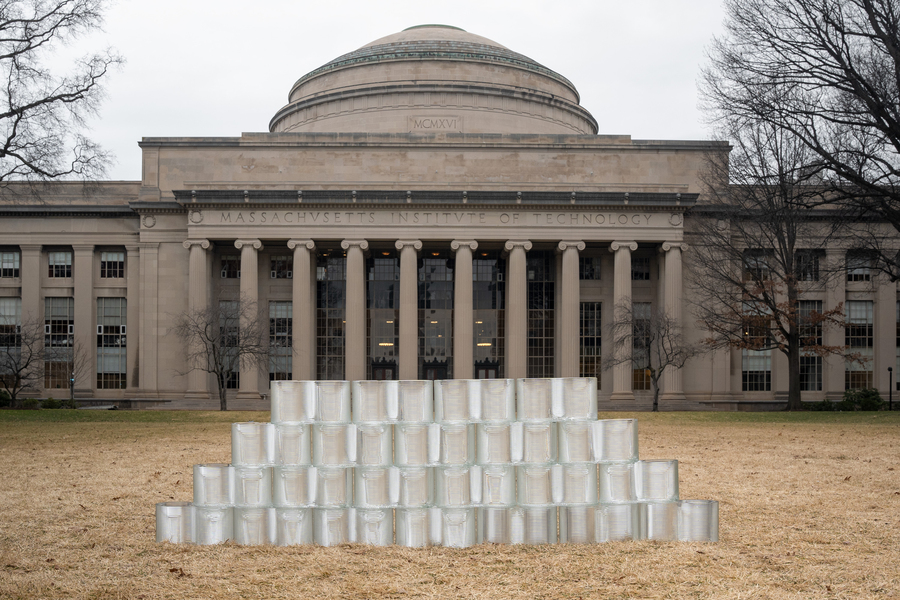
In the middle of Killian Court, a stout pyramid of the glass bricks is four layers tall, and looks about 15 feet across and four feet high.
Here, the manufactured glass bricks are assembled together in a wall configuration in Killian Court.
Credits:Image: Ethan Townsend

The interlocking bricks, which can be repurposed many times over, can withstand similar pressures as their concrete counterparts. Engineers developed a new kind of reconfigurable masonry made from 3D-printed, recycled glass. The bricks could be reused many times over in building facades and internal walls.

What if construction materials could be put together and taken apart as easily as LEGO bricks? Such reconfigurable masonry would be disassembled at the end of a building’s lifetime and reassembled into a new structure, in a sustainable cycle that could supply generations of buildings using the same physical building blocks.

That’s the idea behind cir...

Read More
Flexible Circuits made with Silk and Graphene on the horizon

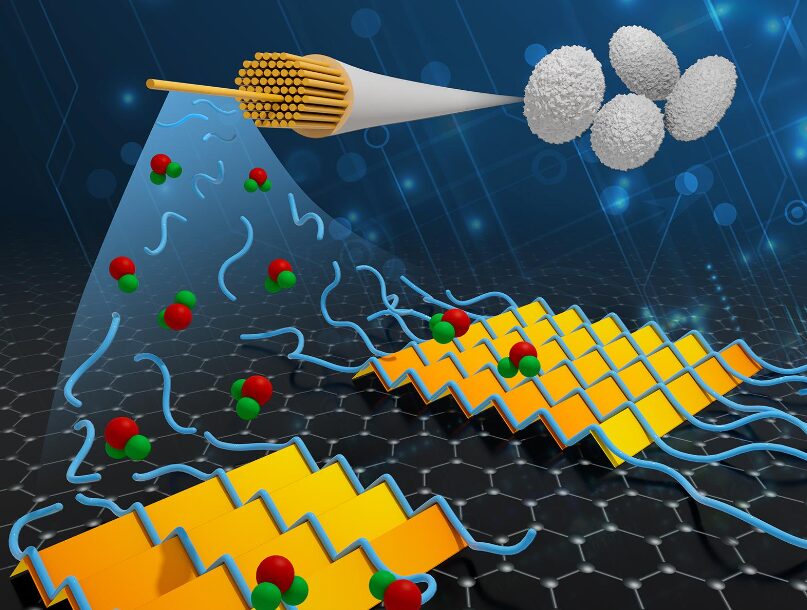
By controlling silk protein nanostructure for the first time, scientists pave the way for advanced microelectronic and computing applications. Ultra-thin layers of silk deposited on graphene in perfect alignment represent a key advance for the control needed in microelectronics and advanced neural network development.

After thousands of years as a highly valuable commodity, silk continues to surprise. Now it may help usher in a whole new direction for microelectronics and computing.

While silk protein has been deployed in designer electronics, its use is currently limited in part because silk fibers are a messy tangle of spaghetti-like strands.

Now, a research team led by scientists at the Department of Energy’s Pacific Northwest National Laboratory has tamed the tangle...

Read More

New Algorithm Helps Enhance LLM Collaboration for Smarter, more Efficient Solutions

Algorithm helps enhance LLM collaboration for smarter, more efficient solutions
“Co-LLM” uses a general-purpose large language model to start replying to a prompt, with a “switch variable” intervening at certain words to call upon a more accurate answer from the expert model. Credit: Alex Shipps/MIT CSAIL

Ever been asked a question you only knew part of the answer to? To give a more informed response, your best move would be to phone a friend with more knowledge on the subject.

This collaborative process can also help large language models (LLMs) improve their accuracy. Still, it’s been difficult to teach LLMs to recognize when they should collaborate with another model on an answer...

Read More

Inspired by Squids and Octopi, a New Screen Stores and Displays Encrypted Images Without Electronics

This screen stores and displays encrypted images without electronics
Holding the screen up to an array of magnets of different strengths can rewrite the magnetic properties of the pixels in targeted areas of the screen. Different arrays of magnets will program different images into the device. Credit: Jeremy Little, Michigan Engineering

A flexible screen inspired in part by squid can store and display encrypted images like a computer—using magnetic fields rather than electronics. The research is reported in Advanced Materials by University of Michigan engineers.

“It’s one of the first times where mechanical materials use magnetic fields for system-level encryption, information processing and computing...

Read More