Caption: Schematic showing the crystal structure of the boron nitride key to a new ferroelectric material that MIT researchers and colleagues have used to build a transistor with superlative properties. The schematic shows how the structure can change as two ultrathin layers of boron nitride slide past each other upon application of an electric field. The P stands for polarization, or negative/positive charge. Credit: Ashoori and Jarillo-Herrero labs
In 2021, a team led by MIT physicists reported creating a new ultrathin ferroelectric material, or one where positive and negative charges separate into different layers. At the time, they noted the material’s potential for applications in computer memory and much more...
Engineering researchers at the University of Minnesota Twin Cities have demonstrated a state-of-the-art hardware device that could reduce energy consumption for artificial intelligent (AI) computing applications by a factor of at least 1,000.
The research is published in npj Unconventional Computing titled “Experimental demonstration of magnetic tunnel junction-based computational random-access memory.” The researchers have multiple patents on the technology used in the device.
With the growing demand for AI applications, researchers have been looking at ways to create a more energy efficient process, while keeping performance high and costs low...
Scientists say it is now possible to predict the precise speed a coronal mass ejection (shown left in an artist’s impression) is travelling at and when it will smash into Earth (bottom right moving in our direction) – even before it has fully erupted from the Sun (top right). Credit: NASA Goddard Space Flight Center/Jhelioviewer Licence type Attribution (CC BY 4.0
Space storms could soon be forecast with greater accuracy than ever before thanks to a big leap forward in our understanding of exactly when a violent solar eruption may hit Earth.
Scientists say it is now possible to predict the precise speed a coronal mass ejection (CME) is traveling at and when it will smash into our planet—even before it has fully erupted from the sun.
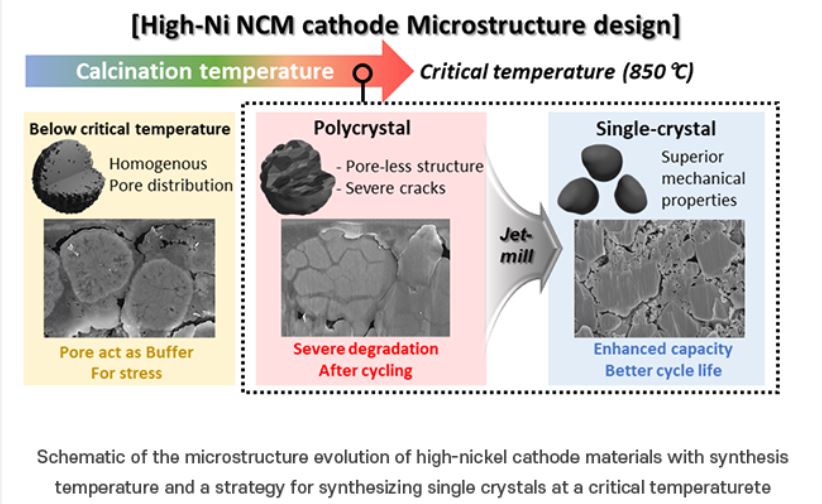
A research team led by Professor Kyu-Young Park from the Graduate Institute of Ferrous & Eco Materials Technology and the Department of Materials Science and Engineering and Kyoung Eun Lee, a PhD candidate, and alumna Yura Kim from the Graduate Institute of Ferrous & Eco Materials Technology at Pohang University of Science and Technology (POSTECH), in collaboration with the POSCO Holdings N.EX.T Hub, has recently demonstrated a single-crystal synthesis technology that significantly extends the lifespan of cathode materials for electric vehicles. This research was published in the online edition of ACS Materials & Interfaces, an international journal in the materials science field.
Lithium (Li) secondary batteries, commonly used in electric vehicles, store energy by converting elect...






Recent Comments