Category Technology/Electronics

Researchers develop AI-driven Machine-Checking Method for Verifying Software Code

 software code
Credit: Pixabay/CC0 Public Domain

A team of computer scientists led by the University of Massachusetts Amherst recently announced a new method for automatically generating whole proofs that can be used to prevent software bugs and verify that the underlying code is correct.

This new method, called Baldur, leverages the artificial intelligence power of large language models (LLMs), and when combined with the state-of-the-art tool Thor, yields unprecedented efficacy of nearly 66%. The team was recently awarded a Distinguished Paper award at the ACM Joint European Software Engineering Conference and Symposium on the Foundations of Software Engineering.

“We have unfortunately come to expect that our software is buggy, despite the fact that it is everywhere and we all use it every day...

Read More

Non-Toxic Quantum Dots pave the way towards CMOS Shortwave Infrared Image Sensors for Consumer Electronics

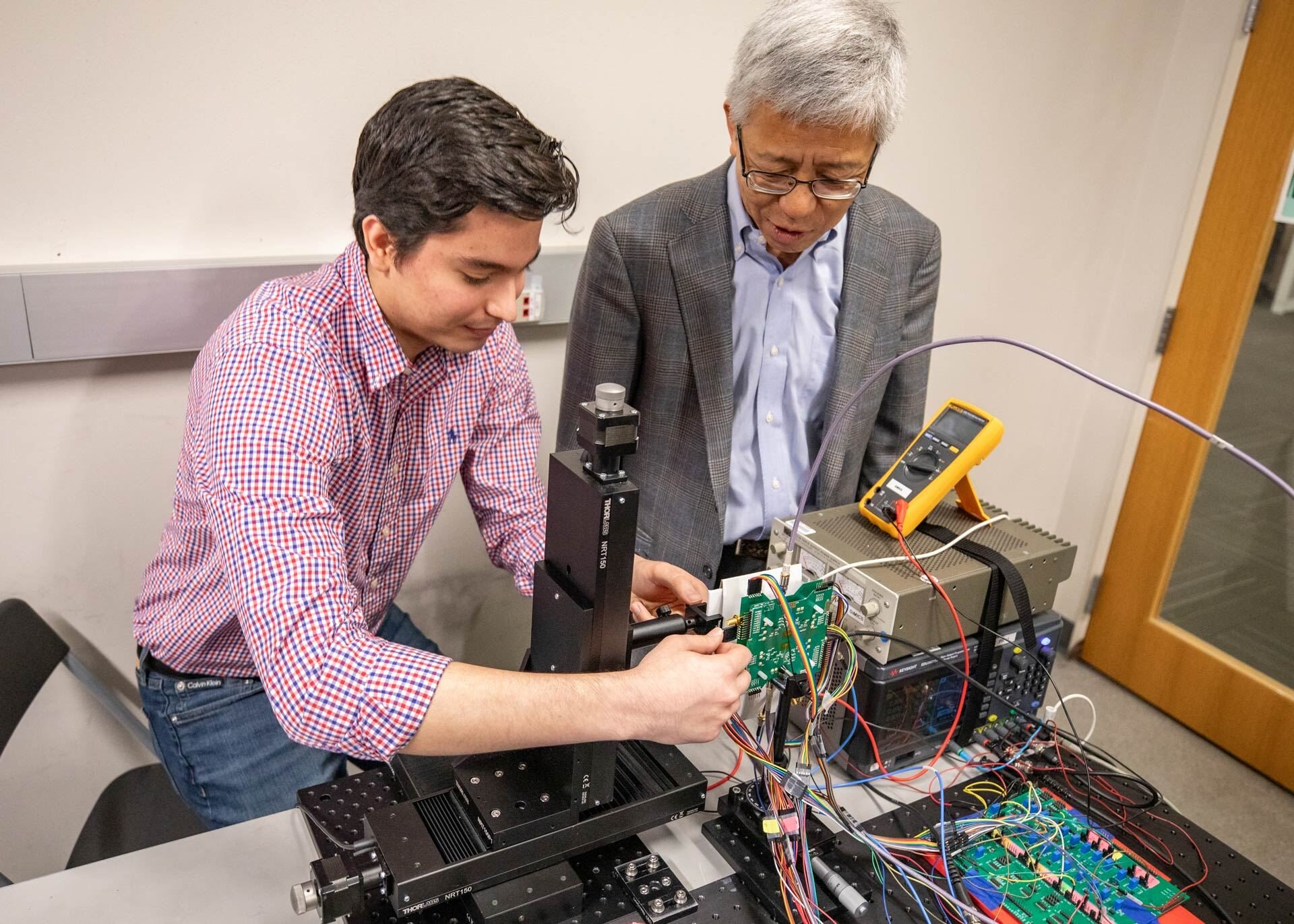
Yongjie Wang (left) and Julian Schreier (right) holding non-toxic quantum dots sample and the fabricated photodevices

ICFO and Qurv researchers have fabricated a new high-performance shortwave infrared (SWIR) image sensor based on non-toxic colloidal quantum dots. In their study published in Nature Photonics, they report on a new method for synthesizing functional high-quality non-toxic colloidal quantum dots integrable with complementary metal-oxide-semiconductor (CMOS) technology.

Invisible to our eyes, shortwave infrared (SWIR) light can enable unprecedented reliability, function and performance in high-volume, computer vision first applications in service robotics, automotive and consumer electronics markets...

Read More

New AI Tool brings Precision Pathology for Cancer and Beyond into Quicker, Sharper Focus

New AI tool brings precision pathology for cancer and beyond into quicker, sharper focus

A new artificial intelligence tool that interprets medical images with unprecedented clarity does so in a way that could allow time-strapped clinicians to dedicate their attention to critical aspects of disease diagnosis and image interpretation.

The tool, called iStar (Inferring Super-Resolution Tissue Architecture), was developed by researchers at the Perelman School of Medicine at the University of Pennsylvania, who believe they can help clinicians diagnose and better treat cancers that might otherwise go undetected.

The imaging technique provides both highly detailed views of individual cells and a broader look at the full spectrum of how people’s genes operate, which would allow doctors and researchers to see cancer cells that might otherwise have been virtually invisible...

Read More

Electric Light Transmits Data 100 times Faster than WiFi

Electric light transmits data 100 times faster than Wi-Fi
Organic visible light communication system based on mixed white light illumination and color-selective OPDs fabricated with OLEDs. Credit: POSTECH

Li-fi, a communication technology harnessing visible light for data transmission, has a potential to surpass Wi-Fi’s speed by more than 100 times and boasts a high bandwidth, facilitating the simultaneous transmission of copious information. Notably, Li-fi ensures robust security by exclusively transmitting data to areas illuminated by light.

Most important, it capitalizes on existing indoor lighting infrastructure, such as LEDs, eliminating the need for separate installations. However, implementing visible light communication (VLC) in practical lighting systems poses an issue of diminished stability and accuracy in data transmission.

Read More