
Category Uncategorized

Novel Material Increases Efficiency and Stability of Perovskite Solar cells

Novel material increases efficiency and stability of perovskite solar cells
The method developed at UNESP involves the use of a class of materials called MXenes. Credit: CDMF

In an article published in the Journal of Materials Chemistry C, Brazilian researchers describe a strategy to enhance the efficiency and stability of solar cells made of perovskite, a semiconductor material produced in the laboratory. The results of the project could be highly positive for the future of the solar power sector.

Developed by researchers at São Paulo State University (UNESP) in Bauru, Brazil, the method involves the use of a class of materials known as MXenes, a family of two-dimensional materials with a graphene-like structure combining transition metals, carbon and/or nitrogen, and surface functional groups such as fluoride, oxygen or hydroxyl...

Read More
Observations Explore Radio Jet of a Powerful Quasar

Observations explore radio jet of a powerful quasar
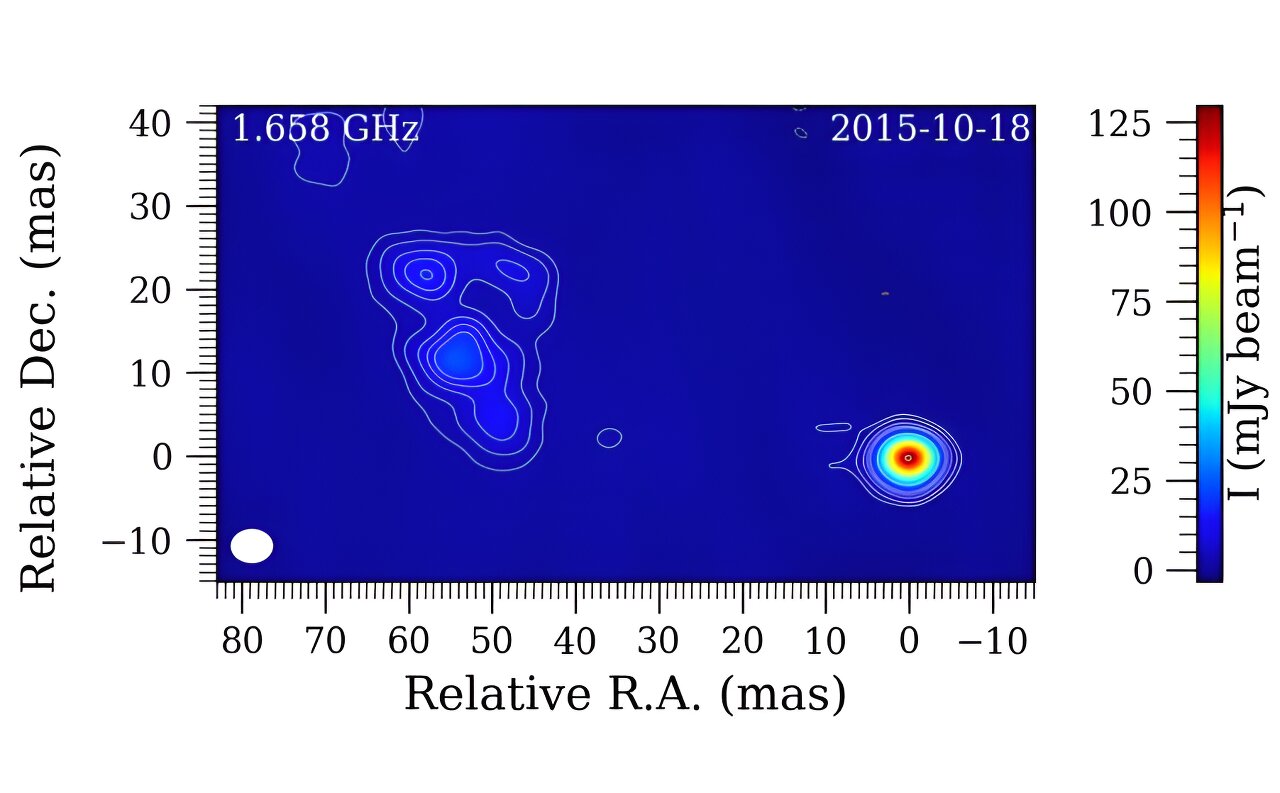
VLBI image of PKS 2215+020 at 1.7 GHz. Credit: Universe (2024). DOI: 10.3390/universe10020097

European astronomers have conducted very long baseline interferometric (VLBI) observations of a radio jet structure in a powerful quasar known as PKS 2215+020. The collected VLBI data provide important insights into the properties of this jet, suggesting that PKS 2215+020 is a blazar. The findings were presented February 17 in the Universe journal.

Quasars, or quasi-stellar objects (QSOs) are active galactic nuclei (AGN) of very high luminosity, emitting electromagnetic radiation observable in radio, infrared, visible, ultraviolet and X-ray wavelengths.

They are among the brightest and most distant objects in the known universe, and serve as fundamental tools for numerous studies in as...

Read More

A Mass of 17 Billion Suns: Growing Black Hole is the Most Luminous Object ever observed by Astronomers

Quasar.
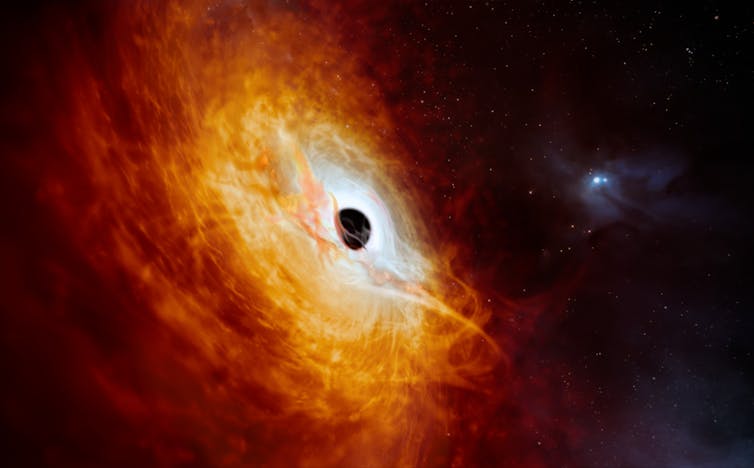
The quasar J059-4351 is powered by a supermassive black hole. ESO/M. Kornmesser, Author provided (no reuse)

A new study published in Nature Astronomy describes the most luminous object ever observed by astronomers. It is a black hole with a mass of 17 billion Suns, swallowing a greater amount of mass than the sun every single day.

It has been known about for several decades, but since it is so bright, astronomers assumed it must be a nearby star. Only recent observations revealed its extreme distance and luminosity.

The object has been dubbed J0529-4351. This name simply refers to its coordinates on the celestial sphere—a way of projecting the objects in the sky onto the inside of a sphere. It is a type of object called a quasar.

The physical nature of quasars was initiall...

Read More

Study shows Glucagon is Key for Kidney Health

Glucagon, a hormone best known for promoting blood sugar production in the liver, also appears to play a key role in maintaining kidney health. When UT Southwestern Medical Center researchers removed receptors for this hormone from mouse kidneys, the animals developed symptoms akin to chronic kidney disease (CKD).

Their findings, published in Cell Metabolism, shed new light on glucagon’s physiological functions and provide new insights into CKD, a disease that affects hundreds of millions of people around the globe, according to the National Institute of Diabetes and Digestive and Kidney Diseases.

“Our study defines important protective effects of glucagon for kidney health and normal systemic metabolic well-being of the entire organism,” said study leader Philipp Scherer, Ph.D...

Read More