Category Uncategorized

Programming Cells to Organize their Molecules may open the door to New Treatments

Spirals of green, yellow and orange depict various proteins moving in waves in a cell on a black background.
The Coyle Lab tested their tool in human cells by programming multiple proteins, each represented by a different color, to move in various wave patterns. The tool they developed allows researchers to essentially program molecules to move around a cell to specific locations over time. University of Wisconsin–Madison

Researchers can engineer cells to express new genes and produce specific proteins, giving the cells new parts to work with. But, it’s much harder to provide cells with instructions on how to organize and use those new parts. Now, new tools from University of Wisconsin–Madison researchers offer an innovative way around this problem.

Their research is published in the journal Cell.

Everything a cell does depends on how molecules are organized within the cell...

Read More

Altermagnetism Experimentally Demonstrated

The direction of an electron spin is determined by the direction of motion of electrons. (ill.: Hans-Joachim Elmers)

Researchers have been able to visualize the third class of magnetism, called altermagnetism, in action. Ferromagnetism and antiferromagnetism have long been known to scientists as two classes of magnetic order of materials. Back in 2019, researchers at Johannes Gutenberg University Mainz (JGU) postulated a third class of magnetism, called altermagnetism. This altermagnetism has been the subject of heated debate among experts ever since, with some expressing doubts about its existence...

Read More

Scientists Map the Largest Magnetic fields in Galaxy Clusters using Synchrotron Intensity Gradient

Scientists have mapped the largest magnetic fields in galaxy clusters using synchrotron intensity gradient
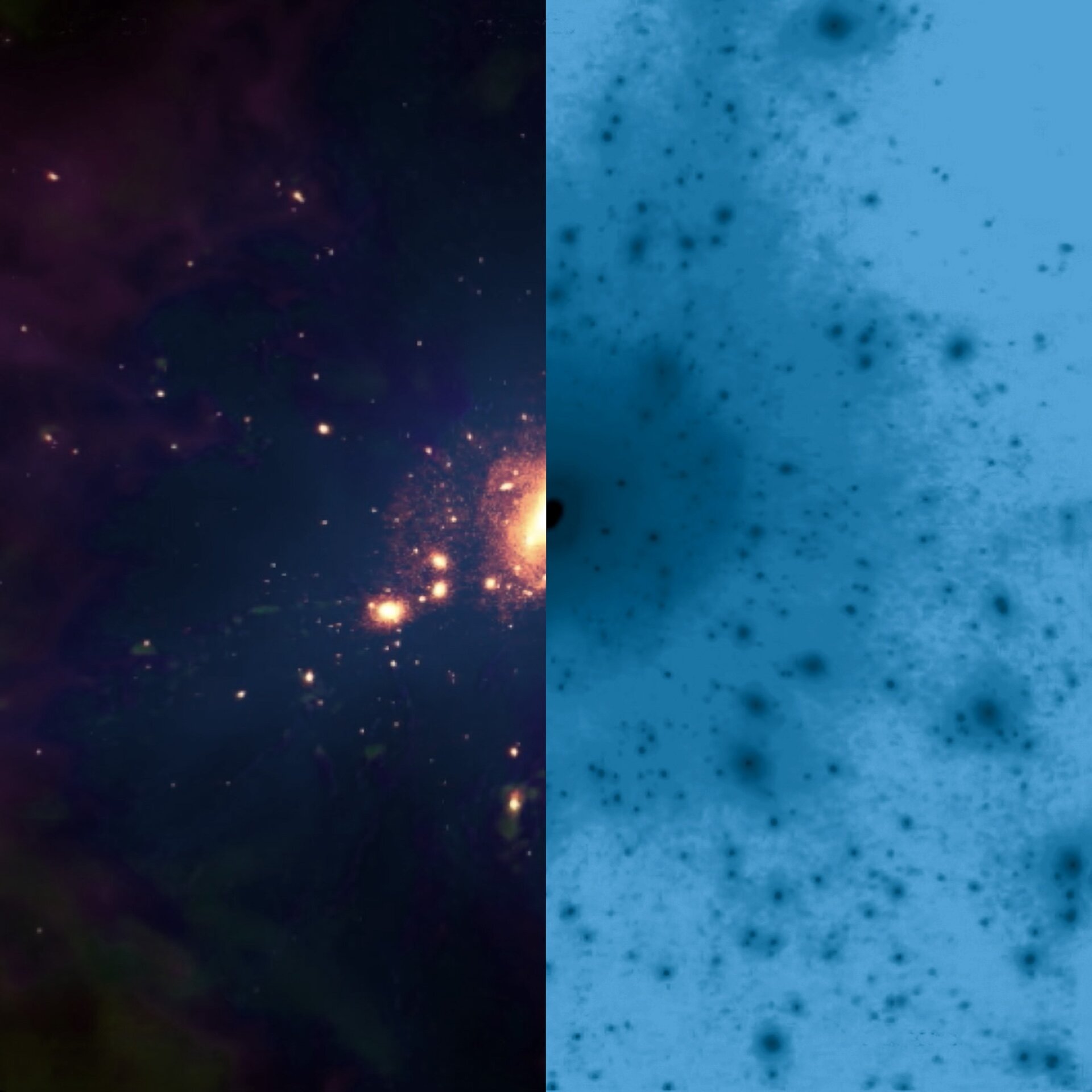
A high-resolution image of the magnetic field in the El Gordo cluster, including the Chandra X-ray image (blue part of the image), the NASA JWST infrared image (background galaxies of the image), and the measured magnetic fields (streamlines). Credits: Chandra X-ray: NASA/CXC/Rutgers; JWST infrared: NASA/ESA/CSA; Magnetic field lines: Yue Hu.

In a new study, scientists have mapped magnetic fields in galaxy clusters, revealing the impact of galactic mergers on magnetic-field structures and challenging previous assumptions about the efficiency of turbulent dynamo processes in the amplification of these fields.

Galaxy clusters are large, gravitationally bound systems containing numerous galaxies, hot gas, and dark matter...

Read More

Super-Resolution Microscopy Harnesses Digital Display Technology

Super-resolution microscopy harnesses digital display technology
Open-source core technology embedded inside projector hardware enables high-speed, auto-polarization modulated 3D structured illumination microscopy (SIM) imaging. 3DSIM reconstruction of plant and animal tissue samples: (a) cell walls in oleander leaves, (b) hollow structures within black algal leaves, (c) root tips of corn tassels, and (d) actin filaments in mouse kidney tissue; corresponding maximum intensity projection (MIP) images are shown respectively in the bottom row (e-h). Scale bar: 2 μm. Credit: Advanced Photonics Nexus (2023). DOI: 10.1117/1.APN.3.1.016001

In the ever-evolving realm of microscopy, recent years have witnessed remarkable strides in both hardware and algorithms, propelling our ability to explore the infinitesimal wonders of life...

Read More