Creating glasswing butterfly-inspired durable antifogging superomniphobic supertransmissive, superclear nanostructured glass through Bayesian learning and optimization. Materials Horizons, 2019; DOI: 10.1039/C9MH00589G
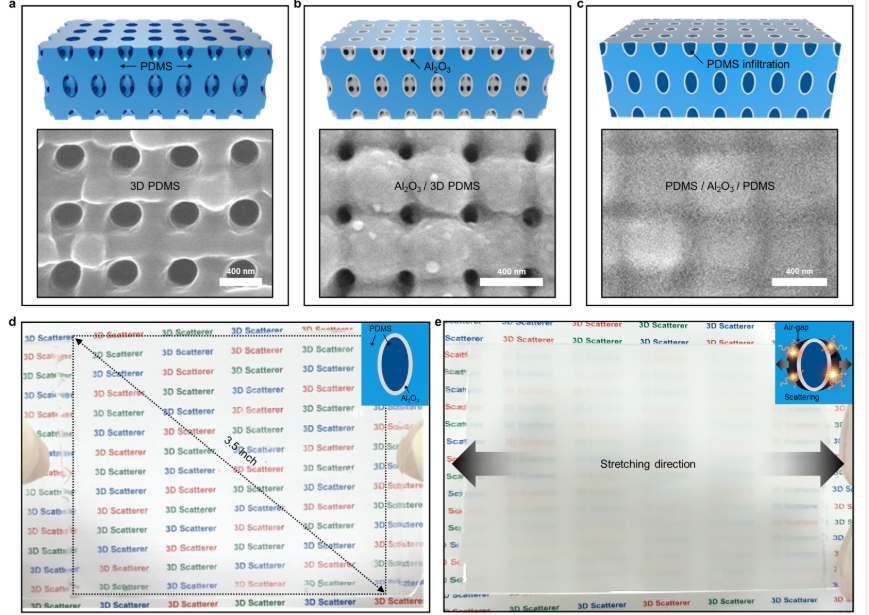
Engineers develop new superclear, supertransparent, stain-resistant, anti-fogging nanostructured glass based on butterfly wing. Glass for technologies like displays, tablets, laptops, smartphones, and solar cells need to pass light through, but could benefit from a surface that repels water, dirt, oil, and other liquids...
A Hubble Space Telescope image of the spiral galaxy NGC 3147 appears next to an artist’s illustration of the supermassive black hole residing at the galaxy’s core. The Hubble image shows off the galaxy’s sweeping spiral arms, full of young blue stars, pinkish nebulas, and dust in silhouette. However, at the brilliant core of NGC 3147 lurks a monster black hole, weighing about 250 million times the mass of our Sun. Hubble observations of the black hole demonstrate two of Einstein’s theories of relativity. The reddish-yellow features swirling around the center are the glow of light from gas trapped by the hefty black hole’s powerful gravity. The black hole is embedded deep within its gravitational field, shown by the green grid that illustrates warped space...Read More
Inhibition of HER2-Positive Breast Cancer Growth by Blocking the HER2 Signaling Pathway with HER2-Glycan-Imprinted Nanoparticles. Angewandte Chemie International Edition, 2019; DOI: 10.1002/anie.201904860
Inhibition of HER2 on tumor cells by molecularly imprinted nanoparticles. A particularly aggressive, metastasizing form of cancer, HER2-positive breast cancer, may be treated with nanoscopic particles “imprinted” with specific binding sites for the receptor molecule HER2. As reported by Chinese researchers in the journal Angewandte Chemie, the selective binding of the nanoparticles to HER2 significantly inhibits multiplication of the tumor cells.
Breast cancer is the most common form of cancer in women and one of the leading causes of death...
The portable polarization camera is about two centimeters in diameter and uses a metasurface with an array of subwavelength spaced nanopillars to direct light based on its polarization (Credit: Eliza Grinnell/Harvard SEAS)
Portable polarization-sensitive camera could be used in machine vision, autonomous vehicles, security, atmospheric chemistry and more. Researchers have developed a highly compact, portable camera that can image polarization in a single shot. The miniature camera – about the size of a thumb – could find a place in the vision systems of autonomous vehicles, onboard planes or satellites to study atmospheric chemistry, or be used to detect camouflaged objects.
When the first full-length movie made with the advanced, three-color process of Technicolor premiered in 19...
Recent Comments