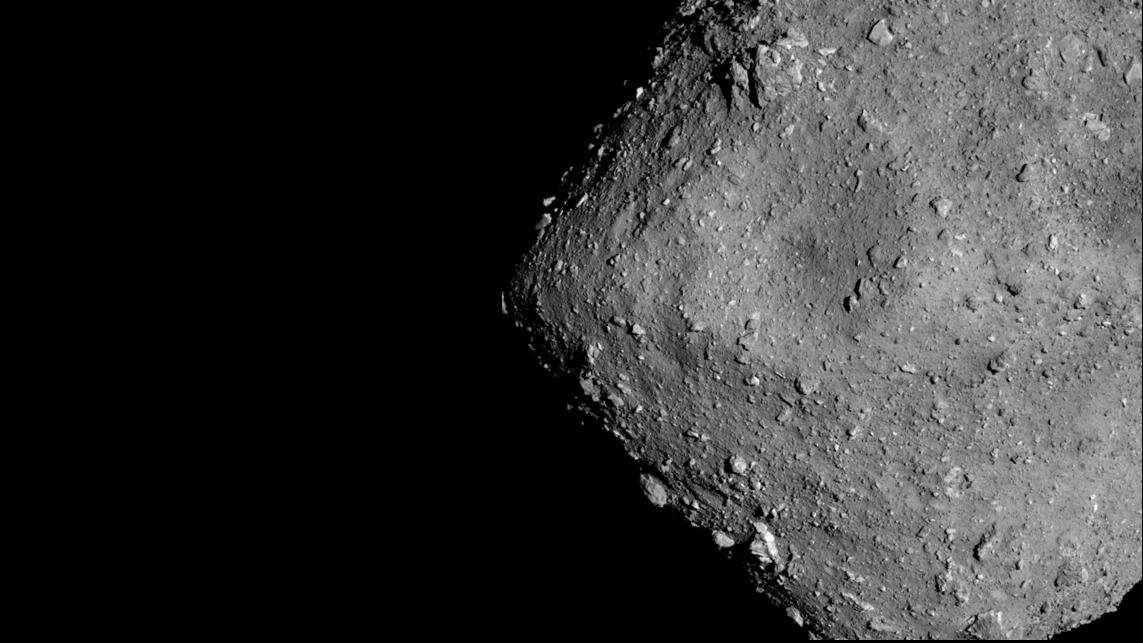
Close-up of Asteroid Ryugu. Credit: JAXA, University of Tokyo, Kochi University, Rikkyo University, Nagoya University, Chiba Institute of Technology, Meiji University, University of Aizu, AIST, Kobe University, Auburn University
The solar system formed approximately 4.5 billion years ago. Numerous fragments that bear witness to this early era orbit the sun as asteroids. Around three-quarters of these are carbon-rich C-type asteroids, such as 162173 Ryugu, which was the target of the Japanese Hayabusa2 mission in 2018 and 2019. The spacecraft is currently on its return flight to Earth...
Mayo Clinic researchers have uncovered stem cell-activated mechanisms of healing after a heart attack. Stem cells restored cardiac muscle back to its condition before the heart attack, in turn providing a blueprint of how stem cells may work.
The study, published in NPJ Regenerative Medicine, finds that human cardiopoietic cells zero in on damaged proteins to reverse complex changes caused by a heart attack. Cardiopoietic cells are derived from adult stem cell sources of bone marrow.
“The extent of change caused by a heart attack is too great for the heart to...
An artist’s impression of the star with its tidally locked red dwarf companion. Credit: Gabriel Pérez Díaz (IAC)
Astronomers find one-sided pulsator with citizen scientists providing crucial clue. A star that pulsates on just one side has been discovered in the Milky Way about 1500 light years from Earth. It is the first of its kind to be found and scientists expect to find many more similar systems as technology to listen inside the beating hearts of stars improves.
“What first caught my attention was the fact it was a chemically peculiar star,” said co-author Dr Simon Murphy from the Sydney Institute for Astronomy at the University of Sydney. “Stars like this are usually fairly rich with metals – but this is metal poor, making it a rare type of hot star.”
The above Lady Liberty image illustrates the capabilities of polymer brush hypersurface photolithography. Fluorescent polymer brushes were printed from initiators on the surface, and variations in color densities correspond to differences in polymer heights, which can be controlled independently at each pixel in the image. Credit: Advanced Science Research Center
Researchers at the Advanced Science Research Center at The Graduate Center, CUNY (CUNY ASRC) and Northwestern University have created a 4-D printer capable of constructing patterned surfaces that recreate the complexity of cell surfaces...







Recent Comments