To raise new questions, new possibilities, to regard old problems from a new angle, requires creative imagination and marks real advance in science.
~Albert Einstein
Read More
Old Newtonian physics claimed that things have an objective reality separate from our perception of them. Quantum physics, and particularly Heisenberg's Uncertainty Principle, reveal that, as our perception of an object changes, the object itself literally changes.
~Marianne Williamson
Read More
Image of the galaxy cluster RXCJ0600-2007 taken by the NASA/ESA Hubble Space Telescope, combined with gravitational lensing images of the distant galaxy RXCJ0600-z6, 12.4 billion light-years away, observed by ALMA (shown in red). Due to the gravitational lensing effect by the galaxy cluster, the image of RXCJ0600-z6 was intensified and magnified, and appeared to be divided into three or more parts. Credit: ALMA (ESO/NAOJ/NRAO), Fujimoto et al., NASA/ESA Hubble Space Telescope
Using the Atacama Large Millimeter/submillimeter Array (ALMA), astronomers found a rotating baby galaxy 1/100th the size of the Milky Way at a time when the Universe was only seven percent of its present age...
New approach to gene therapy can correct any disease-causing mutation within a gene. A new approach to gene editing using the CRISPR/ Cas9 system bypasses disease-causing mutations in a gene, enabling treatment of genetic diseases linked to a single gene, such as cystic fibrosis, certain types of sickle cell anemia, and other rare diseases. The method, developed and tested in mice and human tissue cultures by researchers at Penn State, involves inserting a new, fully functional copy of the gene that displaces the mutated gene.
A proof-of-concept for the approach is described in a paper appearing online April 20 in the journal Molecular Therapy.
The CRISPR/Cas9 system has allowed promising new gene therapies that can target and correct disease-causing mutations in a gene...
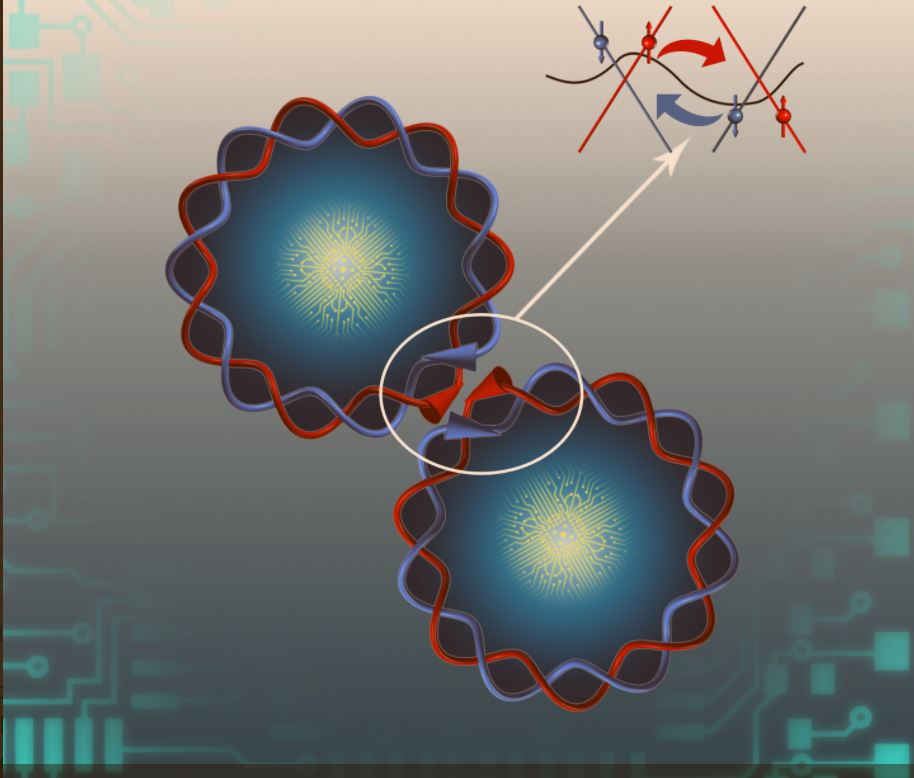
Researchers from the Physical Chemistry Department of the Fritz Haber Institute and the Max Planck Institute for the Structure and Dynamics of Matter in Hamburg have found out that ultrafast switches in material properties can be prompted by laser pulses – and why. This knowledge may enable new transistor concepts.
Making the speed of electronic technology as fast as possible is a central aim of contemporary materials research. The key components of fast computing technologies are transistors: switching devices that turn electrical currents on and off very quickly as basic steps of logic operations...
Images of the Milky Way and the Large Magellanic Cloud (LMC) are overlaid on a map of the surrounding galactic halo. The smaller structure is a wake created by the LMC’s motion through this region. The larger light-blue feature corresponds to a high density of stars observed in the northern hemisphere of our galaxy. Credit: NASA/ESA/JPL-Caltech/Conroy et. al. 2021
The highlight of the new chart is a wake of stars, stirred up by a small galaxy set to collide with the Milky Way. The map could also offer a new test of dark matter theories. Astronomers using data from NASA and ESA (European Space Agency) telescopes have released a new all-sky map of the outermost region of our galaxy. [Editor’s note: See Related Multimedia link below...
Recent Comments