‘Egg Carton’ Quantum Dot Array could lead to Ultralow Power Devices

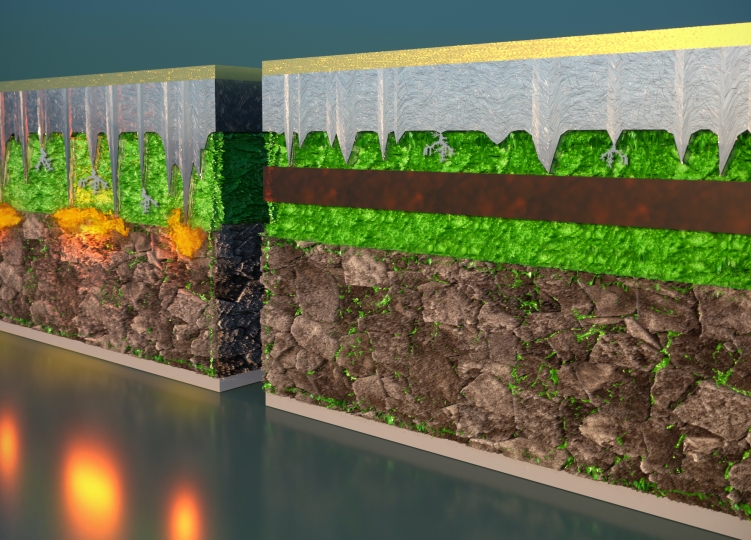
An illustration of the egg crate electronic structure, shown between two mirrors so that the red laser light resonates. The polaritons, trapped in the pockets, are represented by the sum of their parts: a green exciton, with electron and hole shown inside, attached to a red lightwave. Even with just a few excitons in the wells, the energy required to add a new one begins to jump
  An illustration of the egg crate electronic structure, shown between two mirrors so that the red laser light resonates. The polaritons, trapped in the pockets, are represented by the sum of their parts: a green exciton, with electron and hole shown inside, attached to a red lightwave. Even with just a few excitons in the wells, the energy required to add a new one begins to jump. Credit: Long Zhang, Deng Lab, University of Michigan.

A new path toward sending and receiving information with single photons of light has been discovered by an international team of researchers led by the University of Michigan...

Read More

Earth has a Hot New Neighbor – and it’s an Astronomer’s Dream

Artist's impression of the rocky terrain and lava rivers on the surface of Gliese 486b
It’s getting hot in here … 430 degrees Celsius hot, that is. Artist’s interpretation: RenderArea

A rocky planet discovered in the Virgo constellation could change how we look for life in the universe. It could be our best chance yet of studying rocky planet atmospheres outside the solar system, a new international study involving UNSW Sydney shows.

The planet, called Gliese 486b (pronounced Glee-seh), is a ‘super-Earth’: that is, a rocky planet bigger than Earth but smaller than ice giants like Neptune and Uranus. It orbits a red dwarf star around 26 light-years away, making it a close neighbour — galactically speaking.

With a piping-hot surface temperature of 430 degrees Celsius, Gliese 486b is too hot to support human life...

Read More

The Right ‘5-a-day’ Mix is 2 Fruit and 3 Vegetable Servings for Longer Life

Studies representing nearly 2 million adults worldwide show that eating about five daily servings of fruits and vegetables, in which 2 are fruits and 3 are vegetables, is likely the optimal amount for a longer life, according to new research published today in the American Heart Association’s flagship journal Circulation.

Diets rich in fruits and vegetables help reduce risk for numerous chronic health conditions that are leading causes of death, including cardiovascular disease and cancer. Yet, only about one in 10 adults eat enough fruits or vegetables, according to the U.S. Centers for Disease Control and Prevention.

“While groups like the American Heart Association recommend four to five servings each of fruits and vegetables daily, consumers likely get inconsistent messages ...

Read More

Dethroning Electrocatalysts for Hydrogen Production with Inexpensive Alternative Material

Dethroning Electrocatalysts for Hydrogen Production with Inexpensive Alternative Material

Today, we can say without a shadow of doubt that an alternative to fossil fuels is needed. Fossil fuels are not only non-renewable sources of energy but also among the leading causes of global warming and air pollution. Thus, many scientists worldwide have their hopes placed on what they regard as the fuel of tomorrow: hydrogen (H2). Although H2 is a clean fuel with incredibly high energy density, efficiently generating large amounts of it remains a difficult technical challenge.

Water splitting — the breaking of water molecules — is among the most explored methods to produce H2. While there are many ways to go about it, the best-performing water splitting techniques involve electrocatalysts made from expensive metals, such as platinum, ruthenium, and iridium...

Read More