New Quantum Nanodevice can simultaneously act as a Heat Engine and a Refrigerator

image of an engine and a refrigerator
 RIKEN researchers have produced a quantum nanodevice that can behave both as an engine and a refrigerator—at the same time. Left: © Martin Steinthaler/Getty; Right: © lilographik/Getty

A multitasking nanomachine that can act as a heat engine and a refrigerator at the same time has been created by RIKEN engineers. The device is one of the first to test how quantum effects, which govern the behavior of particles on the smallest scale, might one day be exploited to enhance the performance of nanotechnologies.

Conventional heat engines and refrigerators work by connecting two pools of fluid. Compressing one pool causes its fluid to heat up, while rapidly expanding the other pool cools its fluid...

Read More

Ripples in Space-Time could provide clues to Missing Components of the Universe

An illustration of waves blending and creating a distinct new signature. Credit: Ezquiaga and Zumalácarregui

There’s something a little off about our theory of the universe. Almost everything fits, but there’s a fly in the cosmic ointment, a particle of sand in the infinite sandwich. Some scientists think the culprit might be gravity—and that subtle ripples in the fabric of space-time could help us find the missing piece.

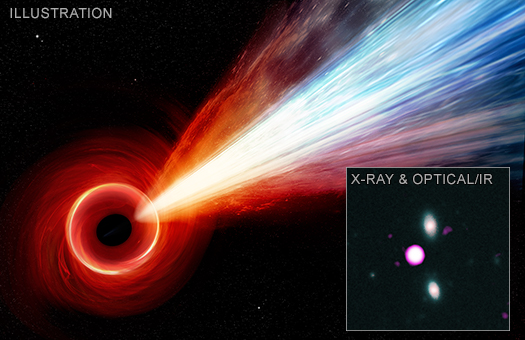
A new paper co-authored by a University of Chicago scientist lays out how this might work. Published Dec. 21 in Physical Review D, the method depends on finding such ripples that have been bent by traveling through supermassive black holes or large galaxies on their way to Earth.

The trouble is that something is making the universe not only expand, but expand...

Read More

New Drug Inhibits the Growth of Cancer cells

Cartoon representation of the POLRMT-Inhibitor complex.
© Hauke S. Hillen

Blocking gene expression in mitochondria in mice stops cancer cells from growing. A newly developed compound starves cancer cells by attacking their “power plants” — the mitochondria. The new compound prevents the genetic information within mitochondria from being read. Researchers from the Max Planck Institute for Biology of Ageing in Cologne, the Karolinska Institute in Stockholm and the University of Gothenburg report in their study that this compound could be used as a potential anti-tumour drug in the future; not only in mice but also in human patients.

Mitochondria provide our cells with energy and cellular building blocks necessary for normal tissue and organ function...

Read More

Extremely Energy Efficient Microprocessor developed using Superconductors

Extremely energy efficient microprocessor developed using superconductors
AQFP MANA microprocessor die photo. MANA is the world’s first adiabatic superconductor microprocessor. Credit: Yokohama National University

Researchers from Yokohama National University in Japan have developed a prototype microprocessor using superconductor devices that are about 80 times more energy efficient than the state-of-the-art semiconductor devices found in the microprocessors of today’s high-performance computing systems.

As today’s technologies become more and more integrated in our daily lives, the need for more computational power is ever increasing. Because of this increase, the energy use of that increasing computational power is growing immensely...

Read More