Developing Smarter, Faster Machine Intelligence with Light

Massively parallel amplitude-only Fourier neural network
A massively parallel amplitude-only Fourier neural network

Researchers at the George Washington University, together with researchers at the University of California, Los Angeles, and the deep-tech venture startup Optelligence LLC, have developed an optical convolutional neural network accelerator capable of processing large amounts of information, on the order of petabytes, per second. This innovation, which harnesses the massive parallelism of light, heralds a new era of optical signal processing for machine learning with numerous applications, including in self-driving cars, 5G networks, data-centers, biomedical diagnostics, data-security and more.

Global demand for machine learning hardware is dramatically outpacing current computing power supplies...

Read More

Compressive Fluctuations Heat Ions in Space Plasma

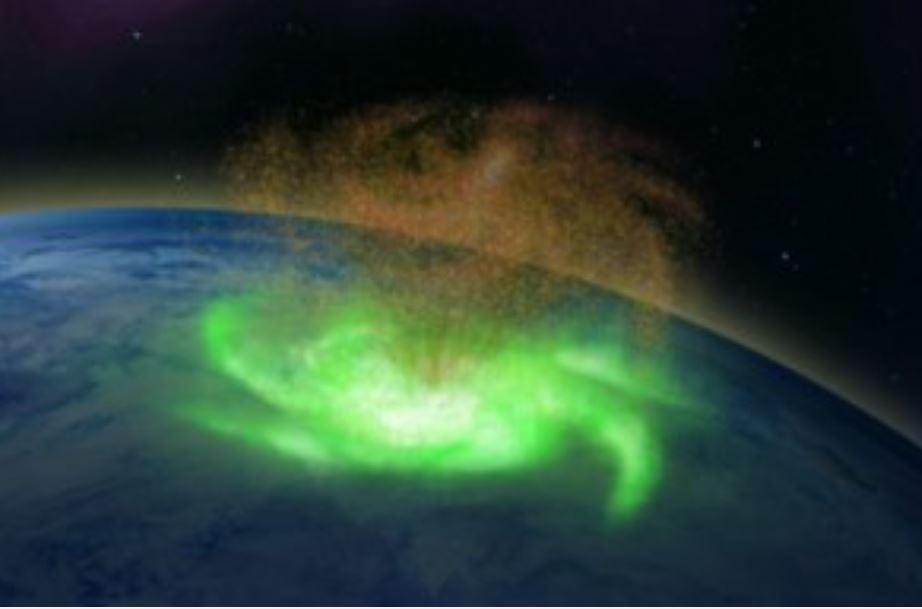
Artist’s impression of the ions and electrons in various space plasmas. (Credit: Yohei Kawazura)

New simulations carried out in part on the Space Plasma in Japan have found that the reason ions exist at higher temperatures than electrons in space plasma is because they are better able to absorb energy from compressive turbulent fluctuations in the plasma. These finding have important implications for understanding observations of various astronomical objects such as the images of the accretion disk and shadow of the M87 supermassive black hole captured by the Event Horizon Telescope.

In addition to the normal three states of matter (solid, liquid, and gas) which we see around us every day, there is an additional state called plasma which exists only at high temperatures...

Read More

Scientists create Entangled Photons 100 times more Efficiently than previously possible

Yuping Huang and colleagues at Stevens Institute of Technology demonstrate a quantum circuit that can readily be integrated with other optical components, paving the way for high-speed, reconfigurable, and multifaceted quantum devices.

Super-fast quantum computers and communication devices could revolutionize countless aspects of our lives — but first, researchers need a fast, efficient source of the entangled pairs of photons such systems use to transmit and manipulate information. Researchers at Stevens Institute of Technology have done just that, not only creating a chip-based photon source 100 times more efficient that previously possible, but bringing massive quantum device integration within reach.

“It’s long been suspected that this was possible in theory, but we’re the first...

Read More

Longest Intergalactic Gas Filament discovered

Right click to download: Optical image
Optical image
of the Abell 3391/95 system © Reiprich et al., Astronomy & Astrophysics

Study confirms models on the evolution of our universe. Astrophysicists have for the first time observed a gas filament with a length of 50 million light years. Its structure is strikingly similar to the predictions of computer simulations. The observation therefore also confirms our ideas about the origin and evolution of our universe.

More than half of the matter in our universe has so far remained hidden from us. However, astrophysicists had a hunch where it might be: In so-called filaments, unfathomably large thread-like structures of hot gas that surround and connect galaxies and galaxy clusters...

Read More