Next step in Simulating the Universe

Researchers led by the University of Tsukuba devise a new approach to show how ghost-like neutrinos helped shape the Universe

New approach to show how ghost-like neutrinos helped shape the Universe. Computer simulations have struggled to capture the impact of elusive particles called neutrinos on the formation and growth of the large-scale structure of the Universe. But now, a research team from Japan has developed a method that overcomes this hurdle.

In a study published this month in The Astrophysical Journal, researchers led by the University of Tsukuba present simulations that accurately depict the role of neutrinos in the evolution of the Universe.

Why are these simulations important? One key reason is that they can set constraints on a currently unknown quantity: the neutri...

Read More

Telomere Shortening Protects Against Cancer

teleomeresgenericbig
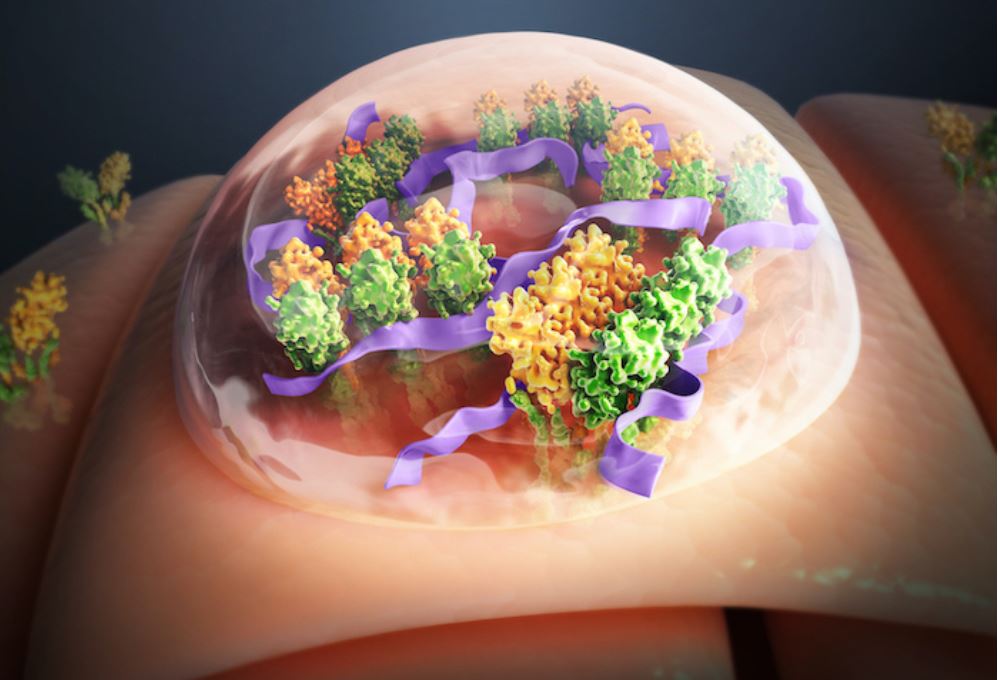
Human telomeres (green) at the ends of chromosomes (blue).

Researchers have found the first evidence that telomere shortening is not just a sign of aging, but a key component of the body’s cancer prevention system. As time goes by, the tips of your chromosomes — called telomeres — become shorter. This process has long been viewed as an unwanted side-effect of aging, but a recent study shows it is in fact good for you.

“Telomeres protect the genetic material,” says Titia de Lange, Leon Hess Professor at Rockefeller. “The DNA in telomeres shortens when cells divide, eventually halting cell division when the telomere reserve is depleted.”

New results from de Lange’s lab provide the first evidence that telomere shortening helps prevent cancer in humans, likely because of its power to...

Read More

T-Ray Technology reveals what’s getting Under your Skin

T-ray technology reveals what’s getting under your skin
A demonstration of how the T-ray equipment can be used to scan an individual’s skin. Credit: University of Warwick

A new method for analysing the structure of skin using a type of radiation known as T-rays could help improve the diagnosis and treatment of skin conditions such as eczema, psoriasis and skin cancer.

Scientists from the University of Warwick and The Chinese University of Hong Kong (CUHK) have shown that using a method that involves analysing T-rays fired from several different angles, they can build a more detailed picture of the structure of an area of skin and how hydrated it is than current methods allow.

Their method is reported in Advanced Photonics Research and could provide a new tool for scientists and clinicians for characterising the properties of skin in...

Read More

Experiments unravelling the Mystery of Mars’ Moon Phobos. What causes the Weathering of the Mars moon Phobos?

© NASA/JPL-Caltech/University of Arizona

There is no weather in space – but there is weathering: Celestial bodies are bombarded by high energy particles. On the Mars moon Phobos, the situation is complicated: It is hit by particles from the sun, but it is partly shielded by Mars. New experiments explain what is going on, in 2024 a space mission will reach Phobos and check the results.

Of course, there is no weather in our sense of the word in space — nevertheless, soil can also “weather” in the vacuum of space if it is constantly bombarded by high-energy particles, such as those emitted by the sun...

Read More