
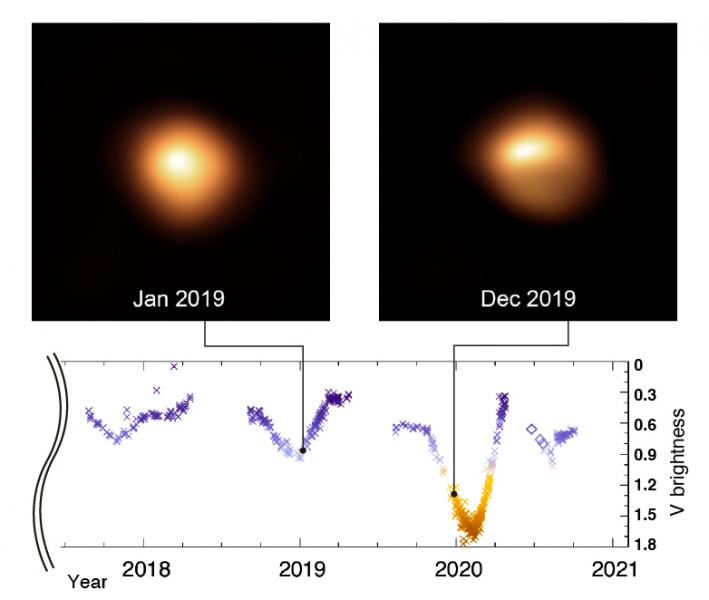
Recalibrated its mass, radius, and distance. Betelgeuse is normally one of the brightest, most recognizable stars of the winter sky, marking the left shoulder of the constellation Orion...
Read More


Until we recognize the essential role of biology, our attempts to truly unify the universe will remain a train to nowhere. ~Robert Lanza Read More

Good health is not something we can buy. However, it can be an extremely valuable savings account. ~Anne Wilson Schaef Read More

The only way forward, if we are going to improve the quality of the environment, is to get everybody involved. ~Richard Rogers Read More

To raise new questions, new possibilities, to regard old problems from a new angle, requires creative imagination and marks real advance in science. ~Albert Einstein Read More

Old Newtonian physics claimed that things have an objective reality separate from our perception of them. Quantum physics, and particularly Heisenberg's Uncertainty Principle, reveal that, as our perception of an object changes, the object itself literally changes. ~Marianne Williamson Read More

Astronomy compels the soul to look upwards and leads us from this world to another. ~ Read More
February 10, 2021,
 Astronomy/Space
Recalibrated its mass, radius, and distance. Betelgeuse is normally one of the brightest, most recognizable stars of the winter sky, marking the left shoulder of the constellation Orion...
Read More
February 8, 2021,
Biology/Biotechnology, Health/Medical
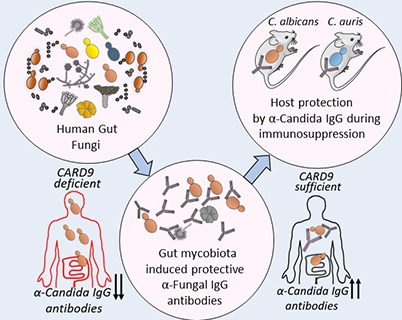
Common fungi, often present in the gut, teach the immune system how to respond to their more dangerous relatives, according to new research from scientists at Weill Cornell Medicine. Breakdowns in this process can leave people susceptible to deadly fungal infections.
The study, published Feb. 5 in Cell, reveals a new twist in the complex relationship between humans and their associated microbes, and points the way toward novel therapies that could help combat a rising tide of drug-resistant pathogens.
The new discovery stemmed from work on inflammatory bowel disease, which often causes patients to carry larger than normal populations of fungi in their guts...
Read More
February 8, 2021,
Physics
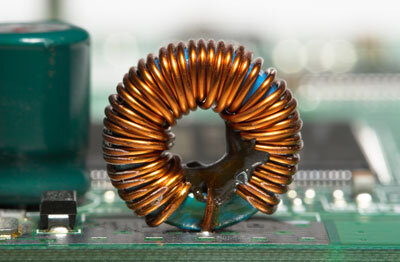
Mobile-phone chargers and other devices could become much smaller after an all-RIKEN team of physicists successfully shrunk an electrical component known as an inductor to microscale dimensions using a quantum effect.
Inductors are a basic component of modern electrical circuits, and they are used in a wide range of applications including information processing, wireless circuits and chargers for mobile devices. They are based on the law of induction that English physicist Michael Faraday discovered in 1831...
Read More
February 8, 2021,
Astronomy/Space

Astronomers have for the first time used distant galaxies as ‘scintillating pins’ to locate and identify a piece of the Milky Way’s missing matter.
For decades, scientists have been puzzled as to why they couldn’t account for all the matter in the universe as predicted by theory. While most of the universe’s mass is thought to be mysterious dark matter and dark energy, 5 percent is ‘normal matter’ that makes up stars, planets, asteroids, peanut butter and butterflies. This is known as baryonic matter.
However, direct measurement has only accounted for abo...
Read More
Recent Comments