






‘Galaxy-sized’ Observatory sees potential hints of Gravitational Waves

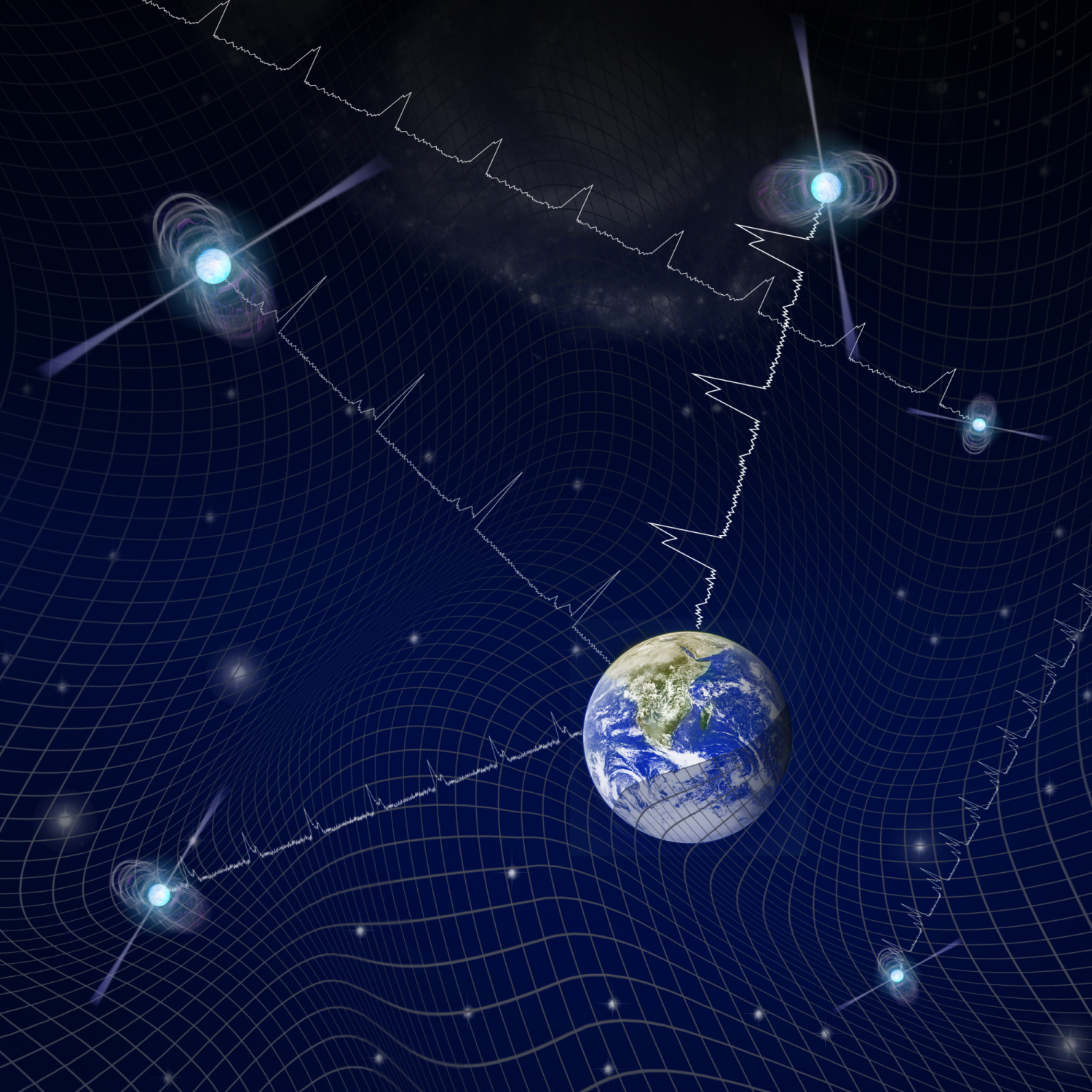
Graphic showing pulsar light traveling to Earth amid a sea of gravitational waves. (Credit: NANOGrav/T. Klein)

Scientists have used a “galaxy-sized” space observatory to find possible hints of a unique signal from gravitational waves, or the powerful ripples that course through the universe and warp the fabric of space and time itself.

The new findings, which appeared recently in The Astrophysical Journal Letters, hail from a U.S. and Canadian project called the North American Nanohertz Observatory for Gravitational Waves (NANOGrav).

For over 13 years, NANOGrav researchers have pored over the light streaming from dozens of pulsars spread throughout the Milky Way Galaxy to try to detect a “gravitational wave background...

Read More


Botulism Breakthrough? Taming botulinum toxin to deliver therapeutics

botulism treatment
The toxin-based delivery platform consists of the modified botulinum toxin at upper left (protease domain in gold, translocation domain in blue, and receptor-binding domain in purple) and the nanobody (the pink tag). When this nanobody-toxin fusion protein binds to the receptor (cyan) on the neuron surface, the cell takes it in through the process of endocytosis, corralling the fusion protein inside a vesicle (light green circle). The toxin’s protease domain, carrying the nanobody, then crosses into the interior of the cell. (Image: Sicai Zhang/Dong Lab, Boston Children’s Hospital)

Treatment reverses paralysis in mice; offers a general delivery platform for neurologic drugs. Currently there’s no treatment for botulism once the toxin gets into neurons...

Read More

Mighty Morphing 3D Printing

Engineers demonstrate a new shape-changing nozzle that could revolutionize ‘4D printing’ applications. Engineers at the University of Maryland (UMD) have created a new shape-changing or “morphing” 3D printing nozzle that was featured as a Frontispiece in the January 5th issue of the journal Advanced Materials Technologies.

The team’s morphing nozzle offers researchers new means for 3D printing “fiber-filled composites” — materials made up of short fibers that boost special properties over traditional 3D-printed parts, such as enhancing part strength or electrical conductivity. The challenge is that these properties are based on the directions or “orientations” of the short fibers, which has been difficult to control during the 3D printing process, until now.

“When 3D printing wi...

Read More

Chandra Studies Extraordinary Magnetar

This image contains an exceptional magnetar, a type of neutron star with very powerful magnetic fields.

In 2020, astronomers added a new member to an exclusive family of exotic objects with the discovery of a magnetar. New observations from NASA’s Chandra X-ray Observatory help support the idea that it is also a pulsar, meaning it emits regular pulses of light.

Magnetars are a type of neutron star, an incredibly dense object mainly made up of tightly packed neutron, which forms from the collapsed core of a massive star during a supernova.

What sets magnetars apart from other neutron stars is that they also have the most powerful known magnetic fields in the universe. For context, the strength of our planet’s magnetic field has a value of about one Gauss, while a refrigerator magnet measures about 100 Gauss...

Read More