





Putty-like Composites of Gallium metal with potential for Real-World Application

Figure 1.
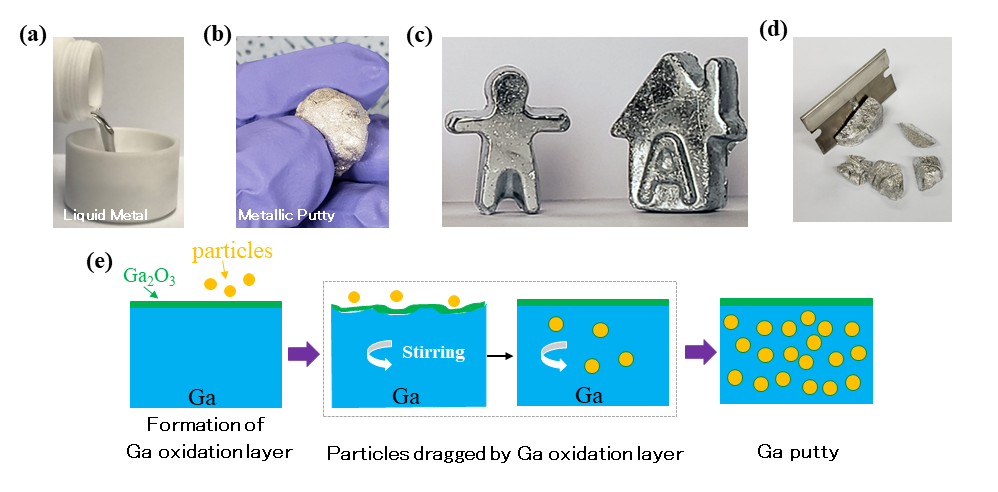
. (a) Liquid gallium being poured into a container. (b) Gallium putty being molded into a ball. (c) Various figures made from gallium putty. (d) Gallium putty being cut by a blade. (e) The mechanism of formation of gallium putty involves filler particles being encapsulated by a gallium oxide layer and incorporated into the gallium.

Researchers created a novel functional composite of gallium with putty or paste-like physical properties. The composite possesses excellent electromagnetic shielding as well as thermal conductivity. Gallium is a highly useful element that has accompanied the advancement of human civilization throughout the 20th century. Gallium is designated as a technologically critical element, as it is essential for the fabrication of semiconductors and transistors...

Read More

Astronomers agree: Universe is nearly 14 billion years old

Squiggly colored lines, look very abstract
A portion of a new picture of the oldest light in the universe taken by the Atacama Cosmology Telescope. This part covers a section of the sky 50 times the moon’s width, representing a region of space 20 billion light-years across. The light, emitted just 380,000 years after the Big Bang, varies in polarization (represented here by redder or bluer colors). Astrophysicists used the spacing between these variations to calculate a new estimate for the universe’s age. Credit: ACT Collaboration

From an observatory high above Chile’s Atacama Desert, astronomers have taken a new look at the oldest light in the universe. Their observations, plus a bit of cosmic geometry, suggest that the universe is 13.77 billion years old – give or take 40 million years...

Read More

A Giant Black Hole keeps Evading Detection and scientists can’t explain it

This composite image of the galaxy cluster Abell 2261 contains optical data from NASA's Hubble Space Telescope and Japan's Subaru Telescope showing galaxies in the cluster and in the background, and data from NASA's Chandra X-ray Observatory showing hot gas (colored pink) pervading the cluster. The middle of the image shows the large elliptical galaxy in the center of the cluster.
This composite image of the galaxy cluster Abell 2261 contains optical data from NASA’s Hubble Space Telescope and Japan’s Subaru Telescope showing galaxies in the cluster and in the background, and data from NASA’s Chandra X-ray Observatory showing hot gas (colored pink) pervading the cluster. The middle of the image shows the large elliptical galaxy in the center of the cluster.
(Image: © X-ray: NASA/CXC/Univ of Michigan/K. Gültekin; Optical: NASA/STScI/NAOJ/Subaru; Infrared: NSF/NOAO/KPNO)

An enormous black hole keeps slipping through astronomers’ nets. Supermassive black holes are thought to lurk at the hearts of most, if not all, galaxies...

Read More

New research may explain Severe Virus Attacks on the Lungs

The development of human macrophages.
The development of human macrophages. Illustration: The research team.

In some cases, immune cells in the lungs can contribute to worsening a virus attack. In a new study, researchers at Karolinska Institutet in Sweden describe how different kinds of macrophages, develop in the lungs and which of them may be behind severe lung diseases. The study, which was published in Immunity, may contribute to future treatments for COVID-19, among other diseases.

The structure of the lungs exposes them to viruses and bacteria from both the air and the blood. Macrophages are immune cells that, among other things, protect the lungs from such attacks...

Read More