To raise new questions, new possibilities, to regard old problems from a new angle, requires creative imagination and marks real advance in science.
~Albert Einstein
Read More
Old Newtonian physics claimed that things have an objective reality separate from our perception of them. Quantum physics, and particularly Heisenberg's Uncertainty Principle, reveal that, as our perception of an object changes, the object itself literally changes.
~Marianne Williamson
Read More
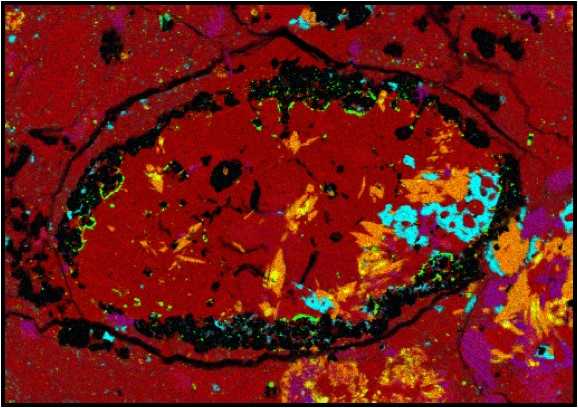
SwRI scientists studied the composition of a small shard of a meteoroid to determine that it likely originated from a previously unknown parent asteroid. This false-color micrograph of the meteoroid sample shows the unexpected amphibole crystals identified in orange.Courtesy of NASA/USRA/Lunar and Planetary Institute
Mineralogy points to large, water-rich parent asteroid for carbonaceous chondrite meteorite. A Southwest Research Institute-led team of scientists has identified a potentially new meteorite parent asteroid by studying a small shard of a meteorite that arrived on Earth a dozen years ago...
The S1 protein likely causes the brain to release inflammatory products causing a storm in the brain, researchers said. Alice Gray
A new study shows how spike protein crosses the blood-brain barrier. The SARS-CoV-2 virus, like many viruses before it, is bad news for the brain. In a new study, researchers found that the spike protein, often depicted as the red arms of the virus, can cross the blood-brain barrier in mice. The spike proteins alone can cause brain fog. Since the spike protein enters the brain, the virus also is likely to cross into the brain.
In a study published Dec.16 in Nature Neuroscience, researchers found that the spike protein, often depicted as the red arms of the virus, can cross the blood-brain barrier in mice. This strongly suggests that SARS-CoV-2, the cause ...
A massively parallel amplitude-only Fourier neural network
Researchers at the George Washington University, together with researchers at the University of California, Los Angeles, and the deep-tech venture startup Optelligence LLC, have developed an optical convolutional neural network accelerator capable of processing large amounts of information, on the order of petabytes, per second. This innovation, which harnesses the massive parallelism of light, heralds a new era of optical signal processing for machine learning with numerous applications, including in self-driving cars, 5G networks, data-centers, biomedical diagnostics, data-security and more.
Global demand for machine learning hardware is dramatically outpacing current computing power supplies...
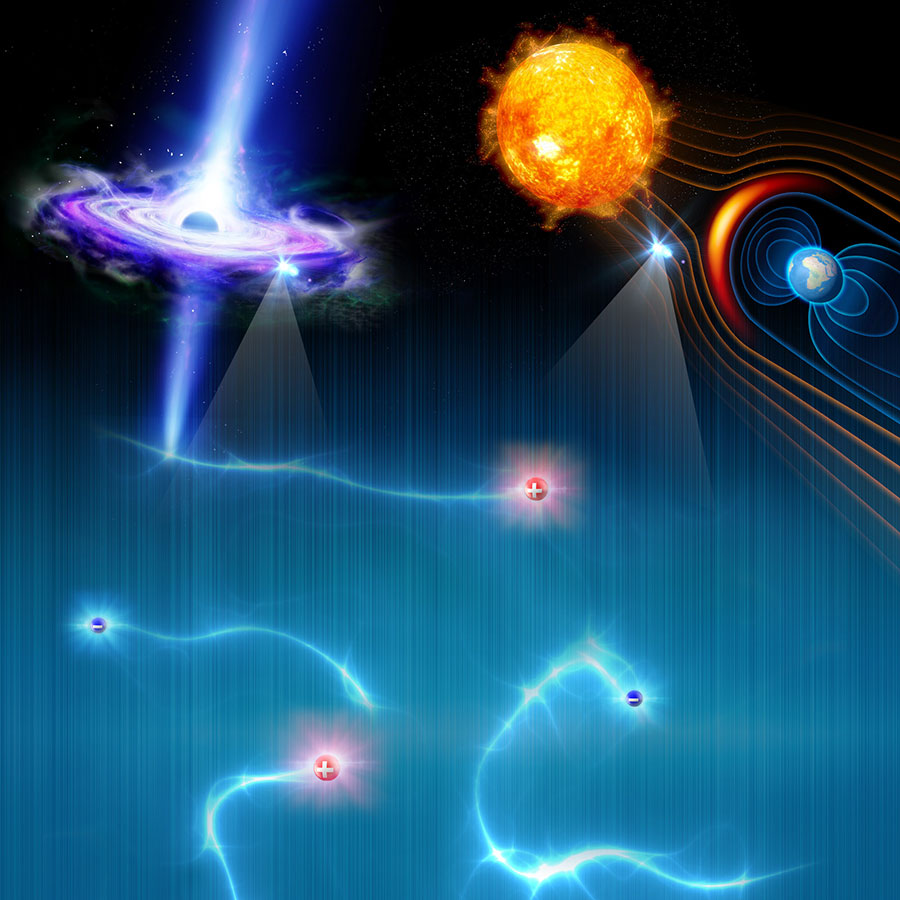
Artist’s impression of the ions and electrons in various space plasmas. (Credit: Yohei Kawazura)
New simulations carried out in part on the Space Plasma in Japan have found that the reason ions exist at higher temperatures than electrons in space plasma is because they are better able to absorb energy from compressive turbulent fluctuations in the plasma. These finding have important implications for understanding observations of various astronomical objects such as the images of the accretion disk and shadow of the M87 supermassive black hole captured by the Event Horizon Telescope.
In addition to the normal three states of matter (solid, liquid, and gas) which we see around us every day, there is an additional state called plasma which exists only at high temperatures...













Recent Comments