To raise new questions, new possibilities, to regard old problems from a new angle, requires creative imagination and marks real advance in science.
~Albert Einstein
Read More
Old Newtonian physics claimed that things have an objective reality separate from our perception of them. Quantum physics, and particularly Heisenberg's Uncertainty Principle, reveal that, as our perception of an object changes, the object itself literally changes.
~Marianne Williamson
Read More
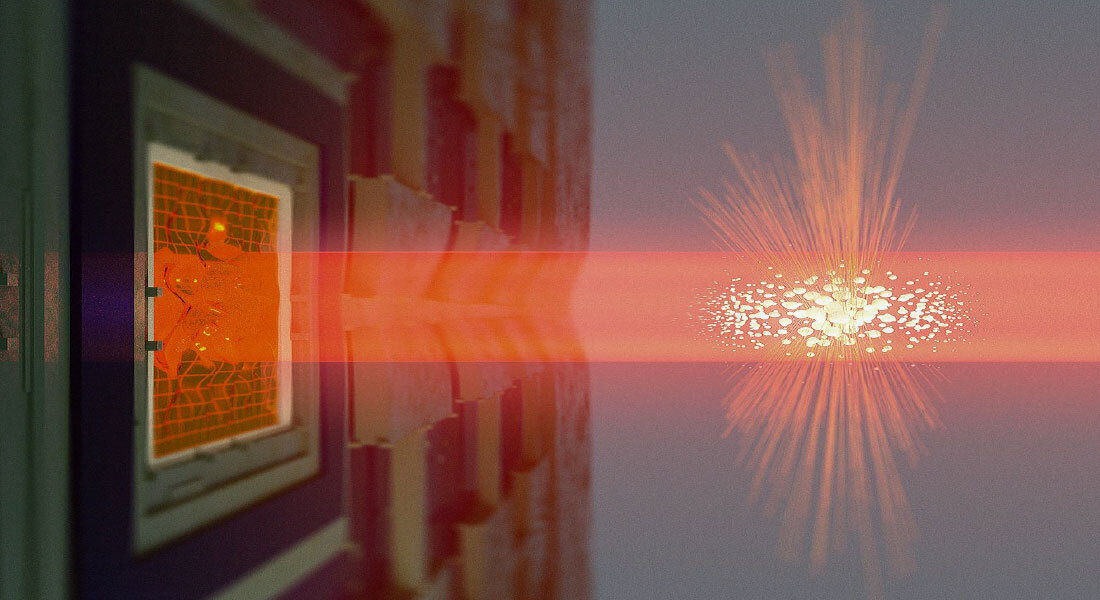
Light propagates through the atomic cloud shown in the center and then falls onto the SiN membrane shown on the left. As a result of interaction with light the precession of atomic spins and vibration of the membrane become quantum correlated. This is the essence of entanglement between the atoms and the membrane. Credit: Niels Bohr Institute
A team of researchers at the Niels Bohr Institute, University of Copenhagen, have succeeded in entangling two very different quantum objects. The result has several potential applications in ultra-precise sensing and quantum communication and is now published in Nature Physics.
Entanglement is the basis for quantum communication and quantum sensing...
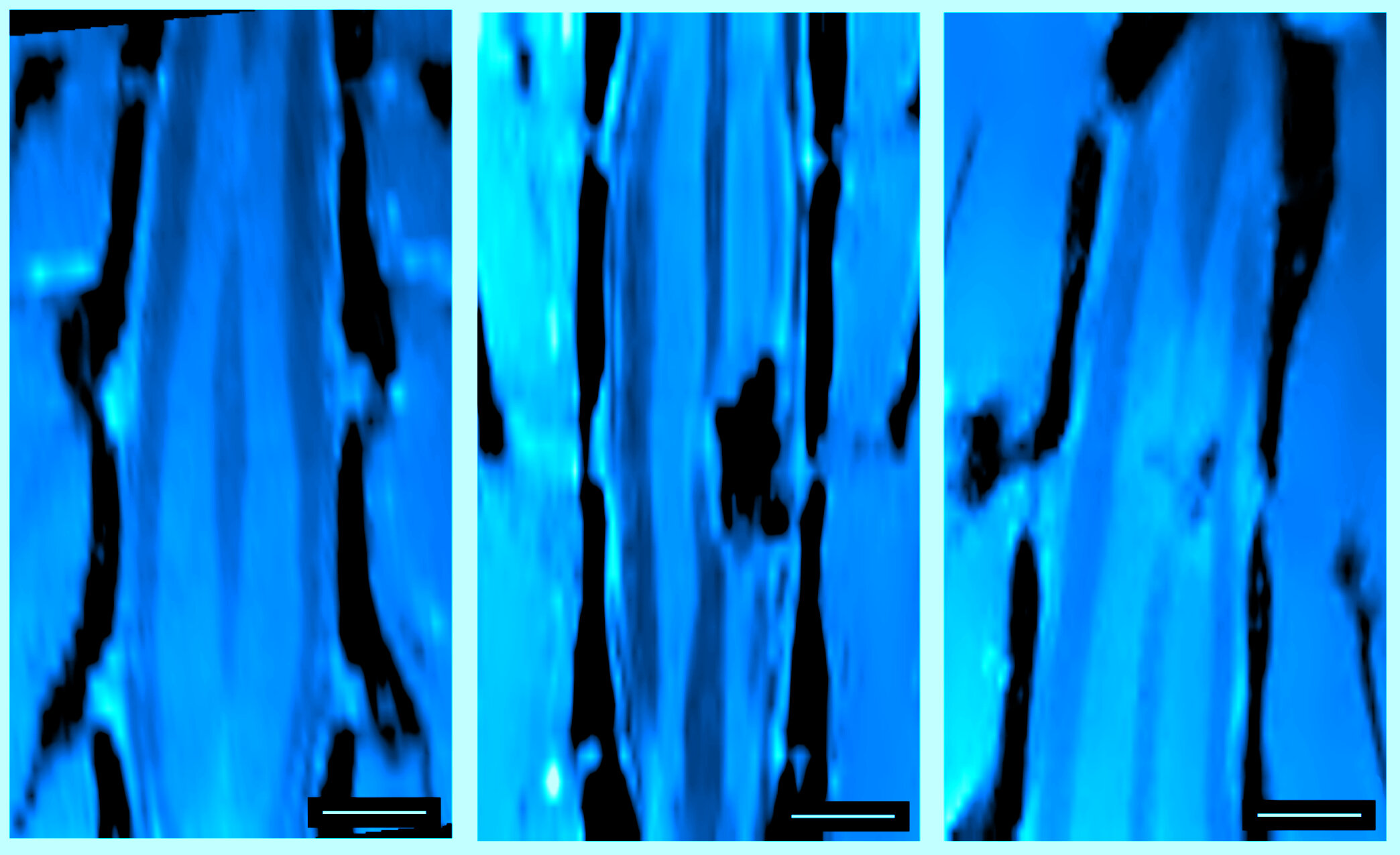
From left to right: image of a healthy backbone (control); image of an injured backbone without an implant; image of an injured backbone in which the biocompatible nanomaterial has been implanted and where the neuronal reconnection can be observed. Credit: Author: Pedro Ramos / CIC biomaGUNE
Research conducted by two groups at the Center for Cooperative Research in Biomaterials CIC biomaGUNE and one at SISSA, Scuola Internazionale Superiore di Studi Avanzati (Italy), have shown that functional materials based on carbon nanotubes facilitate the reconnecting of neuronal networks damaged as a result of spinal cord injuries...
3D illustration of one phase of the life cycle of the parasite that causes cutaneous leishmaniasis Illustration: Shutterstock.com
Scientists use CRISPR to edit structural gene in organism that causes leishmaniasis. Scientists are planning for Phase 1 human trials of a vaccine they developed by using CRISPR gene-editing technology to mutate the parasite that causes leishmaniasis, a skin disease common in tropical regions of the world and gaining ground in the United States.
“If you assure protection in the sand fly model, then you have a good shot at a real vaccine,” said Abhay Satoskar, a co-lead investigator of the work and professor of pathology and microbiology at The Ohio State University.
The team applied the new technology to the century-old Middle Eastern practice of le...
Observations with the space telescope reveal details of the exoplanet WASP-189b – one of the most extreme planets known. Eight months after the space telescope CHEOPS started its journey into space, the first scientific publication using data from CHEOPS has been issued. CHEOPS is the first ESA mission dedicated to characterising known exoplanets. Exoplanets, i.e...












Recent Comments