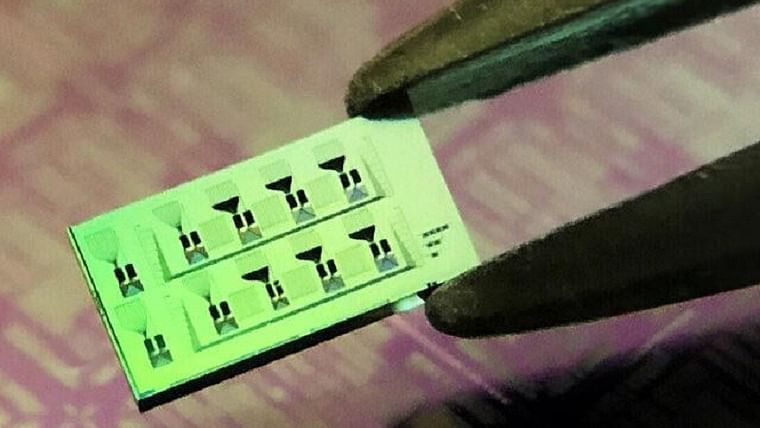
Implantable Transmitter provides Wireless option for Biomedical devices

A Purdue University team developed a fully implantable transmitter chip for wireless sensor nodes and biomedical devices. (Image provided)

Purdue University innovators are working on inventions to use micro-chip technology in implantable devices and other wearable products such as smart watches to improve biomedical devices, including those used to monitor people with glaucoma and heart disease.

The Purdue team developed a fully implantable radio-frequency transmitter chip for wireless sensor nodes and biomedical devices. The research is published in the journal IEEE Transactions on Circuits and Systems II. The transmitter chip consumes lowest amount of energy per digital bit published to date.

The transmitter works in a similar fashion to communication technology in mobile phone...

Read More

Surprisingly Dense Exoplanet challenges Planet Formation theories

noirlab2018a – Artist’s impression of K2-25b
New detailed observations with NSF’s NOIRLab facilities reveal a young exoplanet, orbiting a young star in the Hyades cluster, that is unusually dense for its size and age. Slightly smaller than Neptune, K2-25b orbits an M-dwarf star — the most common type of star in the galaxy — in 3.5 days.
Credit: NOIRLab/NSF/AURA/J. Pollard

Small telescope and inexpensive diffuser key to results. New detailed observations with NSF’s NOIRLab facilities reveal a young exoplanet, orbiting a young star in the Hyades cluster, that is unusually dense for its size and age. Weighing in at 25 Earth-masses, and slightly smaller than Neptune, this exoplanet’s existence is at odds with the predictions of leading planet formation theories.

New observations...

Read More

Transferrin identified as Potential Contributor to COVID-19 Severity

Could transferrin be a potential biomarker for COVID-19 severity?

The University of Kent’s School of Biosciences and the Institute of Medical Virology at Goethe-University, Frankfurt am Main, have identified that a glycoprotein known as transferrin may critically contribute to severe forms of COVID-19.

SARS-CoV-2 is the coronavirus that causes COVID-19. It is currently not known why some individuals develop only mild or no symptoms when infected, whilst others experience severe, life-threatening forms of the disease. However, it is known that the risk of COVID-19 becoming severe increases with age and is higher in males than in females. Many severe COVID-19 cases are characterised by increased blood clotting and thrombosis formation.

The team combined existing data on gene expres...

Read More

Simplified Circuit Design could Revolutionize how Wearables are manufactured

Credit: GETTY IMAGES

Researchers have demonstrated the use of a ground-breaking circuit design that could transform manufacturing processes for wearable technology.

Silicon-based electronics have aggressively become smaller and more efficient over a short period of time, leading to major advances in devices such as mobile phones. However, large-area electronics, such as display screens, have not seen similar advances because they rely on a device, thin-film transistor (TFT), which has serious limitations.

In a study published by IEEE Sensors Journal, researchers from the University of Surrey, University of Cambridge and the National Research Institute in Rome have demonstrated the use of a pioneering circuit design that uses an alternative type of device, the source-gated transis...

Read More