






LIGO-Virgo-KAGRA detect most massive black hole merger to date

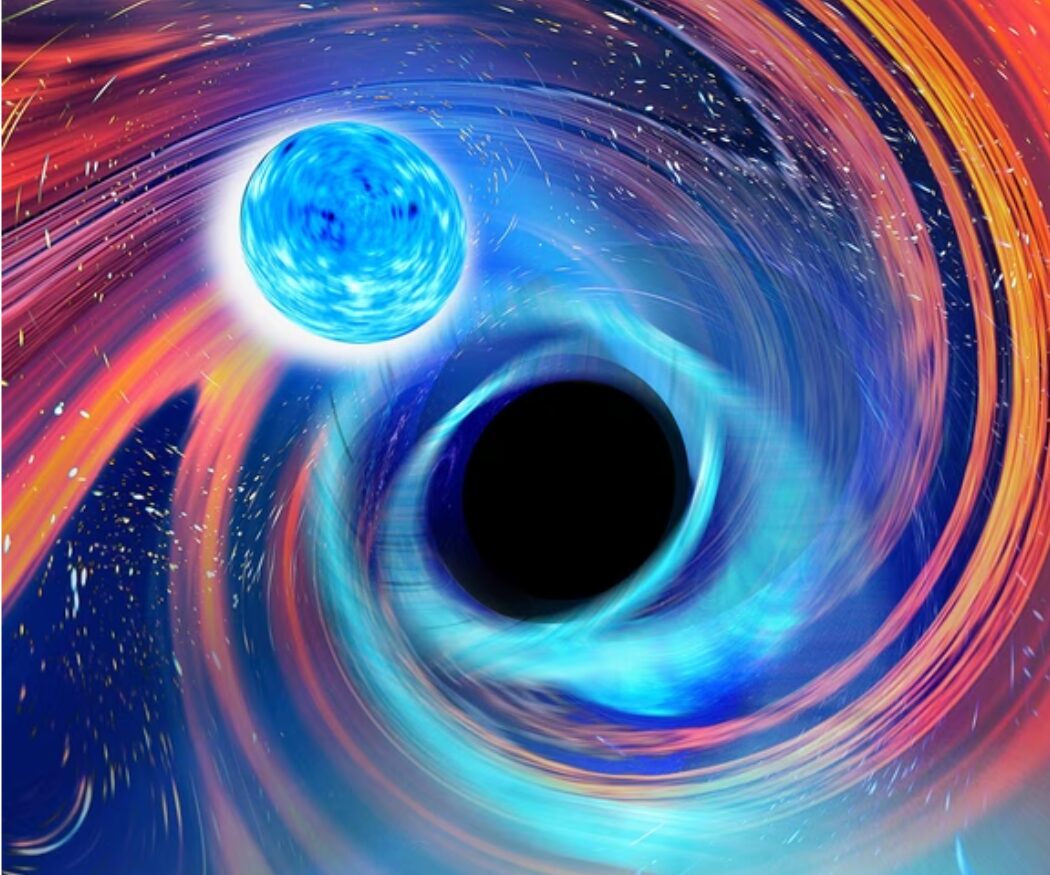
Artwork of a neutron star–black hole merger.
Credit: Carl Knox, OzGrav-Swinburne University

The LIGO-Virgo-KAGRA (LVK) Collaboration has detected the merger of the most massive black holes ever observed with gravitational waves using the LIGO observatories. The powerful merger produced a final black hole approximately 225 times the mass of our sun. The signal, designated GW231123, was detected during the fourth observing run of the LVK network on November 23, 2023.

LIGO, the Laser Interferometer Gravitational-wave Observatory, made history in 2015 when it made the first-ever direct detection of gravitational waves, ripples in space-time. In that case, the waves emanated from a black hole merger that resulted in a final black hole 62 times the mass of our sun...

Read More

Universal stem cells reset immunity in a systemic sclerosis patient

Universal stem cells reset immunity in a systemic sclerosis patient
Graphical abstract. Credit: Cell (2025). DOI: 10.1016/j.cell.2025.05.038

Research led by Naval Medical University’s Changzheng Hospital in China reports that an off-the-shelf cell therapy built from induced pluripotent stem cells (iPSCs) loosened life-limiting skin and organ scarring in a woman with systemic sclerosis.

Systemic sclerosis progressively suffocates tissue through immune misfires, collapsed micro-vessels, and runaway collagen conditions that resist standard immunosuppressants, biologics, and anti-fibrotic drugs while driving a 40% 10-year mortality.

Cell-based approaches such as hematopoietic-stem-cell transplants and CAR-T therapies have shown promise but carry high toxicity or labor-intensive custom manufacturing, leaving clinicians and patients in search of safe...

Read More

Autonomous gallbladder removal: Robot performs first realistic surgery without human help

Robot performs 1st realistic surgery without human help
The robot used with the Surgical Robot Transformer-Hierarchy to perform gallbladder surgery. Credit: XinHao Chen/Johns Hopkins University

A robot trained on videos of surgeries performed a lengthy phase of a gallbladder removal without human help. The robot operated for the first time on a lifelike patient, and during the operation, responded to and learned from voice commands from the team—like a novice surgeon working with a mentor.

The robot performed unflappably across trials and with the expertise of a skilled human surgeon, even during unexpected scenarios typical in real-life medical emergencies.

The work, led by Johns Hopkins University researchers, is a transformative advancement in surgical robotics, where robots can perform with both mechanical precision and human-li...

Read More

Life on Venus? Probe mission could search Venus clouds for unexplained hydrogen-rich gases

Life on Venus? UK probe could reveal the answer
An artist’s impression of the proposed VERVE mission to Venus the answer whether tiny bacterial lifeforms really do exist in the planet’s clouds. Credit: Danielle Futselaar

The answer to whether tiny bacterial life-forms really do exist in the clouds of Venus could be revealed once and for all by a UK-backed mission.

Over the past five years, researchers have detected the presence of two potential biomarkers—the gases phosphine and ammonia—which on Earth can only be produced by biological activity and industrial processes.

Their existence in the Venusian clouds cannot easily be explained by known atmospheric or geological phenomena, so Cardiff University’s Professor Jane Greaves and her team are plotting a way to get to the bottom of it.

Revealing a new mission concept at ...

Read More
