






Scientists use Light to Accelerate Supercurrents, access Forbidden Light, Quantum World

This illustration shows light wave acceleration of supercurrents, which gives researchers access to a new class of quantum phenomena. That access could chart a path forward for practical quantum computing, sensing and communicating applications. Larger image. Image courtesy of Jigang Wang.

Scientists are using light waves to accelerate supercurrents and access the unique properties of the quantum world, including forbidden light emissions that one day could be applied to high-speed, quantum computers, communications and other technologies.

The scientists have seen unexpected things in supercurrents – electricity that moves through materials without resistance, usually at super cold temperatures – that break symmetry and are supposed to be forbidden by the conventional laws of physic...

Read More
NASA’s Curiosity Rover finds clues to chilly Ancient Mars buried in Rocks

This graphic depicts paths by which carbon has been exchanged among Martian interior, surface rocks, polar caps, waters and atmosphere, and it also depicts a mechanism by which it is lost from the atmosphere.
Credits: Lance Hayashida/Caltech

By studying the chemical elements on Mars today — including carbon and oxygen — scientists can work backwards to piece together the history of a planet that once had the conditions necessary to support life.

Weaving this story, element by element, from roughly 140 million miles (225 million kilometers) away is a painstaking process. But scientists aren’t the type to be easily deterred...

Read More

Scientists find Brain Center that ‘Profoundly’ Shuts Down Pain

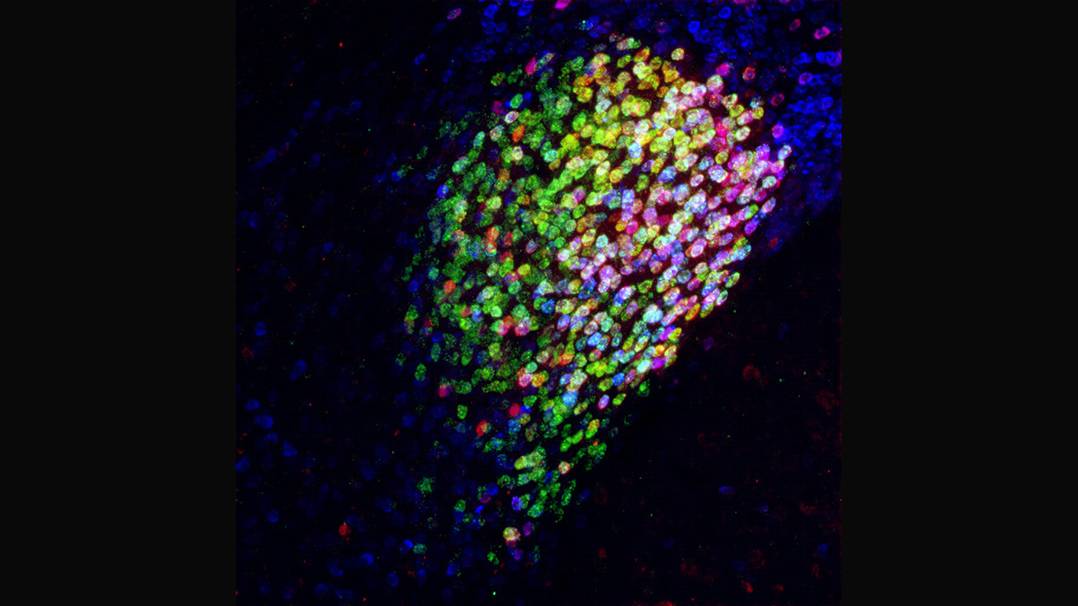
Neuron cells in the central amygdala of a mouse brain. Red, magenta and yellow cells (but not green or blue) are parts of a collection of neurons called the CeAga that has potent pain-suppression abilities. (Fan Wang Lab)

A Duke University research team has found a small area of the brain in mice that can profoundly control the animals’ sense of pain.

Somewhat unexpectedly, this brain center turns pain off, not on. It’s also located in an area where few people would have thought to look for an anti-pain center, the amygdala, which is often considered the home of negative emotions and responses, like the fight or flight response and general anxiety.

“People do believe there is a central place to relieve pain, that’s why placebos work,” said senior author Fan Wang, the Morris N...

Read More

Early Bird uses 10 times Less Energy to Train Deep Neural Networks

Rice University’s Early Bird method for training deep neural networks finds key connectivity patterns early in training, reducing the computations and carbon footprint for the increasingly popular form of artificial intelligence known as deep learning. (Graphic courtesy of Y. Lin/Rice University)

Novel training method could shrink carbon footprint for greener deep learning. Engineers have found a way to train deep neural networks for a fraction of the energy required today. Their Early Bird method finds key network connectivity patterns early in training, reducing the computations and carbon footprint for training deep learning.

Early Bird is an energy-efficient method for training deep neural networks (DNNs), the form of artificial intelligence (AI) behind self-driving cars, inte...

Read More