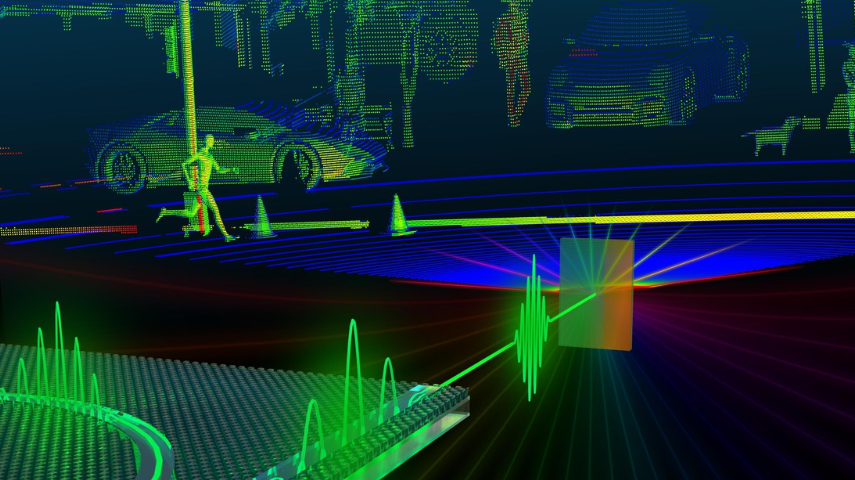
New Metasurface Laser produces world’s first Super-Chiral Light

Laser opens up a new world of applications using optical control of physical objects. Researchers have demonstrated the world’s first metasurface laser that produces “super-chiral light”: light with ultra-high angular momentum. The light from this laser can be used as a type of “optical spanner” to or for encoding information in optical communications.

“Because light can carry angular momentum, it means that this can be transferred to matter. The more angular momentum light carries, the more it can transfer. So you can think of light as an ‘optical spanner’,” Professor Andrew Forbes from the School of Physics at the University of the Witwatersrand (Wits) in Johannesburg, South Africa, who led the research...

Read More

Hubble captures Breakup of Comet ATLAS

The NASA/ESA Hubble Space Telescope has provided astronomers with the sharpest view yet of the breakup of Comet C/2019 Y4 (ATLAS). The telescope resolved roughly 30 fragments of the fragile comet on 20 April and 25 pieces on 23 April.

The NASA/ESA Hubble Space Telescope has provided astronomers with the sharpest view yet of the breakup of Comet C/2019 Y4 (ATLAS). The telescope resolved roughly 30 fragments of the fragile comet on 20 April and 25 pieces on 23 April.

The comet was first discovered in December 2019 by the ATLAS (Asteroid Terrestrial-impact Last Alert System) robotic astronomical survey system in Hawaiʻi, USA...

Read More

Boosting the Immune System’s Appetite for Cancer

Brain Tumor
UTSW
Brain Tumor

Immunotherapy combo that encourages immune cells to consume tumors could lead to long-term remission for glioblastoma. A combination of immunotherapy agents that encourages some immune cells to eat cancer cells and alert others to attack tumors put mice with a deadly type of brain cancer called glioblastoma into long-term remission, a new study led by UT Southwestern scientists suggests. The finding, published online March 20, 2020, in Nature Communications, could lead to new therapies that may significantly extend survival for human glioblastoma patients, which stands at an average of 15 months after diagnosis even with current state-of-the-art therapies.

The immune system has two branches: innate immunity, an evolutionarily older system that continually scans the b...

Read More

Environment-friendly Compound shows promise for solar cell use

Scanning electron microscopy image of a BaZrS3 film deposited on quartz

Relatively inexpensive compound could perform safely and effectively in solar cells. A team of engineers, material scientists, and physicists demonstrated how a new material — a lead-free chalcogenide perovskite — that hadn’t previously been considered for use in solar cells could provide a safer and more effective option than others that are commonly considered.

A widespread transition to solar energy will depend heavily on reliable, safe, and affordable technology like batteries for energy storage and solar cells for energy conversion. At Rensselaer Polytechnic Institute, researchers are focused heavily on both parts of that equation.

In research published today in Advanced Functional Materials, a team of e...

Read More