

Invisible object has two companion stars visible to the naked eye...
Read More


Until we recognize the essential role of biology, our attempts to truly unify the universe will remain a train to nowhere. ~Robert Lanza Read More

Good health is not something we can buy. However, it can be an extremely valuable savings account. ~Anne Wilson Schaef Read More

The only way forward, if we are going to improve the quality of the environment, is to get everybody involved. ~Richard Rogers Read More

To raise new questions, new possibilities, to regard old problems from a new angle, requires creative imagination and marks real advance in science. ~Albert Einstein Read More

Old Newtonian physics claimed that things have an objective reality separate from our perception of them. Quantum physics, and particularly Heisenberg's Uncertainty Principle, reveal that, as our perception of an object changes, the object itself literally changes. ~Marianne Williamson Read More

Astronomy compels the soul to look upwards and leads us from this world to another. ~ Read More
Invisible object has two companion stars visible to the naked eye...
Read More
May 6, 2020,
 Physics, Technology/Electronics, Astronomy/Space

A University of Central Florida researcher and his team have developed an advanced new rocket-propulsion system once thought to be impossible.
The system, known as a rotating detonation rocket engine, will allow upper stage rockets for space missions to become lighter, travel farther, and burn more cleanly.
The result were published this month in the journal Combustion and Flame. “The study presents, for the first time, experimental evidence of a safe and functioning hydrogen and oxygen propellant detonation in a rotating detonation rocket engine,” said Kareem Ahmed, an assistant professor in UCF’s Department of Mechanical and Aerospace Engineering who led the research.
The rotating detonations are continuous, Mach 5 expl...
Read More
May 6, 2020,
Health/Medical, Biology/Biotechnology

Study shows low intake of flavonoid-rich foods linked with higher Alzheimer’s risk over 20 years. Older adults who consumed small amounts of flavonoid-rich foods, such as berries, apples and tea, were two to four times more likely to develop Alzheimer’s disease and related dementias over 20 years compared with people whose intake was higher, according to a new study led by scientists at the Jean Mayer USDA Human Nutrition Research Center on Aging (USDA HNRCA) at Tufts University.
The epidemiological study of 2,800 people aged 50 and older examined the long-term relationship between eating foods containing flavonoids and risk of Alzheimer’s disease (AD) and Alzheimer’s disease and related dementias (ADRD)...
Read More
May 6, 2020,
Physics, Technology/Electronics, Chemistry/Nanotechnology
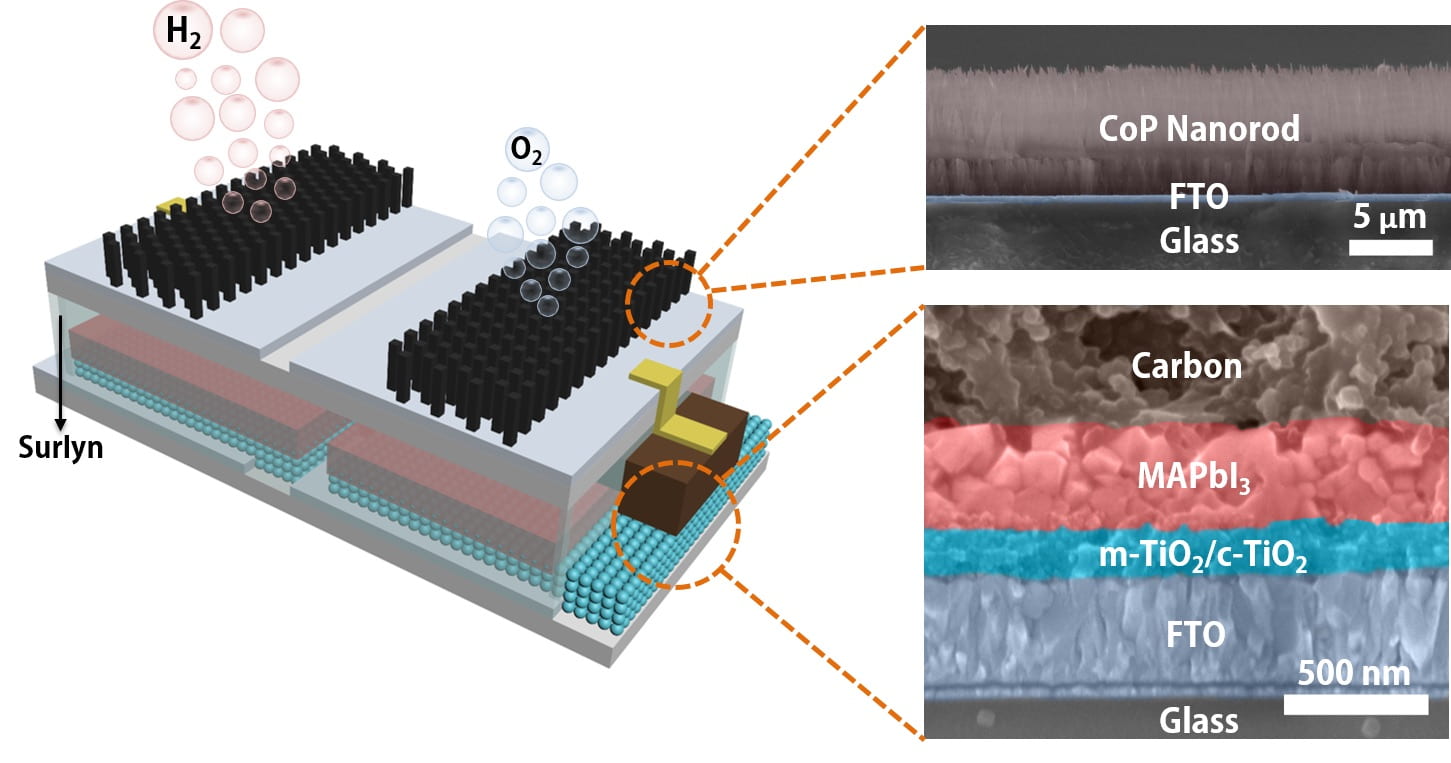
‘Artificial leaf’ concept inspires research into solar-powered fuel production. Rice University researchers have created an efficient, low-cost device that splits water to produce hydrogen fuel.
The platform developed by the Brown School of Engineering lab of Rice materials scientist Jun Lou integrates catalytic electrodes and perovskite solar cells that, when triggered by sunlight, produce electricity...
Read More
Recent Comments