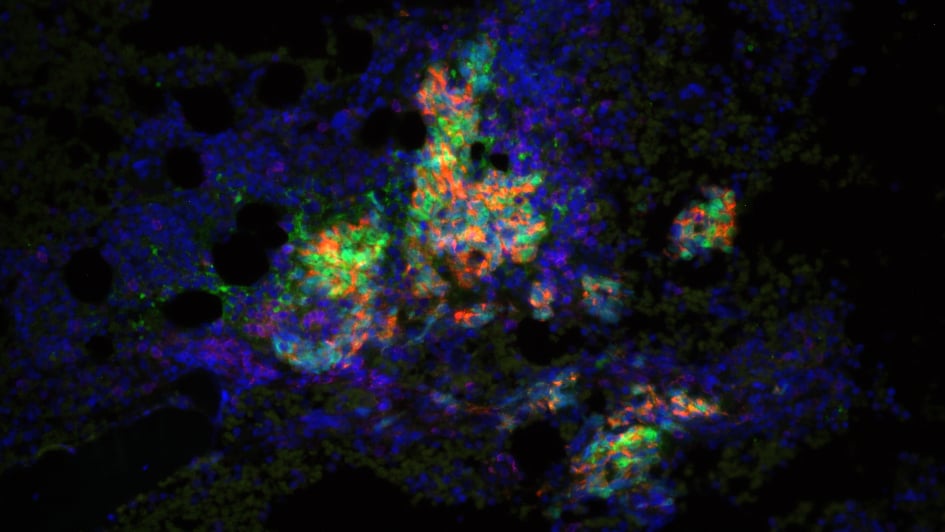
Tumors Hijack the Cell Death Pathway to Live

From left: Drs. Yang-Xin Fu, Chuanhui Han, and Zhida Liu

Cancer cells avoid an immune system attack after radiation by commandeering a cell signaling pathway that helps dying cells avoid triggering an immune response, a new study led by UTSW scientists suggests. The findings, published in a recent issue of Nature Immunology, could eventually lead to new ways to augment existing treatments to fight this disease.

Researchers have long known that radiation – a mainstay of treatment protocols for many types of cancerous tumors – kills cancer cells in two different ways: The high-energy beams smite some cells directly, and these dead cells leak DNA that triggers a tumor-fighting immune response through proteins known as interferons (IFNs)...

Read More

Making Big Data Processing more Energy Efficient using Magnetic Circuits

lateral inhibition magnetic processing
Maximized Lateral Inhibition in Paired Magnetic Domain Wall Racetracks for Neuromorphic Computing

New research finds that magnetic wires, spaced a certain way, can lead to a 20-30x reduction in the amount of energy needed to run neural network training algorithms.

The rapid progression of technology has led to a huge increase in energy usage to process the massive troves of data generated by devices. But researchers in the Cockrell School of Engineering at The University of Texas at Austin have found a way to make the new generation of smart computers more energy efficient.

Traditionally, silicon chips have formed the building blocks of the infrastructure that powers computers...

Read More

NASA missions help reveal the power of Shock waves in a Nova Explosion

V906 Carinae (circled) shines near peak brightness in this image taken on March 23, 2018, three days after the nova was discovered. The beautiful cloud of gas and dust dominating the picture is part of the Carina Nebula.
Credits: Copyright 2018 by A. Maury and J. Fabrega, used with permission

Unprecedented observations of a nova outburst in 2018 by a trio of satellites, including two NASA missions, have captured the first direct evidence that most of the explosion’s visible light arose from shock waves — abrupt changes of pressure and temperature formed in the explosion debris.

A nova is a sudden, short-lived brightening of an otherwise inconspicuous star...

Read More

Identical Mice, different Gut Bacteria, different Levels of Cancer

Photo of researcher suited up holding tank with mouse inside.
Photo courtesy of ULAM Germ-Free Mouse Facility.

Researchers at the University of Michigan Rogel Cancer Center are shedding new light on the way microorganisms that live in the gastrointestinal tract can affect the development of colorectal cancer.

Some types of gut bacteria are better than others at stimulating certain immune cells, specifically CD8+ T cells, in the body, they found. And while these CD8+ T cells normally help protect the body against cancer, overstimulating them may promote inflammation and exhaust the T cells — which can actually increase susceptibility to cancer, according to new mouse model study published in Cell Reports.

The work will help scientists pinpoint which populations of bacteria are tumor suppressive or tumor promoting and how, says study first au...

Read More