






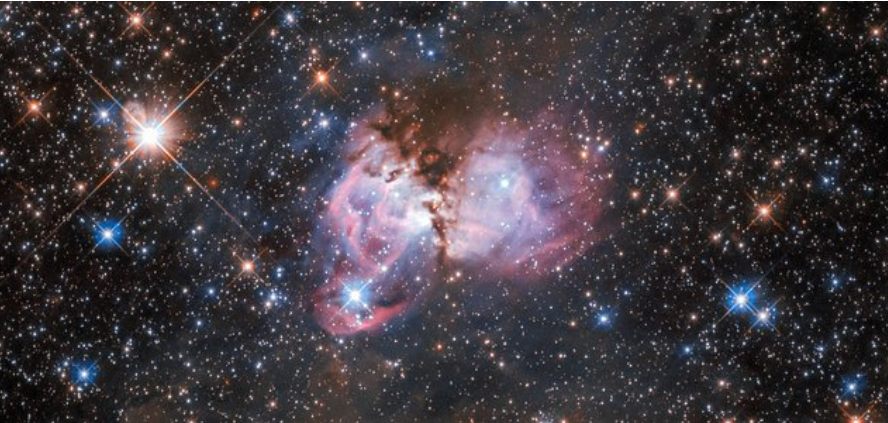
Scientists shed light on Mystery of Dark Matter

Scientists know dark matter exists because of its interaction via gravity with visible matter like stars and planets.

Scientists have identified a sub-atomic particle that could have formed the ‘dark matter’ in the Universe during the Big Bang. Nuclear physicists are putting forward a new candidate for dark matter – a particle they recently discovered called the d-star hexaquark.

Up to 80% of the Universe could be dark matter, but despite many decades of study, its physical origin has remained an enigma. While it cannot be seen directly, scientists know it exists because of its interaction via gravity with visible matter like stars and planets. Dark matter is composed of particles that do not absorb, reflect or emit light.

Now, nuclear physicists at the University of York are p...

Read More

Novel Coronavirus (COVID-19) imaging features overlap with SARS and MERS

47-year-old Chinese man with 2-day history of fever, chills, productive cough, sneezing, and fatigue who presented to emergency department. (Courtesy of Liu M, China-Japan Friendship Hospital, Beijing, China)
B, Initial CT images obtained show small round areas of mixed ground-glass opacity and consolidation (rectangles) at level of aortic arch (A) and ventricles (B) in right and left lower lobe posterior zones.

COVID-19’s imaging features are variable and nonspecific, but the imaging findings reported thus far do show...

Read More

Potassium Metal Battery emerges as a rival to Lithium-ion technology

Rensselaer team finds solution to persistent problem facing potassium metal batteries

Rensselaer team finds solution to persistent problem facing potassium-metal batteries. Researchers demonstrate how they can overcome dendrites to create a metal battery that performs nearly as well as a lithium-ion battery, but relies on potassium – a much more abundant and less expensive element.

If you were to look inside a lithium-ion battery you’d typically find a cathode made of lithium cobalt oxide and an anode made of graphite. During charging and discharging, lithium ions flow back and forth between these two electrodes.

In this setup, if researchers were to simply replace lithium cobalt oxide with potassium cobalt oxide, performance would drop...

Read More

What if mysterious ‘Cotton Candy’ Planets actually sport Rings?

An artist’s conception of Piro and Vissapragada’s model of a ringed planet transiting in front of its host star. They used these models to constrain which of the known super-puffs could be explained by rings. Illustration is by Robin Dienel and courtesy of the Carnegie Institution for Science.

Some of the extremely low-density, “cotton candy like” exoplanets called super-puffs may actually have rings, according to new research published in The Astronomical Journal by Carnegie’s Anthony Piro and Caltech’s Shreyas Vissapragada

Super-puffs are notable for having exceptionally large radii for their masses – which would give them seemingly incredibly low densities...

Read More