






Artificial Intelligence yields new Antibiotic

MIT researchers used a machine-learning algorithm to identify a drug called halicin that kills many strains of bacteria. Halicin (top row) prevented the development of antibiotic resistance in E. coli, while ciprofloxacin (bottom row) did not.

Image: courtesy of the Collins Lab at MIT

A deep-learning model identifies a powerful new drug that can kill many species of antibiotic-resistant bacteria

Using a machine-learning algorithm, MIT researchers have identified a powerful new antibiotic compound. In laboratory tests, the drug killed many of the world’s most problematic disease-causing bacteria, including some strains that are resistant to all known antibiotics. It also cleared infections in two different mouse models.

The computer model, which can screen more than a hundr...

Read More

How Newborn Stars prepare for the Birth of Planets

VANDAM survey
Credit: ALMA (ESO/NAOJ/NRAO), J. Tobin; NRAO/AUI/NSF, S. Dagnello

An international team of astronomers used two of the most powerful radio telescopes in the world to create more than three hundred images of planet-forming disks around very young stars in the Orion Clouds. These images reveal new details about the birthplaces of planets and the earliest stages of star formation.

Most of the stars in the universe are accompanied by planets. These planets are born in rings of dust and gas, called protoplanetary disks. Even very young stars are surrounded by these disks. Astronomers want to know exactly when these disks start to form, and what they look like. But young stars are very faint, and there are dense clouds of dust and gas surrounding them in stellar nurseries...

Read More

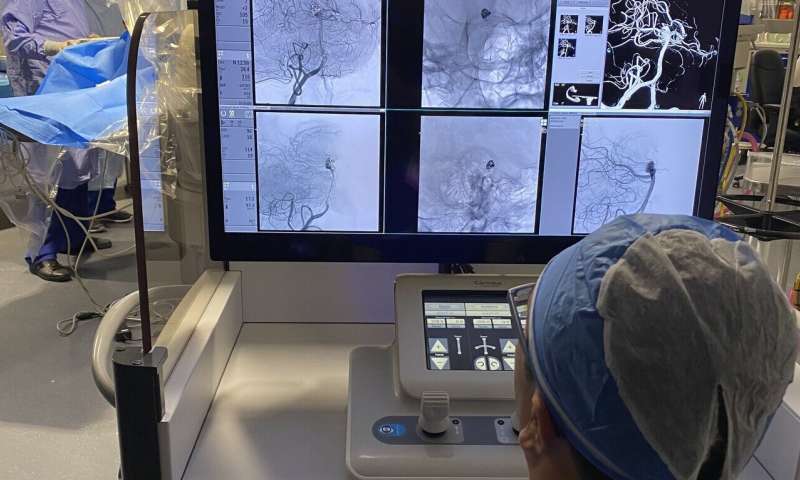
Surgeons successfully Treat Brain Aneurysms using a Robot

Image result for Surgeons successfully Treat Brain Aneurysms using a Robot
Dr. Vitor Mendes Pereira views images from remote control stent placement for a brain aneurysm. Credit: Roger Boyle

A robot was used to treat brain aneurysms for the first time. The robotic system could eventually allow remote surgery, enabling surgeons to treat strokes from afar. Using a robot to treat brain aneurysms is feasible and could allow for improved precision when placing stents, coils and other devices, according to late breaking science presented today at the American Stroke Association’s International Stroke Conference 2020 . The conference, Feb. 19-21 in Los Angeles, is a world premier meeting for researchers and clinicians dedicated to the science of stroke and brain health.

Robotic technology is used in surgery and cardiology, but not for brain vascular procedures...

Read More

Sub-Neptune sized planet validated with the Habitable-Zone Planet Finder

A signal originally detected by the Kepler spacecraft has been validated as an exoplanet using the Habitable-zone Planet Finder (HPF), an astronomical spectrograph built by a Penn State team and recently installed on the 10m Hobby-Eberly Telescope at McDonald Observatory in Texas. The HPF provides the highest precision measurements to date of infrared signals from nearby low-mass stars, and astronomers used it to validate the candidate planet by excluding all possibilities of contaminating signals to very high level of probability. The details of the findings appear in the Astronomical Journal.

The planet, called G 9-40b, is about twice the size of the Earth, but likely closer in size to Neptune, and orbits its low mass host star, an M dwarf star, only 100 light years from Earth...

Read More