XMM-Newton discovers Scorching Gas in Milky Way’s Halo

Milky Way halo – artist’s impression

ESA’s XMM-Newton has discovered that gas lurking within the Milky Way’s halo reaches far hotter temperatures than previously thought and has a different chemical make-up than predicted, challenging our understanding of our galactic home.

A halo is a vast region of gas, stars and invisible dark matter surrounding a galaxy. It is a key component of a galaxy, connecting it to wider intergalactic space, and is thus thought to play an important role in galactic evolution.

Until now, a galaxy’s halo was thought to contain hot gas at a single temperature, with the exact temperature of this gas dependent on the mass of the galaxy.

However, a new study using ESA’s XMM-Newton X-ray space observatory now shows that the Milky Way’s halo contains no...

Read More

Ingestible Medical Devices can be Broken Down with Light

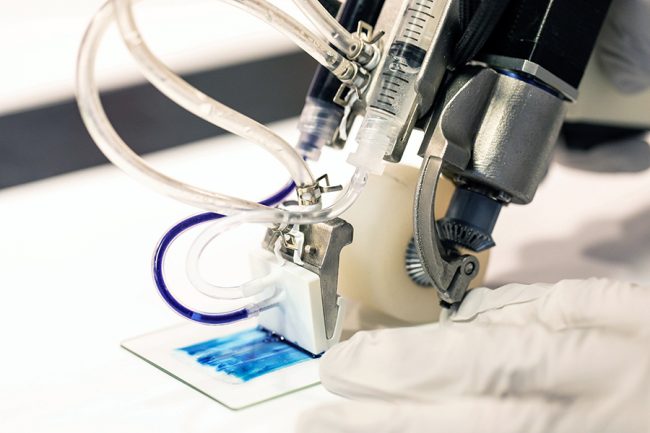
MIT engineers demonstrated a bariatric balloon that can be inflated in the stomach and then degraded by shining light on the seal, which is made of a novel light-sensitive polymer.
Image: Ritu Raman

New light-sensitive material could eliminate some of the endoscopic procedures needed to remove gastrointestinal devices

A variety of medical devices can be inserted into the gastrointestinal tract to treat, diagnose, or monitor GI disorders. Many of these have to be removed by endoscopic surgery once their job is done. However, MIT engineers have now come up with a way to trigger such devices to break down inside the body when they are exposed to light from an ingestible LED.

The new approach is based on a light-sensitive hydrogel that the researchers designed...

Read More

Taking the Temperature of Dark Matter

Astronomical image
This image from the Hubble Space Telescope shows lensing of distant galaxies by gravity. UC Davis astronomers are using this phenomenon to learn more about the properties of dark matter.

Warm, cold, just right? Physicists at the University of California, Davis are taking the temperature of dark matter, the mysterious substance that makes up about a quarter of our universe.

We have very little idea of what dark matter is and physicists have yet to detect a dark matter particle. But we do know that the gravity of clumps of dark matter can distort light from distant objects. Chris Fassnacht, a physics professor at UC Davis and colleagues are using this distortion, called gravitational lensing, to learn more about the properties of dark matter.

The standard model for dark matter is ...

Read More

Activation of a distinct Genetic Pathway can Slow the Progress of Metastatic Breast Cancer

CancverResearch_RobinA_Pic

In a study published today in the international journal, Cancer Research a journal of the American Association for Cancer Research, investigators at the Olivia Newton-John Cancer Research Institute (the La Trobe University School of Cancer Medicine) have shown that when the protein bone morphogenetic protein-4 (BMP4) is switched off, breast cancer can become more aggressive. BMP4 is active during fetal development and is maintained during adulthood in some healthy organs, including the breast.

In this study, led by investigators Dr Bedrich Eckhardt (a Susan G Komen Postdoctoral Fellow) and Prof Robin Anderson (Head of the Translational Breast Cancer Program), it was hypothesised that restoring BMP4 activity would block the ability of breast tumours to metastasise.

“At its core, ...

Read More