






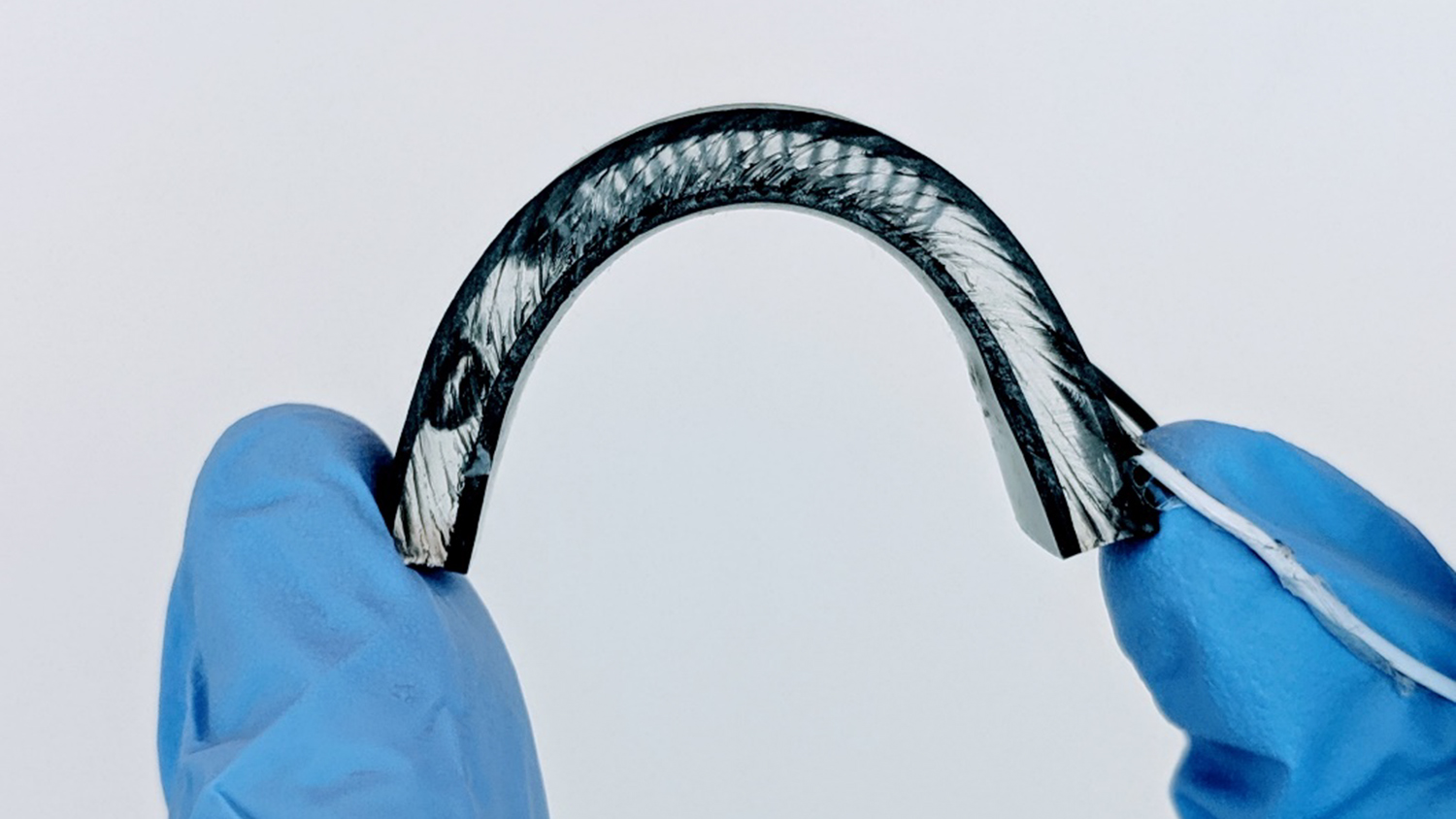
Wearable Health Tech gets Efficiency Upgrade

Photo of flexible, wearable device.
NC State’s improved theromoelectric generator demonstrates efficiency and flexibility. Photo courtesy of Mehmet Ozturk, NC State University.

North Carolina State University engineers have demonstrated a flexible device that harvests the heat energy from the human body to monitor health. The device surpasses all other flexible harvesters that use body heat as the sole energy source.

In a paper published in Applied Energy, the NC State researchers report significant enhancements to the flexible body heat harvester they first reported in 2017. The harvesters use heat energy from the human body to power wearable technologies – think of smart watches that measure your heart rate, blood oxygen, glucose and other health parameters – that never need to have their batteries recharged...

Read More

Citizen Science discovers a new form of the Northern Lights

Dune-shaped auroral emissions
Very rarely, a gravity wave rising up in the atmosphere can be filtered and bent to travel between the mesopause and an inversion layer intermittently formed below the mesopause. The mesopause and the inversion layer are colder than the other layers of the atmosphere. In the wave channel established between these two layers, gravity waves coming from below can travel long distances without subsiding. Dune-shaped auroral emissions are created when solar wind charges the oxygen atoms surging through the channel. (Graphic credit: Jani Närhi)

Working together with space researchers, Finnish amateur photographers have discovered a new auroral form...

Read More

Nanoparticle Chomps away Plaques that cause Heart Attacks

The dotted line outlines the atherosclerotic artery and the green represents our nanoparticles, which are in the plaque. The red indicates macrophages, which is the cell type that the nanoparticles are stimulating to eat the debris.

Michigan State University and Stanford University scientists have invented a nanoparticle that eats away – from the inside out – portions of plaques that cause heart attacks.

Bryan Smith, associate professor of biomedical engineering at MSU, and a team of scientists created a “Trojan Horse” nanoparticle that can be directed to eat debris, reducing and stabilizing plaque. The discovery could be a potential treatment for atherosclerosis, a leading cause of death in the United States.

The results, published in the current issue of Nature Nanotechno...

Read More

Method Detects Defects in 2D Materials for future Electronics, Sensors

A yellow laser beam shines on a chip and reveals a grain boundary defect
A laser beam (yellow) reflects off a 2D material (orange) highlighting a grain boundary defect in the atomic lattice.
 IMAGE: MRI/PENN STATE

To further shrink electronic devices and to lower energy consumption, the semiconductor industry is interested in using 2D materials, but manufacturers need a quick and accurate method for detecting defects in these materials to determine if the material is suitable for device manufacture. Now a team of researchers has developed a technique to quickly and sensitively characterize defects in 2D materials.

Two-dimensional materials are atomically thin, the most well-known being graphene, a single-atom-thick layer of carbon atoms.

“People have struggled to make these 2D materials without defects,” said Mauricio Terrones, Verne M...

Read More