Bandage Material helps Stop Bleeding Without Adhering to the Wound

Wundverband
Promotes healing and can subsequently be easliy removed: a new kind of bandage coated with silicone and carbon nanofibres. (Visualisations: Li Z et al. Nature Communications 2019)

Researchers from ETH Zurich and the National University of Singapore have developed a new kind of bandage that helps blood to clot and doesn’t stick to the wound. This marks the first time that scientists have combined both properties in one material.

“We did not actually plan this, but that is just how science works sometimes: you start researching one thing and end up somewhere else,” says ETH Professor Dimos Poulikakos...

Read More

Machine Learning Shapes Microwaves for a Computer’s Eyes

Two swirling patterns, one of grey and black on the left, the other of yellow and purple on the right
An example of a wave pattern (right) and its intensity levels (left) developed by the machine learning algorithm to best illuminate the most important features of an object being identified.

Engineers from Duke University and the Institut de Physique de Nice in France have developed a new method to identify objects using microwaves that improves accuracy while reducing the associated computing time and power requirements.

The system could provide a boost to object identification and speed in fields where both are critical, such as autonomous vehicles, security screening and motion sensing.

The new machine-learning approach cuts out the middleman, skipping the step of creating an image for analysis by a human and instead analyzes the pure data directly...

Read More

Planet WASP-12b is on a Death Spiral, say scientists

Illustration of star and planet
An artist created this illustration of the searing-hot gas planet WASP-12b and its star. A Princeton-led team of astrophysicists has shown that this exoplanet is spiraling in toward its host star, heading toward certain destruction in about 3 million years.
Illustration by NASA/JPL-Caltech

Earth is doomed – but not for 5 billion years. Our planet will be roasted as our sun expands and becomes a red giant, but the exoplanet WASP-12b, located 600 light-years away in the constellation Auriga, has less than a thousandth of that time left: a comparatively paltry 3 million years.

A Princeton-led team of astrophysicists has shown that WASP-12b is spiraling in toward its host star, heading toward certain destruction. Their paper appears in the Dec...

Read More

Pathways that Extend Lifespan by 500% identified

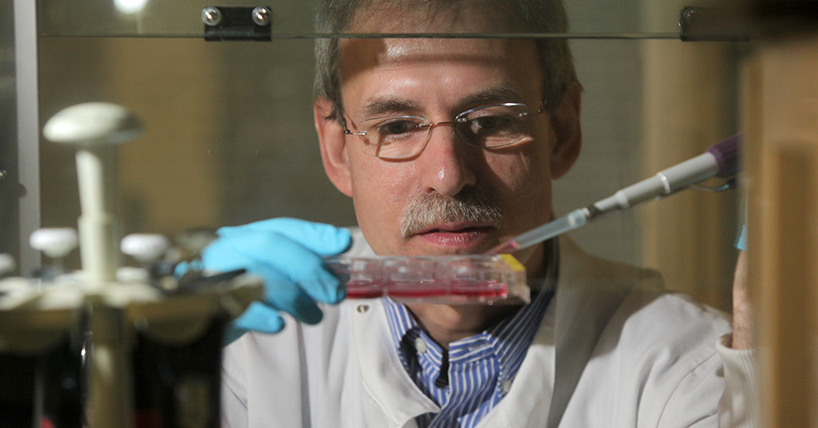
Jarod A. Rollins of the MDI Biological Laboratory in Bar Harbor, Maine, is a lead author of a recent scientific paper that identifies synergistic cellular pathways for longevity that amplify lifespan fivefold in C. elegans, a nematode worm used as a model in aging research. The increase in lifespan would be the equivalent of a human living for 400 or 500 years. The discovery of the synergistic effect opens the door to new, more effective anti-aging therapies. Credit: MDI Biological Laboratory

Discovery of cellular mechanisms could open door to more effective anti-aging therapies. Scientists have identified synergistic cellular pathways for longevity that amplify lifespan fivefold in C. elegans, a nematode worm used as a model in aging research...

Read More