Alzheimer ‘Tau’ protein far surpasses Amyloid in predicting toll on brain tissue

Brain MRI scans
Tau PET brain scans (green) in early clinical-stage Alzheimer’s patients accurately predict the location of brain atrophy measured by MRI 1–2 years later (magenta). Amyloid PET imaging (blue) does not predict the location of either tau or future brain atrophy.

Tau PET brain imaging could launch precision medicine era for Alzheimer’s disease. Brain imaging of pathological tau-protein “tangles” reliably predicts the location of future brain atrophy in Alzheimer’s patients a year or more in advance, according to a new study by scientists at the UC San Francisco Memory and Aging Center...

Read More

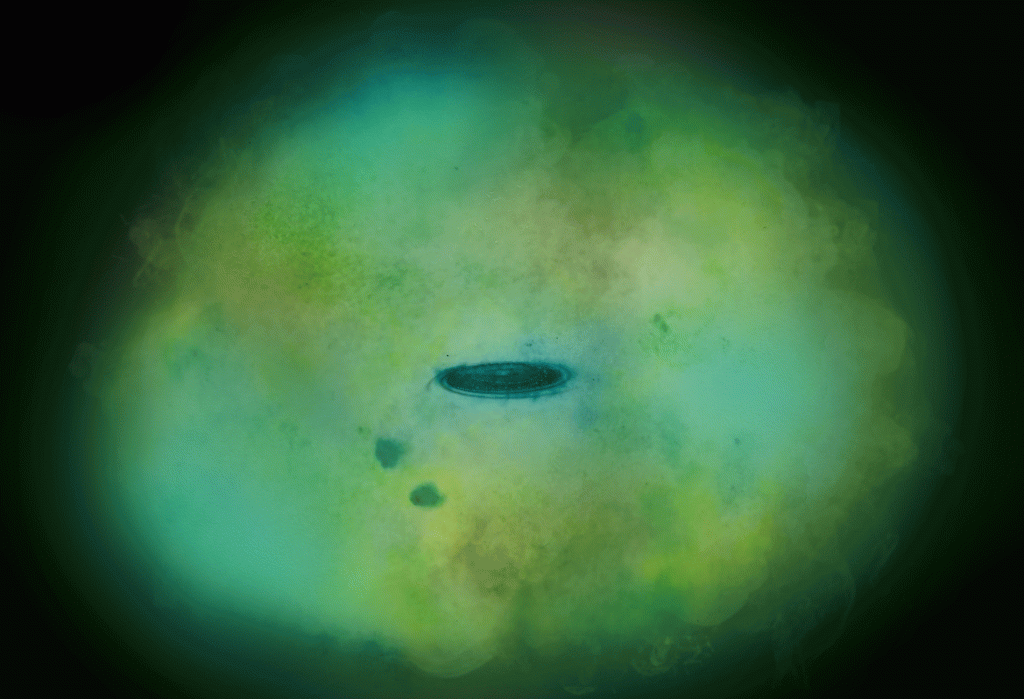
Flexible Photonic Crystal from Liquid Thin-film Metasurface

tunable liquid metasurface
Original article published in Advanced Photonics, https://doi.org/10.1117/1.AP.1.6.066003

Photonic crystals are predicted to be one of the wonders of the 21st century. In the 20th century, new understanding of the electronic band structure-the physics that determines when a solid conducts or insulates-revolutionized the world. That same physics, when applied to photonic crystals, allows us to control light in a similar manner to how we control electrons. If photonic crystals live up to their promise, all-optical transistors that consume little power and enable even more powerful computers could become a reality.

But, that destination isn’t in sight yet. The problem is one of control...

Read More

UNC expert helps treat Astronaut’s Blood Clot during NASA mission

Stephan Moll, M.D., at NASA.
CREDIT
UNC School of Medicine

“My first reaction when NASA reached out to me was to ask if I could visit the International Space Station (ISS) to examine the patient myself,” said Stephan Moll, MD, UNC School of Medicine blood clot expert and long-time NASA enthusiast. “NASA told me they couldn’t get me up to space quickly enough, so I proceeded with the evaluation and treatment process from here in Chapel Hill.”

Moll was the only non-NASA physician NASA consulted when it was discovered that an astronaut aboard the ISS had a deep vein thrombosis (DVT) – or blood clot—in the jugular vein of their neck...

Read More

GMRT discovers a Gigantic Ring of Hydrogen Gas around a distant galaxy

The optical image from the CFHT telescope with the distribution of neutral hydrogen in the form of a large ring shown in red as observed by the GMRT. The other two red blobs show the distribution of neutral hydrogen around two other galaxies which are in the vicinity of the ring. Credit: O. Bait (NCRA-TIFR/GMRT), Duc (ObAS/CFHT)

A team of astronomers at the National Centre for Radio Astrophysics (NCRA) in Pune, India have discovered a mysterious ring of hydrogen gas around a distant galaxy, using the Giant Metrewave Radio Telescope (GMRT). The ring is much bigger than the galaxy it surrounds and has a diameter of about 380,000 light-years (about 4 times that of our Milky Way).

The galaxy (named AGC 203001), is located about 260 million light-years away from us...

Read More