A surprisingly Big Black Hole might have Swallowed a Star from the Inside Out, and scientists are baffled

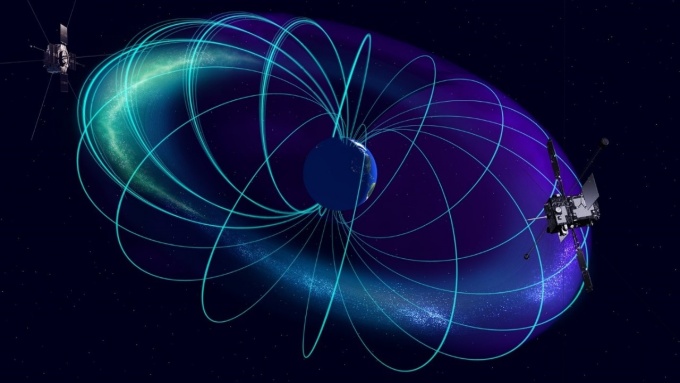
A recently discovered black hole – found by the way it makes a nearby star wobble – is hard to square with our understanding of how these dark cosmic objects form. Credit: NAOC, Chinese Academy of Sciences

About 15,000 light years away, in a distant spiral arm of the Milky Way, there is a black hole about 70 times as heavy as the Sun. The black hole seems too big to be the product of a single star collapsing, which poses questions for our theories of how black holes form.

Our team, led by Professor Jifeng Liu at the National Astronomical Observatories, Chinese Academy of Sciences, has dubbed the mysterious object LB-1.

Astronomers estimate that our galaxy alone contains about 100 million black holes, created when massive stars have collapsed over the past 13 billion years.

...Read More

Tendon Stem Cells could Revolutionize Injury Recovery

This image shows the Patellar tendon 30 days after an injury. The red marks newly discovered tendon stem cells that have self-renewed and are layered over green marked, original tendon cells. During regeneration, some tendon stem cells differentiate to make newly regenerated tendon cells—a process during which they transition into a yellow-orange color. The blue indicates cellular nuclei. Photography is courtesy of Tyler Harvey.

Discovery of tendon stem cells could be a game-changer when it comes to treating tendon injuries, avoiding surgery. The buildup of scar tissue makes recovery from torn rotator cuffs, jumper’s knee, and other tendon injuries a painful, challenging process, often leading to secondary tendon ruptures...

Read More

Molecular Eraser enables better Data Storage and Computers for AI

Abstract Image
Detecting and Directing Single Molecule Binding Events on H-Si(100) with Application to Ultradense Data Storage

Scientists have added a crucial tool to the atomic-scale manufacturing toolkit with major implications for today’s data driven—carbon intensive—world, according to new research from the University of Alberta in Canada.

“Computers today are contributing one gigatonne of carbon emissions to the atmosphere, and we can eliminate that by enhancing the most power-hungry parts of conventional computers with our atomic-scale circuitry,” said Robert Wolkow, professor in the University of Alberta’s Department of Physics a Principal Research Officer at the National Research Council of Canada’s Nanotechnology Research Centre, and chief technical officer of Quantum Silicon Inc, a...

Read More

A new theory for how Black Holes and Neutron Stars Shine Bright

Here, a massive super-computer simulation shows the strong particle density fluctuations that occur in the extreme turbulent environments that host black holes and neutron stars. Dark blue regions are low particle density regions, while yellow regions are strongly over-dense regions. Particles are accelerated to extremely high speeds due to the interactions with strongly turbulence fluctuations in this environment. Credit: Image from published study

Astrophysicists employed massive super-computer simulations to calculate the mechanisms that accelerate charged particles in extreme environments. They concluded their energization is powered by the interplay of chaotic motion and reconnection of super-strong magnetic fields.

For decades, scientists have speculated about the origin of ...

Read More