

Image: Vitaly Podzorov/Rutgers University-New Brunswick
Slightly bending semiconductors made of organic materials ca...
Read More


Until we recognize the essential role of biology, our attempts to truly unify the universe will remain a train to nowhere. ~Robert Lanza Read More

Good health is not something we can buy. However, it can be an extremely valuable savings account. ~Anne Wilson Schaef Read More

The only way forward, if we are going to improve the quality of the environment, is to get everybody involved. ~Richard Rogers Read More

To raise new questions, new possibilities, to regard old problems from a new angle, requires creative imagination and marks real advance in science. ~Albert Einstein Read More

Old Newtonian physics claimed that things have an objective reality separate from our perception of them. Quantum physics, and particularly Heisenberg's Uncertainty Principle, reveal that, as our perception of an object changes, the object itself literally changes. ~Marianne Williamson Read More

Astronomy compels the soul to look upwards and leads us from this world to another. ~ Read More
December 5, 2019,
 Physics, Technology/Electronics
Slightly bending semiconductors made of organic materials ca...
Read More
December 5, 2019,
Astronomy/Space

Researchers report significant seasonal variation in Titan’s energy budget – that is the amount of solar energy absorbed by the celestial body and the thermal energy it emits. The findings, reported in the journal Geophysical Research Letters, could lead to new insights about climate on Earth.
Titan is the only body in the solar system, other than Earth, with a significant atmosphere and liquid surface lakes. “By studying Titan, we can learn a lot about Earth,” said Ellen C...
Read More
December 4, 2019,
Health/Medical, Biology/Biotechnology
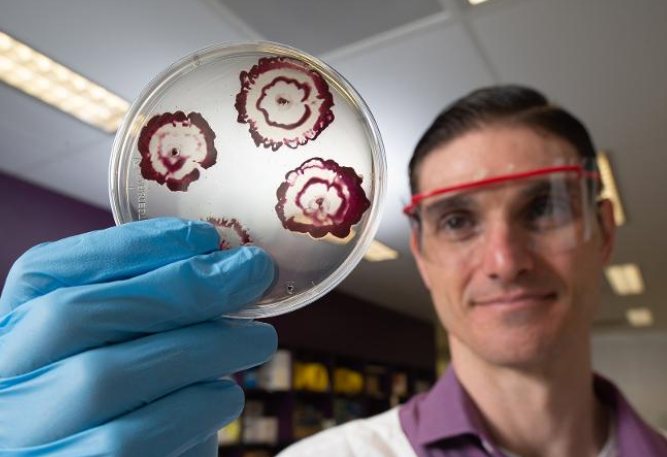
Bacterial biofilms that develop around golden staph infections make treatment difficult and prolonged, but researchers have shown in laboratory work that the hybrid antibiotics they have developed can destroy staph biofilms.
Eradicating deadly staph using a new breed of antibiotics has revealed promising results in research released by QUT, to help overcome one of the biggest modern medical challenges.
The bacteria attach to medical devices including catheters, artificial joints, implants and patients’ burns and wounds, establishing bacterial biofilms, a leading cause of failing antibiotic therapies and chronic infections.
QUT resear...
Read More
December 4, 2019,
Physics, Technology/Electronics

Researchers have developed a revolutionary way to encode computational information without using electrical current. As a global first, this could lead to faster technological devices that could efficiently use energy without overheating.
Modern computer memory encodes information by switching magnetic bits within devices. Now, a ground-breaking study conducted by researchers from the Department of Electrical and Computer Engineering at the National University of Singapore has found a new efficient way of using ‘spin waves’ to switch magnetisation at room temperature for more energy-efficient spin memory and logic devices.
Traditional electronic chips s...
Read More
Recent Comments