






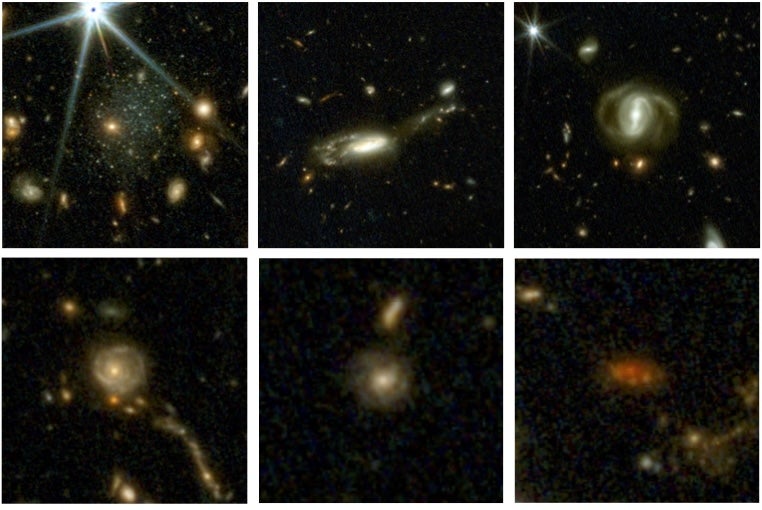
Largest map of the universe announced revealing 800,000 galaxies, challenging early cosmos theories

images of six galaxies taken with the James Webb Space Telescope
Photo Credit
M. Franco / C. Casey / COSMOS-Web collaboration
Six images of galaxies taken from nearly 800,000, from upper left to lower right: the present-day universe, and 3, 4, 8, 9 and 10 billion years ago

Largest map of the universe announced revealing 800,000 galaxies, challenging early cosmos theories

In the name of open science, the multinational scientific collaboration COSMOS on Thursday released the data behind the largest map of the universe. Called the COSMOS-Web field, the project, built with data collected by the James Webb Space Telescope (JWST), consists of all the imaging and a catalog of nearly 800,000 galaxies spanning nearly all of cosmic time. And it’s been challenging existing notions of the infant universe.

“Our goal was to construct this deep field of space ...

Read More
Laser-induced graphene enables greener, flexible hybrid circuit manufacturing

Breakthrough in flexible printed circuit boards: Laser-induced graphene enables sustainable hybrid circuit manufacturing
The process flow for creating Cu-LIG FHEs. Starting from top-left and clockwise to the right: creating a mixture of Pd and SU-8, spin-coating onto a polyimide film and drying, forming LIG from the Pd/SU-8 ink on a polyimide substrate and finally, electroless-copper plating to form conductive circuit elements. Credit: Advanced Materials Technologies (2025). DOI: 10.1002/admt.202401901

Boise State University researchers have unveiled a cutting-edge approach to manufacturing flexible hybrid circuits—reducing costs, waste, and environmental impact. Their work leverages the properties of laser-induced graphene and was recently featured on the cover of Advanced Materials Technologies.

Laser-induced graphene uses a single-step laser manufacturing process that converts carbon-rich mater...

Read More

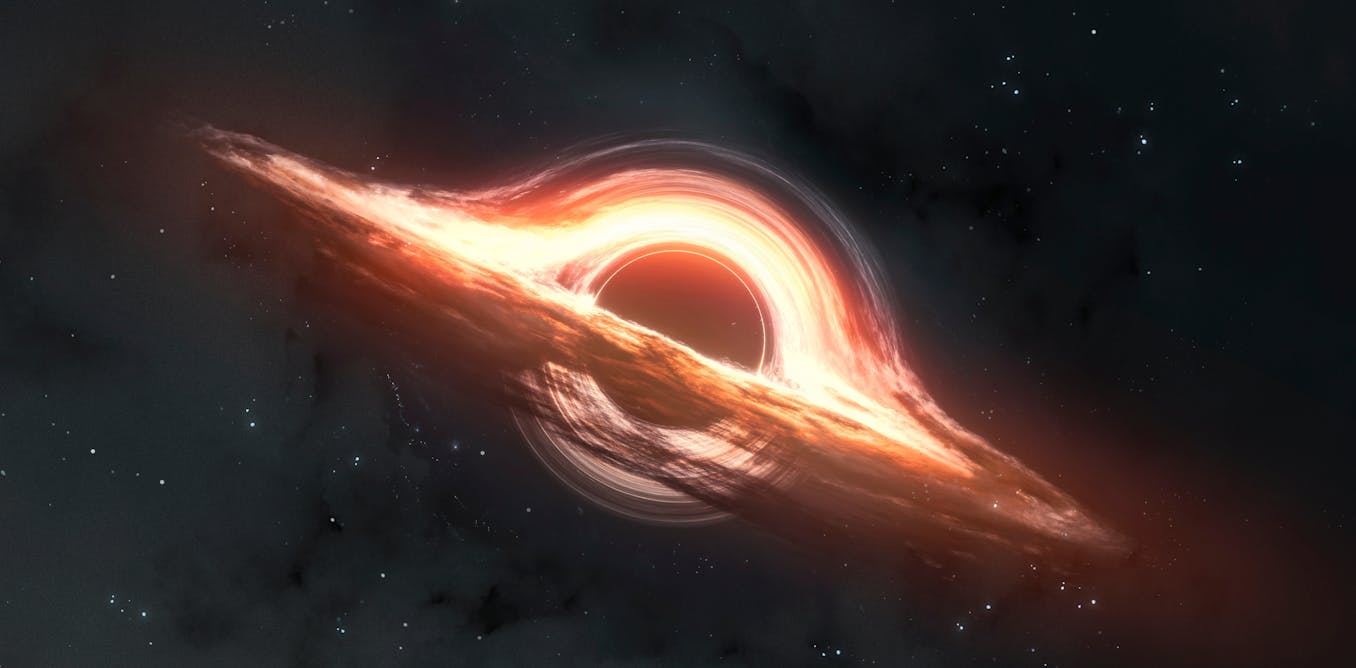
What if the Big Bang wasn’t the beginning? Research suggests it may have taken place inside a black hole

The Big Bang is often described as the explosive birth of the universe—a singular moment when space, time and matter sprang into existence. But what if this was not the beginning at all? What if our universe emerged from something else—something more familiar and radical at the same time?

In a new paper, published in Physical Review D, my colleagues and I propose a striking alternative. Our calculations suggest the Big Bang was not the start of everything, but rather the outcome of a gravitational crunch or collapse that formed a very massive black hole—followed by a bounce inside it.

This idea, which we call the black hole universe, offers a radically different view of cosmic origins, yet it is grounded entirely in known physics and observations.

Today’s standard cosmo...

Read More

Self-powered artificial synapse mimics human color vision

Self-powered artificial synapse mimics human color vision
The top half of this image depicts the proposed artificial synapse made using dye-sensitized solar cells. The plot shows the bipolar voltage response of the synapse depending on the wavelength of light used, which mimics how our eyes perceive the world and enables logic operations. The bottom half of the image shows an experiment in which the proposed system was used to capture and classify various human movements. Credit: Associate Professor Takashi Ikuno from Tokyo University of Science, adapted from Scientific Reports (2025). DOI: 10.1038/s41598-025-00693-0

As artificial intelligence and smart devices continue to evolve, machine vision is taking an increasingly pivotal role as a key enabler of modern technologies...

Read More
