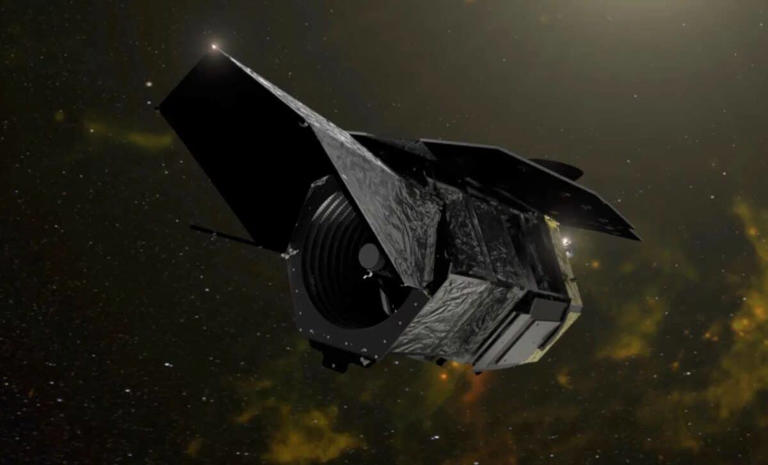
NASA’s Roman telescope will catch 100,000 explosions — and rewrite the Universe’s story

High-Latitude Time-Domain Survey infographic
This infographic describes the High-Latitude Time-Domain Survey that will be conducted by NASA’s Nancy Grace Roman Space Telescope. The survey’s main component will cover over 18 square degrees — a region of sky as large as 90 full moons — and see supernovae that occurred up to about 8 billion years ago. Smaller areas within the survey will pierce even farther, potentially back to when the universe was around a billion years old. The survey will be split between the northern and southern hemispheres, located in regions of the sky that will be continuously visible to Roman. The bulk of the survey will consist of 30-hour observations every five days for two years in the middle of Roman’s five-year primary mission.
Credit: NASA’s Goddard Space Flight Center

NASA’s Roman Space T...

Read More

Six-hour ‘undo’ button: GAI-17 rewinds stroke damage and may beat Alzheimer’s

Beneficial effects of GAPDH-C152A expression and GAI-17 on acute ischemic stroke treatment in model mice
Ischemia-Reperfusion-induced GAPDH aggregates lead to cell death and paralysis, but both GAPDH-C152A expression and GAI-17 treatment can decrease the chances of post-stroke side effects.
Credit: Osaka Metropolitan University

Protein aggregation inhibitor shows lower levels of cell death and paralysis in mice with acute strokes.

Stroke kills millions, but Osaka researchers have unveiled GAI-17, a drug that halts toxic GAPDH clumping, slashes brain damage and paralysis in mice—even when given six hours post-stroke—and shows no major side effects, hinting at a single therapy that could also tackle Alzheimer’s and other tough neurological disorders.

Stroke is said to be the se...

Read More

Quantum internet moves closer as researchers teleport light-based information

Study demonstrates quantum teleportation from telecom photons to an erbium ion-based quantum memory
Quantum teleportation from telecom photons to erbium-ion ensembles. Credit: Group of Prof. Xiao-Song Ma at Nanjing University.

Quantum teleportation is a fascinating process that involves transferring a particle’s quantum state to another distant location, without moving or detecting the particle itself. This process could be central to the realization of a so-called “quantum internet,” a version of the internet that enables the safe and instant transmission of quantum information between devices within the same network.

Quantum teleportation is far from a recent idea, as it was experimentally realized several times in the past. Nonetheless, most previous demonstrations utilized frequency conversion rather than natively operating in the telecom band.

Researchers at Nanjing Univer...

Read More

Mysterious object found dancing with Neptune

A team of astronomers led by the Center for Astrophysics | Harvard & Smithsonian has discovered a rare object far beyond Neptune, from a class known as trans-Neptunian objects, that is moving in rhythm with the giant planet. This image shows the orbits of all of the objects discovered in the Outer Solar System Origins Survey. The orbit of 2020 VN40 is the thickest one, tilted up and to the left from the orbits of most of the objects.  The orbits of the giant planets Jupiter, Saturn, Uranus, and Neptune are the white circles. 
Credit: Rosemary Pike, CfA

This object, called 2020 VN40, is the first confirmed body that orbits the sun once for every ten orbits Neptune completes.

Astronomers have discovered a bizarre object in the outer solar system, 2020 VN40, that dances to Neptune’s g...

Read More