To raise new questions, new possibilities, to regard old problems from a new angle, requires creative imagination and marks real advance in science.
~Albert Einstein
Read More
Old Newtonian physics claimed that things have an objective reality separate from our perception of them. Quantum physics, and particularly Heisenberg's Uncertainty Principle, reveal that, as our perception of an object changes, the object itself literally changes.
~Marianne Williamson
Read More
A new AI agent developed by researchers at the University of Texas at Austin takes a few “glimpses” of its surroundings, representing less than 20 percent of the full 360 degree view, and infers the rest of the whole environment. What makes this system so effective is that it’s not just taking pictures in random directions but, after each glimpse, choosing the next shot that it predicts will add the most new information about the whole scene. Credit: David Steadman/Santhosh Ramakrishnan/University of Texas at Austin.
Computer scientists at The University of Texas at Austin have taught an artificial intelligence agent how to do something that usually only humans can do – take a few quick glimpses around and infer its whole environment, a skill necessary for the development o...
An expanded view of the central part of the cleared region around LkCa 15, showing a composite of two reconstructed images (blue: 2.1 microns, from November 2010; red: 3.7 microns) for LkCa 15. The location of the central star is also marked. Credit: Kraus & Ireland, 2011
Astronomers using the combined power of two Hawaii telescopes have taken groundbreaking, sharp new images of a distant planetary system that likely resembles a baby version of our solar system.
Using Subaru Telescope and W. M. Keck Observatory, the team obtained and analyzed data for an infant Sun-like star named LkCa 15. Previous studies using an advanced interferometry method had inferred that three infant planets were orbiting this star...
MIT neuroscientists are exploring how the brain handles hierarchical decision-making processes that involve breaking down a larger decision into smaller ones that each carry a degree of uncertainty. Image: Chelsea Turner, MIT
Neuroscientists identify a brain circuit that helps break decisions down into smaller pieces. The study sheds light on how the brain reasons about probable causes of failure after a hierarchy of decisions. When making a complex decision, we often break the problem down into a series of smaller decisions. For example, when deciding how to treat a patient, a doctor may go through a hierarchy of steps – choosing a diagnostic test, interpreting the results, and then prescribing a medication.
Making hierarchical decisions is straightforward when the sequence of cho...
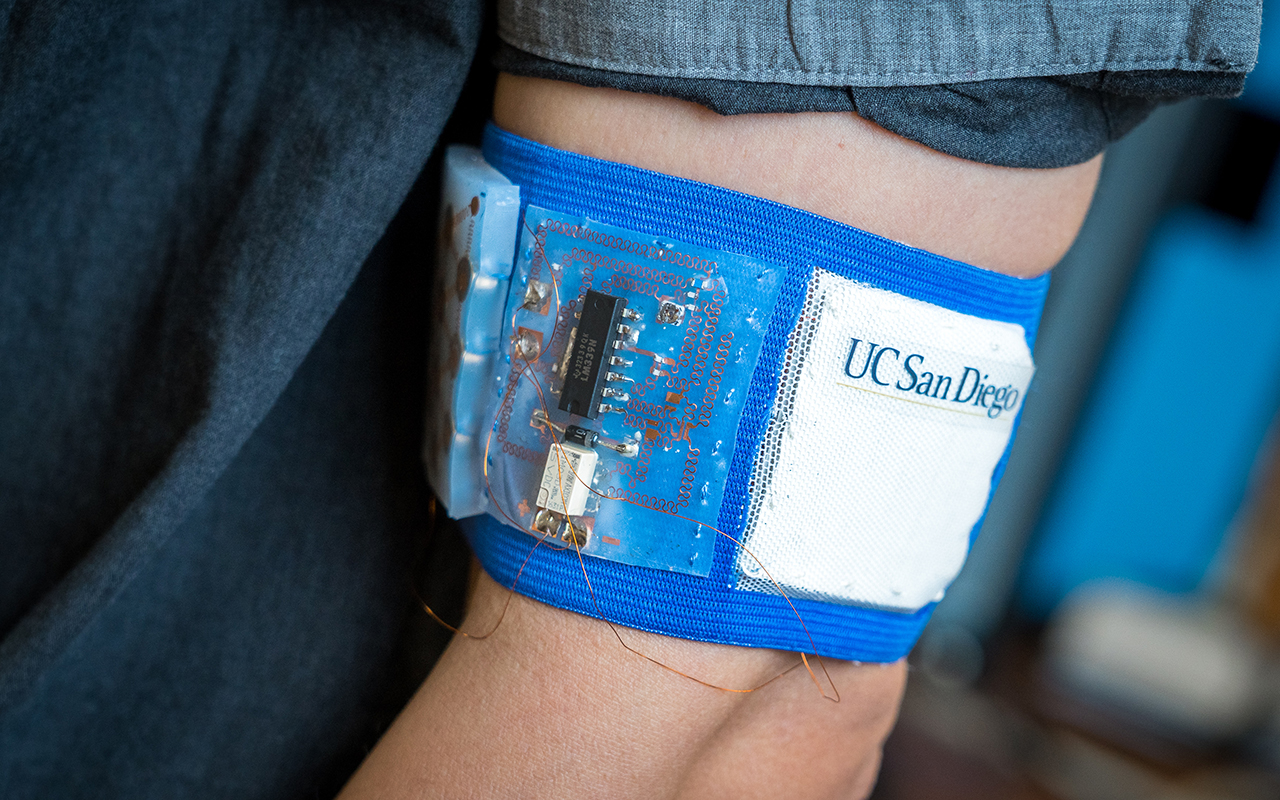
Prototype of the cooling and heating patch embedded in a mesh armband. Photos by David Baillot/UC San Diego Jacobs School of Engineering
Engineers at the University of California San Diego have developed a wearable patch that could provide personalized cooling and heating at home, work, or on the go. The soft, stretchy patch cools or warms a user’s skin to a comfortable temperature and keeps it there as the ambient temperature changes. It is powered by a flexible, stretchable battery pack and can be embedded in clothing. Researchers say wearing it could help save energy on air conditioning and heating.
“This type of device can improve your personal thermal comfort whether you are commuting on a hot day or feeling too cold in your office,” said Renkun Chen, a professor of mechanical an...














Recent Comments